

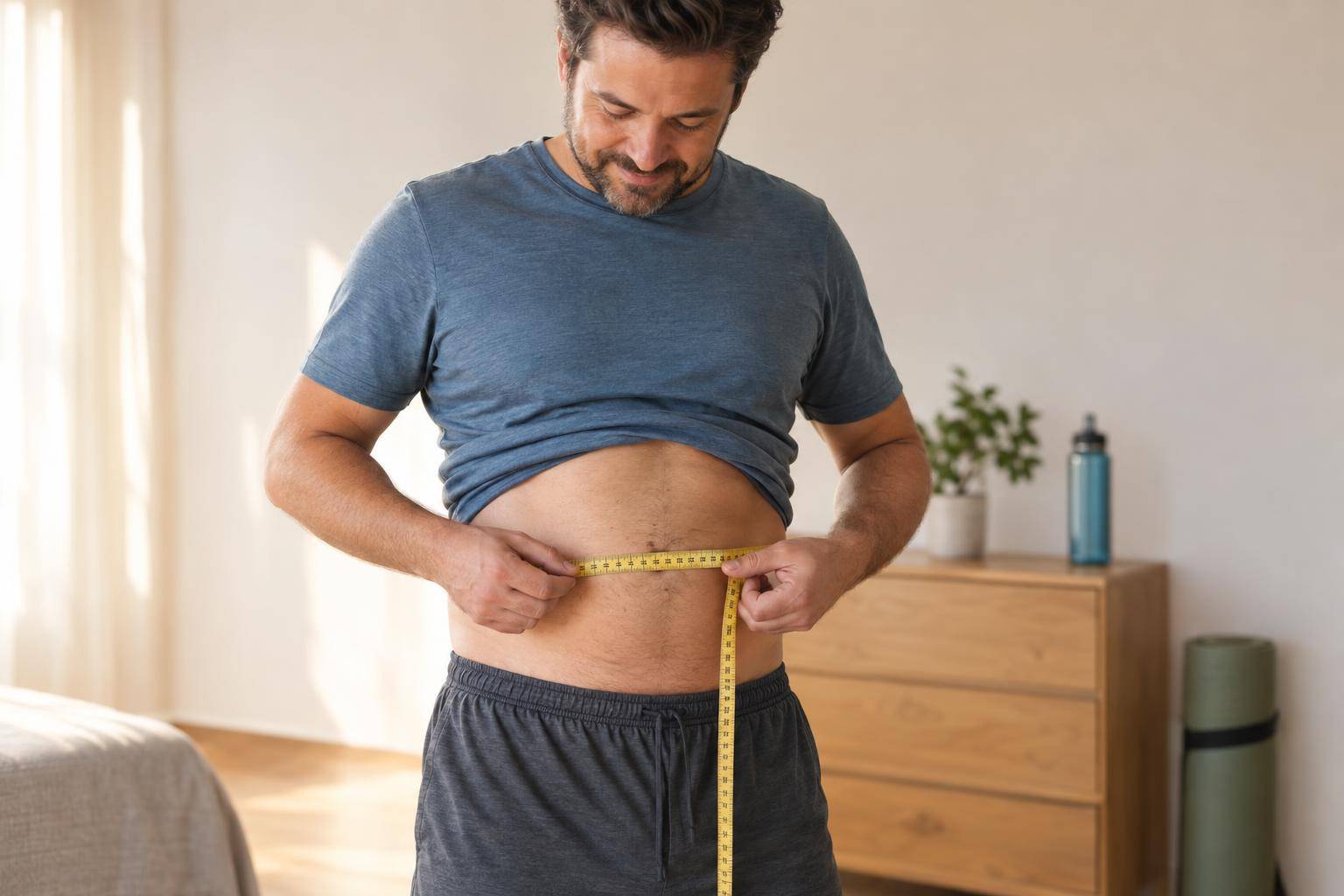
A dad bod means some muscle with extra fat around the waist. It is an informal description of a look, not a medical diagnosis, and no clinical body says where it starts or stops. Informal estimates put it somewhere around the upper teens to mid-20s in body fat percentage, but there is no agreed cutoff, and two men at the same percentage can carry it very differently.
That is why the label is the least useful thing about it. What matters is visceral fat — the fat that sits deep in the abdomen around the organs rather than under the skin — because that is the type linked to type 2 diabetes and heart disease. For men, a waist over 40 inches (about 102 cm) is the threshold commonly used in the U.S. to flag higher risk, though risk can be present well below it.
So the question worth asking is not whether you have a dad bod. It is what your waist, blood pressure, blood sugar and cholesterol actually say. This guide covers how to measure each one, what it can and cannot tell you, and the habits that move them.
Table of Contents
- Watch: Why a Dad Bod Is Not Just Normal Aging
- Abdominal Fat and Health Risks
- How to Check Health Beyond Appearance
- Habits for Body Composition and Metabolic Health
- Focus on Health, Not a Body-Shape Label
- Frequently Asked Questions
Watch: Why a Dad Bod Is Not Just Normal Aging
A short KHOU 11 segment on why the midsection change men expect in their 30s and 40s is worth looking at properly rather than shrugging off as age.
Abdominal Fat and Health Risks
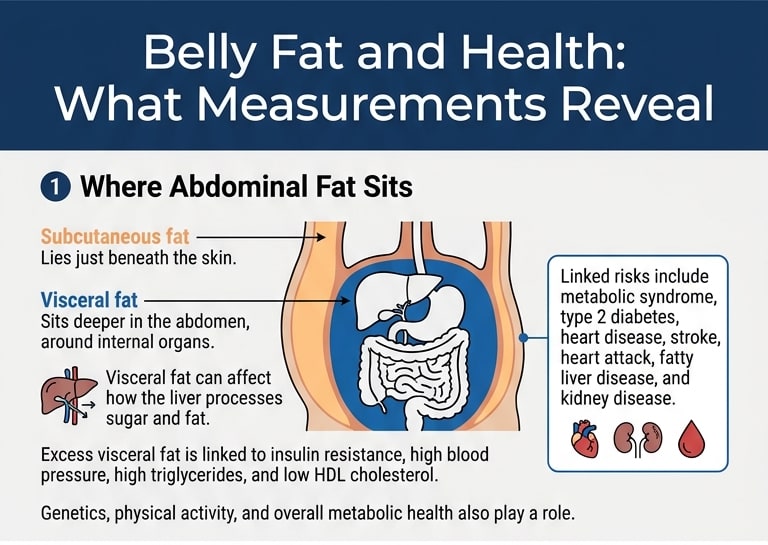
Subcutaneous Fat vs. Visceral Fat
The concern was never the label. It is where the abdominal fat sits.
Subcutaneous fat lies just beneath the skin — the part you can pinch. Visceral fat sits deeper in the abdomen, packed around the internal organs, and it behaves differently: it can affect how the liver processes sugar and fat. [1][4]
Two men can look similar and carry very different amounts of each. That is the whole reason appearance is a poor guide here.
Links to Diabetes, Heart Disease, and Other Conditions
Excess visceral fat is associated with insulin resistance, higher blood pressure, higher triglycerides and lower HDL cholesterol — the cluster that defines metabolic syndrome. From there the associations run on to type 2 diabetes, heart disease and stroke, along with fatty liver disease and kidney disease. [1][3][6]
These are associations across populations, not a prediction about any one person. Genetics, physical activity and overall metabolic health all shape how the picture plays out for you. [3][8]
What Appearance and Measurements Can Tell You
Every indicator has a blind spot. Knowing what each one misses is what keeps you from over-reading a single number.
| Indicator | What it may suggest | What it cannot show |
|---|---|---|
| Visible belly | Possible abdominal fat | Cannot distinguish fat types or establish metabolic health |
| Waist circumference | Higher abdominal-fat risk | Cannot precisely measure visceral fat |
| Blood pressure | Higher strain on blood vessels | Needs repeated readings; does not identify the cause |
| Blood glucose or A1C | Problems regulating blood sugar | Requires clinical interpretation; A1C reflects roughly three months |
| Cholesterol panel | A blood-fat pattern linked to health risks | Does not directly measure artery plaque or heart function |
No row on that table is a diagnosis on its own. A clinician reads them together, alongside your medical history, medications and family history. [9]
How to Check Health Beyond Appearance
Waist size flags abdominal fat even when BMI sits in the normal range, which is exactly why BMI alone misses so many people. But neither measurement predicts cardiovascular risk by itself. [2][5]
How to Measure Your Waist
Stand upright and run a flexible tape around your bare waist, just above the hip bones. Keep it level all the way round and snug without compressing the skin. Measure after a normal exhale, without holding your breath or pulling your stomach in. Take the reading two or three times and check they agree. [5][4]
For men, more than 40 inches (102 cm) is the common U.S. threshold for flagging risk — a prompt to look further, not a diagnosis. Risk can appear at smaller waist sizes, and lower thresholds are used for some Asian populations. [2][5]
The technique matters more than the absolute number if you are tracking change. Measure the same way, at the same time of day, every few weeks.
Check Blood Pressure, Blood Sugar, and Cholesterol
Ask your clinician about blood pressure, fasting glucose or A1C, and a lipid panel. Then review the results together rather than alone: waist size, age, ancestry, family history and any medications all change how a given number should be read. [5][9]
Review Fitness, Sleep, and Daily Habits
Behind every one of those numbers sit habits: how much you move, how well you sleep, how much you drink, whether you smoke. Note disrupted sleep, persistent fatigue, or a drop in how much exercise you can tolerate — those changes often show up before a blood test does. [1][7]
The baseline worth aiming at is at least 150 minutes of moderate aerobic activity a week, plus muscle-strengthening work on two or more days. [10]
Habits for Body Composition and Metabolic Health
Once you know which markers to watch, the work is in the habits that move them. Judge progress by training performance and clinical markers, not by the mirror. Strength and fitness can improve substantially while the scale barely moves — that is body composition changing underneath a stable weight.
Build Eating and Exercise Habits You Can Keep
Build meals around a protein source — eggs, beans, fish, lean meat — with fibre-rich vegetables and whole grains alongside. Match portion size to your actual needs and swap sugary drinks for water, which is usually the single largest easy win.
If weight loss is appropriate, a modest calorie deficit at roughly 0.5% to 1% of body weight per week is the rate that gives you the best chance of keeping muscle while fat comes off. Hitting a sensible protein target does the rest of that job.
For training, build gradually around compound lifts — squats, presses, rows, deadlifts — and track reps or load so you can see progress that the mirror will not show you for months. Core work strengthens the midsection but does not preferentially burn the fat sitting on it; spot reduction is not a thing. [7][10] If you are over 40, the training adjustments that matter at that age are worth reading before you start.
Optional Nutrition Tracking With Welling
The part people underestimate is intake. If you want the nutrition side measured rather than guessed, Welling logs meals from a photo, a chat message or a voice note in 2.6 seconds on average, and tracks calories, macros, fibre and water against a target it sets from your goal.
Two things make it useful for this particular problem. Protein and fibre are visible as weekly averages rather than single days, which is the timescale habits actually operate on. And if your doctor has flagged something specific — sodium, cholesterol — you can tell Welling directly and it will track that metric alongside the rest.
Treat the feedback as support for habits, not as a health assessment.
What Welling Can and Cannot Tell You
| Feature | What it helps with | What to verify yourself |
|---|---|---|
| Photo, chat, and voice logging | Logging without the friction that kills consistency | Portion sizes, and restaurant-meal estimates |
| Calorie and macro tracking | Hitting intake and protein targets | Ingredients and amounts in mixed dishes |
| Weekly averages and coaching replies | Spotting patterns across a week, not a day | Whether a suggestion fits your goals and medical situation |
| International-food support | Meals that generic databases handle badly | Recipe details and serving sizes |
Check entries that could influence a health decision against a label or a known recipe amount, especially where portions or ingredients are unclear. For a medically directed diet, work with a registered dietitian or your clinician rather than relying on app estimates.
Focus on Health, Not a Body-Shape Label
The markers matter more than the label. A dad bod is an informal term for a male physique with some muscle and extra fat around the middle. It is not a diagnosis, and it is not automatically a problem. [6][8]
Measure your waist. Get your blood pressure, blood sugar and cholesterol checked. Take an honest look at your stamina, strength, sleep and daily movement. Then pick the habits you can actually hold on to, and give them months rather than weeks.
If your waist is above the threshold, or any of those numbers fall outside the recommended range, that is the point to talk to a clinician — not to start a crash diet. [3][9]
Frequently Asked Questions
Can I have a dad bod and still be healthy?
Yes. A dad bod is not automatically unhealthy, particularly if you are active, your blood work is clean, and you are not carrying a lot of visceral fat. As Cleveland Clinic puts it, you do not need a six-pack to be healthy. [11]
The caveat is that excess abdominal and visceral fat does raise the risk of high blood pressure, high cholesterol, high blood sugar, diabetes and heart disease. So “healthy dad bod” is a real category — it just has to be established by measurements rather than assumed. [11][8]
What body fat percentage is a dad bod?
There is no official answer, because the term is not a clinical one. Informal estimates cluster around the upper teens to mid-20s for men, but you will find different numbers depending on who is writing. Body fat percentage is also hard to measure accurately outside a lab — home scales and calculators give estimates with wide error bars, which is why waist circumference remains the more practical everyday number.
How can I tell if I am losing fat or muscle?
Weight alone cannot tell you. The usable signals are strength and measurements. If your lifts are holding or improving while your waist shrinks, you are very likely losing fat and keeping muscle. If your lifts are falling, your waist is barely moving and the scale is dropping fast, that is the pattern that suggests muscle is going with it.
Muscle mass declines naturally with age, particularly from the 30s and 40s onward, and a large deficit accelerates it. The two defences are the same ones as always: enough protein, and resistance training at least twice a week.
How can I use Welling to track progress beyond the scale?
Two things it does, and one it does not. It logs your nutrition — so protein, the lever that matters most for holding muscle while you lose fat, is measured rather than guessed — and if your doctor has flagged a specific metric like sodium or cholesterol, you can tell Welling and it will track that alongside your meals. Weight and steps sync in from Apple Health, so the weight trend builds without you entering anything.
What it does not do is measure your body for you. Waist circumference and body fat percentage you record yourself, with a tape and the same technique every time. Welling covers the intake side of the picture; the tape covers the other half.
Will cutting calories alone get rid of visceral fat?
A calorie deficit will reduce fat overall, and visceral fat tends to be fairly responsive to it. But doing it with diet alone usually costs you muscle at the same time, which leaves you lighter with a worse body composition than you started with. Pairing the deficit with resistance training and an adequate protein intake is what makes the weight you lose mostly fat. Aerobic activity contributes independently to the metabolic markers — blood pressure, blood sugar, triglycerides — even where it moves the scale very little.
Sources and References
-
Cleveland Clinic. Visceral fat vs. subcutaneous fat. https://health.clevelandclinic.org/visceral-fat-vs-subcutaneous-fat
-
Ross, R., et al. (2020). Waist circumference as a vital sign in clinical practice: a Consensus Statement from the IAS and ICCR Working Group on Visceral Obesity. Nature Reviews Endocrinology. https://www.nature.com/articles/s41574-019-0310-7
-
Mayo Clinic. Belly fat in men: why weight loss matters. https://www.mayoclinic.org/healthy-lifestyle/mens-health/in-depth/belly-fat/art-20045685
-
Cornier, M. A., et al. How to best assess abdominal obesity. PMC. https://pmc.ncbi.nlm.nih.gov/articles/PMC6299450/
-
Harvard T.H. Chan School of Public Health, The Nutrition Source. Measuring body fatness. https://nutritionsource.hsph.harvard.edu/healthy-weight/measuring-fat/
-
MDVIP. Your dad bod isn’t healthy. https://www.mdvip.com/patients/resources/your-dad-bod-isnt-healthy
-
Main Line Health. Bodities: the dad bod. https://www.mainlinehealth.org/blog/bodities-dad-bod
-
HonorHealth. What your heart really thinks about the dad bod. https://www.honorhealth.com/healthy-living/what-your-heart-really-thinks-about-dad-bod
-
AMA Journal of Ethics (2010). Diagnosing obesity: beyond BMI. https://journalofethics.ama-assn.org/article/diagnosing-obesity-beyond-bmi/2010-04
-
U.S. Department of Health and Human Services, ODPHP. Physical Activity Guidelines for Americans, 2nd edition. https://odphp.health.gov/our-work/nutrition-physical-activity/physical-activity-guidelines
-
Cleveland Clinic. Dad bod: is it healthy? https://health.clevelandclinic.org/dad-bod