

How much protein do you need per day?
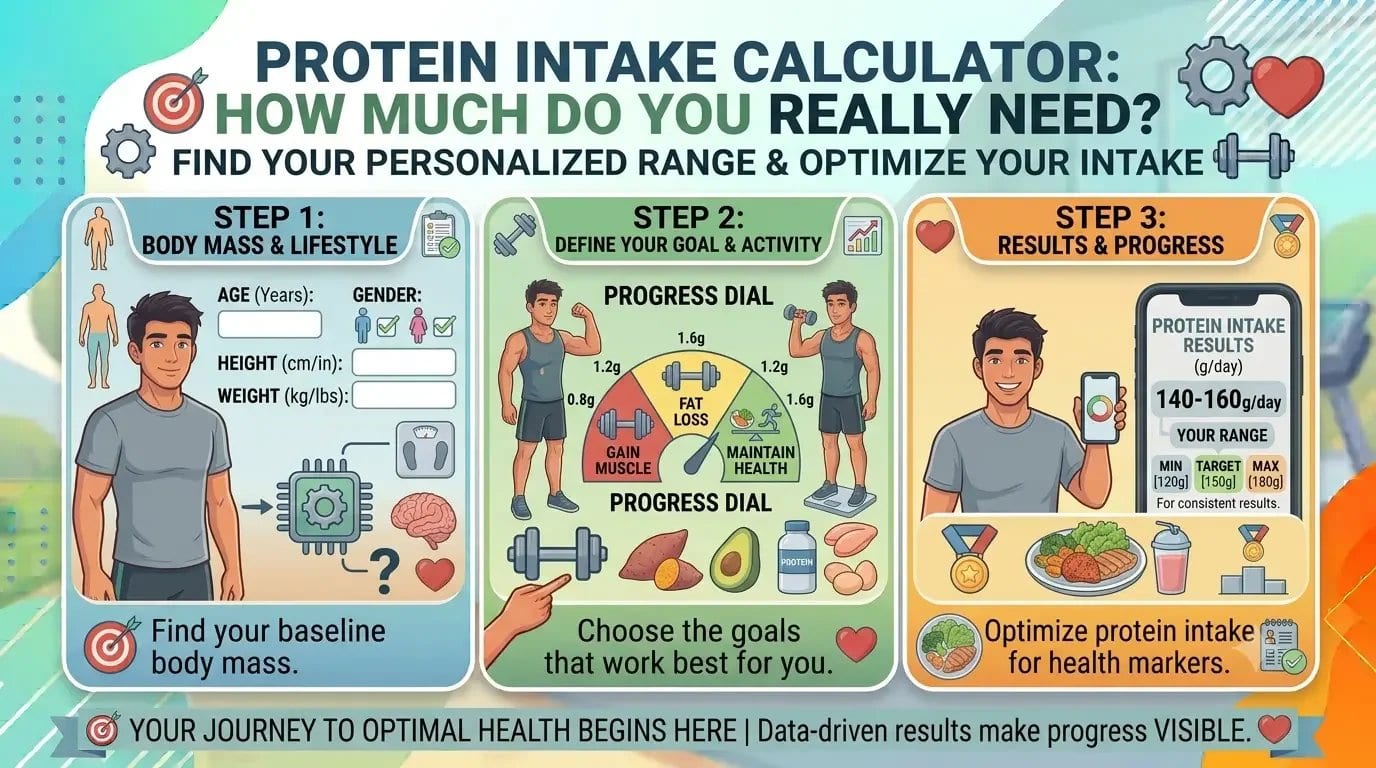
For most active adults, the evidence supports 1.6 to 2.2 grams of protein per kilogram of body weight per day to support muscle maintenance and growth. Sedentary adults need less, around 0.8 to 1.2 g/kg/day. Use the calculator below to find your personal daily protein target based on your weight, activity level, and goal.
Table of Contents
- Protein Intake Calculator
- Why Does Protein Intake Matter?
- How Much Protein Do You Need for Different Goals?
- What Are the Best Food Sources of Protein?
- Does Protein Timing Matter?
- Is Too Much Protein Bad for You?
- How Do You Track Your Daily Protein Intake?
- Frequently Asked Questions
- References
Protein Intake Calculator
Protein Intake Calculator
Your daily protein target
Practical food equivalents to hit your target:
Why Does Protein Intake Matter?
Protein is the structural material of lean body mass. Every cell in the body contains protein, and your body is in a constant state of protein turnover: breaking down old proteins and synthesising new ones. The rate at which you can synthesise new muscle protein depends heavily on how much dietary protein you supply.
Beyond muscle, protein has several properties that make it a uniquely important macronutrient for body composition and general health. It has the highest thermic effect of any macronutrient at 20 to 30 percent, meaning a significant portion of protein calories are used just to digest and metabolise it. It is the most satiating macronutrient per calorie, reducing hunger more effectively than equivalent calories from carbohydrates or fat. And it is the nutrient most directly tied to whether a calorie deficit produces fat loss, muscle loss, or both.
Despite these properties, research consistently finds that the majority of people significantly underestimate their protein intake when relying on memory alone. Tracking protein with a food tracker is one of the most evidence-backed nutrition interventions for improving body composition outcomes.
How Much Protein Do You Need for Different Goals?
For general health and weight maintenance. The Recommended Dietary Allowance of 0.8 g/kg/day represents the minimum to prevent deficiency in sedentary adults. For active adults who exercise regularly, this is too low to support muscle maintenance. A more appropriate range for generally active adults is 1.2 to 1.6 g/kg/day.
For fat loss with muscle preservation. This is where protein requirements are highest. During a calorie deficit, the body is more likely to break down muscle for energy unless protein intake is high enough to spare it. Research, including a 2014 review in the International Journal of Sport Nutrition and Exercise Metabolism, supports intakes of 1.8 to 2.4 g/kg/day during calorie restriction in resistance-trained individuals.
For muscle building. A landmark 2018 meta-analysis published in the British Journal of Sports Medicine, analysing data from 49 studies and over 1,800 participants, found that protein intakes above 1.62 g/kg/day produced no additional gains in muscle mass from resistance training. A practical target of 1.6 to 2.2 g/kg/day provides an adequate buffer above this threshold.
For competitive athletes. Endurance athletes at high training volumes have protein needs that overlap with or exceed those of strength athletes, since protein supports not only muscle repair but also mitochondrial adaptation and recovery. The International Society of Sports Nutrition recommends 1.4 to 2.0 g/kg/day for endurance athletes and up to 2.5 g/kg/day during particularly intense training blocks.
What Are the Best Food Sources of Protein?
The most protein-efficient foods per 100g of cooked weight include chicken breast at around 31g, canned tuna at 26g, salmon at 25g, lean beef mince at 26g, cottage cheese at 11g, Greek yoghurt at 10g, and eggs at 13g per whole egg.
Plant-based sources include tempeh at 19g per 100g, firm tofu at 8g, lentils cooked at 9g, edamame at 11g, and black beans cooked at 9g. These sources are lower in protein density than most animal sources, which means larger portions are needed to hit the same daily target.
One important consideration for plant-based protein is amino acid completeness. Individual plant foods lack one or more essential amino acids, but eating a varied diet that includes complementary protein sources, such as grains and legumes together, provides a complete amino acid profile across the day without needing to combine them at every meal.
Does Protein Timing Matter?
Protein timing has a smaller effect than total daily protein intake, but it is not completely irrelevant. Research published in the Journal of the International Society of Sports Nutrition supports distributing protein intake across three to four meals of 20 to 40g each rather than consuming the majority in one or two meals. This approach keeps muscle protein synthesis elevated more consistently throughout the day.
Post-workout protein consumption within approximately two hours of resistance training is supported by research, though the total daily intake remains the primary driver of muscle protein synthesis outcomes. The practical implication is to prioritise hitting your daily total rather than obsessing over exact timing, while ensuring you are not concentrating all protein in a single meal.
Is Too Much Protein Bad for You?
For healthy adults with normal kidney function, the evidence does not support the widely repeated claim that high protein diets damage kidneys. A 2017 review in the Journal of Nutrition and Metabolism found no adverse effects on kidney function in healthy adults eating up to 2.2 g/kg/day. The concern about kidney damage applies to people with pre-existing chronic kidney disease, for whom dietary protein should be managed under medical guidance.
Very high protein intakes above 3g/kg/day are not well-studied for long-term safety and are not necessary for any training or health goal. Staying within the ranges the calculator provides, up to approximately 2.5 g/kg/day for competitive athletes, is within the range of current safety evidence.
How Do You Track Your Daily Protein Intake?
Knowing your protein target is straightforward. Consistently hitting it across varied daily meals, especially when eating out, cooking different dishes, or using protein supplements, requires reliable daily tracking.
Welling’s macro tracker logs protein automatically for every meal through photo, chat, or voice logging, updating your running daily protein total in real time. When you ask the AI nutrition coach “what can I eat tonight to hit my protein target,” it gives you a specific answer based on exactly how much protein you have already logged today. This is significantly more useful than checking a static number at the end of the day and realising you fell short.
Know your protein target. Hit it every single day.
Welling logs protein automatically from a photo, chat, or voice note in 2.6 seconds on average, and tells you what to eat to close the gap before the end of the day.
Frequently Asked Questions
How much protein do I need to build muscle?
Research from a 2018 meta-analysis in the British Journal of Sports Medicine found that intakes of 1.62 g per kg of body weight per day maximised muscle gains from resistance training in healthy adults. A practical target of 1.6 to 2.2 g/kg/day provides a buffer above this threshold. For a person weighing 75 kg, this means 120 to 165 g of protein per day.
How much protein do I need to lose fat without losing muscle?
During a calorie deficit, higher protein intakes of 1.8 to 2.4 g/kg/day are supported by research to minimise muscle loss alongside fat. The higher end of this range is appropriate for people doing resistance training while in a significant calorie deficit.
Can I get enough protein on a plant-based diet?
Yes. Plant-based diets can meet protein requirements with careful food selection, though it requires more planning than animal-based diets because most plant proteins are lower in protein density and may lack specific essential amino acids when eaten in isolation. Eating a variety of plant protein sources throughout the day covers the full amino acid profile.
Is 100g of protein per day enough?
For a person weighing 70 kg or less at a moderate activity level with a maintenance or gentle fat loss goal, 100g is within the recommended range of 1.2 to 1.6 g/kg/day. For heavier people, those doing significant resistance training, or those in a calorie deficit, 100g is likely on the lower end and may benefit from being higher.
Does protein help with weight loss?
Yes, through two main mechanisms. Protein has the highest thermic effect of any macronutrient, so a meaningful portion of its calories are used just to digest and metabolise it. It is also the most satiating macronutrient, reducing hunger more effectively than equivalent calories from carbohydrates or fat. Higher protein intakes during a calorie deficit also preserve muscle mass, which keeps metabolic rate higher than a low-protein deficit would.
When should I eat protein for best results?
Total daily protein intake matters more than timing for most people. As a practical guideline, distributing protein across three to four meals of approximately 20 to 40g each is more effective than concentrating most protein in one or two meals, because it keeps muscle protein synthesis elevated more consistently throughout the day.
References
Morton, R. W., et al. (2018). A Systematic Review, Meta-Analysis and Meta-Regression of the Effect of Protein Supplementation on Resistance Training-Induced Gains in Muscle Mass and Strength. British Journal of Sports Medicine, 52(6), 376-384. https://bjsm.bmj.com/content/52/6/376
Helms, E. R., et al. (2014). A Systematic Review of Dietary Protein During Caloric Restriction in Resistance Trained Lean Athletes. International Journal of Sport Nutrition and Exercise Metabolism, 24(2), 127-138. https://pubmed.ncbi.nlm.nih.gov/24092765/
Kerksick, C. M., et al. (2017). International Society of Sports Nutrition Position Stand: Nutrient Timing. Journal of the International Society of Sports Nutrition, 14, 33. https://jissn.biomedcentral.com/articles/10.1186/s12970-017-0189-4
Antonio, J., et al. (2016). A High Protein Diet Has No Harmful Effects. Journal of Nutrition and Metabolism, 2016, 9104792. https://pubmed.ncbi.nlm.nih.gov/27807480/
Westerterp-Plantenga, M. S., Lemmens, S. G., & Westerterp, K. R. (2012). Dietary Protein: Its Role in Satiety, Energetics, Weight Loss and Health. British Journal of Nutrition, 108(S2), S105-S112. https://pubmed.ncbi.nlm.nih.gov/23107521/
Phillips, S. M., & Van Loon, L. J. C. (2011). Dietary Protein for Athletes: From Requirements to Optimum Adaptation. Journal of Sports Sciences, 29(S1), S29-S38. https://pubmed.ncbi.nlm.nih.gov/22150425/