

How many calories should you eat to lose weight?
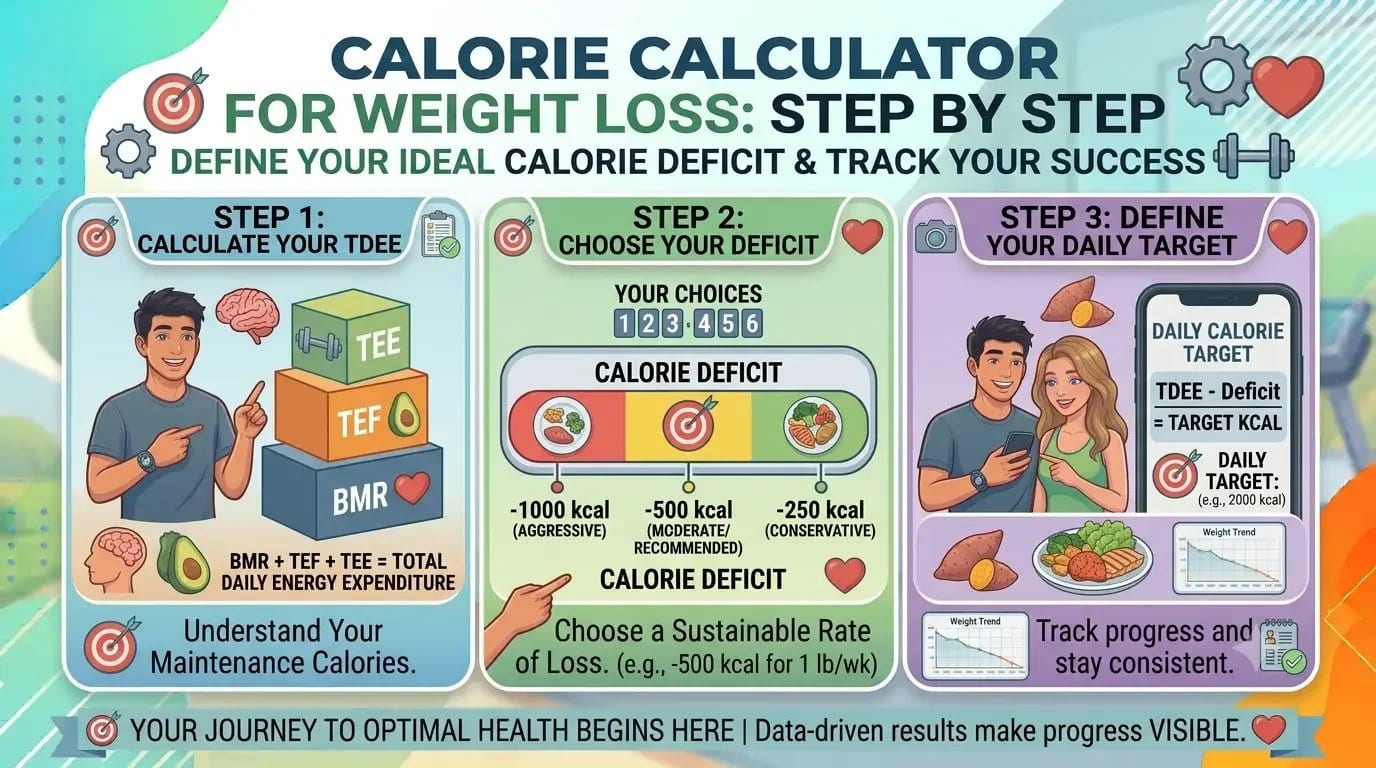
To lose weight, you need to eat fewer calories than your body burns each day. The exact number depends on your age, sex, height, weight, and activity level. For most adults, a daily intake of 300 to 500 calories below your maintenance level produces sustainable fat loss of 0.3 to 0.5 kg per week. Use the calculator below to find your specific daily calorie target.
Table of Contents
- Calorie Calculator for Weight Loss
- How Does the Calculator Work?
- How Many Calories Should You Eat to Lose Weight?
- What Is a Safe Rate of Weight Loss?
- Why Does Your Calorie Target Change Over Time?
- What Happens If You Eat Too Few Calories?
- How Do You Hit Your Daily Calorie Target?
- Frequently Asked Questions
- References
Calorie Calculator for Weight Loss
Calorie Calculator for Weight Loss
Your maintenance calories (TDEE)
Your daily calorie target for weight loss
How Does the Calculator Work?
The calculator uses the Mifflin-St Jeor equation to estimate your Basal Metabolic Rate, multiplies it by an activity factor to produce your Total Daily Energy Expenditure, and subtracts your chosen weekly deficit to give your daily calorie intake target. It also calculates how many weeks it will take to reach your goal weight at the selected pace.
All outputs are estimates with a margin of error of roughly 10 to 15 percent for individuals. Treat the result as a starting number and adjust based on real-world weight tracking over two to three weeks.
How Many Calories Should You Eat to Lose Weight?
There is no single universal answer because the right number depends entirely on your individual TDEE. Two people of the same age and sex can have TDEEs that differ by 400 to 600 calories per day based on differences in body size, muscle mass, and activity level. This is why generic targets like “eat 1,200 calories to lose weight” are misleading and potentially harmful for many people.
What research does consistently support is the size of the deficit relative to your TDEE. A deficit of 500 calories per day is the most commonly studied target, producing approximately 0.5 kg of fat loss per week in controlled settings. A 300-calorie deficit is gentler, producing around 0.3 kg per week. Both are sustainable without significant muscle loss when protein intake is maintained.
The formula the calculator applies: Daily target = TDEE minus daily deficit. Your TDEE is calculated from your individual body stats and activity level, not from a population average.
What Is a Safe Rate of Weight Loss?
Most clinical guidelines recommend a rate of 0.5 to 1 kg per week as a sustainable and safe range for most adults. This corresponds to a daily deficit of approximately 500 to 750 calories, after accounting for the commonly cited 7,700 calories per kilogram of fat approximation.
Rates above 1 kg per week typically require very large deficits that increase risk of muscle loss, fatigue, nutrient deficiency, and metabolic adaptation. Research from a 2011 study published in the International Journal of Obesity found that larger initial deficits produced faster early results but were associated with greater muscle loss unless protein intake was high, suggesting that the rate of loss and protein intake should be considered together rather than independently.
For people with a significant amount of weight to lose, higher initial rates may be appropriate under medical supervision. For people within 5 to 10 kg of their goal weight, gentler deficits of 250 to 300 calories per day are more appropriate to avoid the muscle loss that becomes more significant as body fat decreases.
Why Does Your Calorie Target Change Over Time?
Your calculated daily target is based on your current body weight. As you lose weight, your TDEE decreases because your body is smaller and requires less energy to maintain itself. A person who has lost 10 kg burns fewer calories at maintenance than they did at their starting weight, which means the same calorie intake that produced a 500-calorie deficit at the start of a diet is producing a smaller deficit as weight decreases.
This is the most common reason weight loss slows or plateaus after several weeks of initial progress. The deficit has shrunk, not disappeared, but the rate of loss has slowed accordingly.
The solution is simple: recalculate your TDEE and calorie target using your current weight every four to six weeks. Use the calculator above with your updated body weight to find the adjusted target.
What Happens If You Eat Too Few Calories?
Eating significantly below your minimum safe intake, which this calculator floors at 1,500 kcal for men and 1,200 kcal for women, produces a cascade of physiological responses that make both the short-term and long-term outcomes worse.
In the short term, very low calorie intakes accelerate muscle loss alongside fat loss, reduce metabolic rate through hormonal changes, increase fatigue and cognitive impairment, and produce nutrient deficiencies that affect energy, immune function, and mood.
In the longer term, the metabolic adaptation produced by severe restriction means that when normal eating resumes, weight is typically regained faster than it was lost because the body’s maintenance calorie needs have decreased. This cycle, commonly called yo-yo dieting, produces progressively worse body composition outcomes over multiple cycles.
The most effective approach is a moderate, sustainable deficit maintained over months rather than an aggressive restriction maintained over weeks.
How Do You Hit Your Daily Calorie Target?
Knowing your number is step one. Step two is logging accurately enough to stay close to that number day after day.
Welling logs meals in 2.6 seconds on average from a photo, chat, or voice note, with 95.6 percent food identification accuracy across 15,000 tested meals and a portion estimation error of 1.2 percent. You enter your calculated calorie target in the app and every meal you log is tracked against it automatically, with remaining calories visible throughout the day.
The AI nutrition coach tells you specifically what to eat to stay within your budget as the day progresses. If you have 450 calories left after lunch and want a dinner suggestion that fits, the coach gives you that rather than leaving you to calculate it yourself from a calorie total.
Start tracking your calorie target on Welling
You have your target. Now track it without the manual effort.
Welling logs meals from a photo, chat, or voice note in 2.6 seconds on average and tells you what to eat to stay on track for your weight loss goal.
Frequently Asked Questions
How many calories should I eat a day to lose weight?
This depends entirely on your individual TDEE. The calculator above gives you a personalised number based on your age, sex, height, weight, and activity level. For a rough guide: most women with a sedentary lifestyle need 1,400 to 1,700 calories per day for fat loss. Most men need 1,700 to 2,200 calories per day. These are ranges, not targets, and individual needs vary significantly.
Is 1,200 calories too low to lose weight sustainably?
For many people, yes. A 1,200-calorie intake is below the minimum safe floor for most women and significantly below it for most men. Very low calorie intakes accelerate muscle loss, reduce metabolic rate, and are difficult to sustain. The calculator above applies minimum safe floors and flags when your selected goal pace pushes the target too low.
Why am I not losing weight eating 1,500 calories?
The most likely explanations are: your TDEE is lower than assumed (common for sedentary women below average height), your actual intake is higher than logged (portion estimation error is very common), or metabolic adaptation has reduced your TDEE below the formula’s prediction. Logging more precisely using a photo-based app like Welling and recalculating your TDEE at your current weight are the two most effective first steps.
Does the calorie calculator account for exercise?
Yes. The activity multiplier in the calculator accounts for your general exercise frequency. If you do a significantly harder week of training than usual, your actual TDEE will be higher than estimated, which means you may have a larger deficit than planned. Welling auto-adjusts your daily calorie target based on logged workouts to capture this variation.
How accurate is a weight loss calorie calculator?
The Mifflin-St Jeor formula has a reported accuracy of approximately 10 to 15 percent for individual TDEE estimates. This means your actual maintenance calories may be 200 to 300 calories higher or lower than the calculator predicts. Treat the output as a starting point and adjust based on real-world weight tracking over two to three weeks rather than assuming the formula is exact.
How often should I recalculate my weight loss calorie target?
Every four to six weeks, or whenever you notice your rate of weight loss has slowed significantly from your expected pace. Update the calculator with your current body weight to get an adjusted target that reflects your new TDEE.
References
Mifflin, M. D., et al. (1990). A New Predictive Equation for Resting Energy Expenditure in Healthy Individuals. American Journal of Clinical Nutrition, 51(2), 241-247. https://pubmed.ncbi.nlm.nih.gov/2305711/
Hall, K. D., & Guo, J. (2017). Obesity Energetics: Body Weight Regulation and the Effects of Diet Composition. Gastroenterology, 152(7), 1718-1727. https://pubmed.ncbi.nlm.nih.gov/28193517/
Johansson, K., et al. (2014). Effects of Anti-obesity Drugs, Diet, and Exercise on Weight-Loss Maintenance. American Journal of Clinical Nutrition, 99(1), 14-23. https://pubmed.ncbi.nlm.nih.gov/24172304/
Tremblay, A., & Chaput, J. P. (2012). Adaptive Thermogenesis Can Make a Difference in the Ability of Obese Individuals to Lose Body Weight. International Journal of Obesity, 36(6), 771-776. https://pubmed.ncbi.nlm.nih.gov/22027950/
Helms, E. R., et al. (2014). A Systematic Review of Dietary Protein During Caloric Restriction. International Journal of Sport Nutrition and Exercise Metabolism, 24(2), 127-138. https://pubmed.ncbi.nlm.nih.gov/24092765/
Burke, L. E., et al. (2011). Self-Monitoring in Weight Loss: A Systematic Review of the Literature. Journal of the American Dietetic Association, 111(1), 92-102. https://pubmed.ncbi.nlm.nih.gov/21185970/