

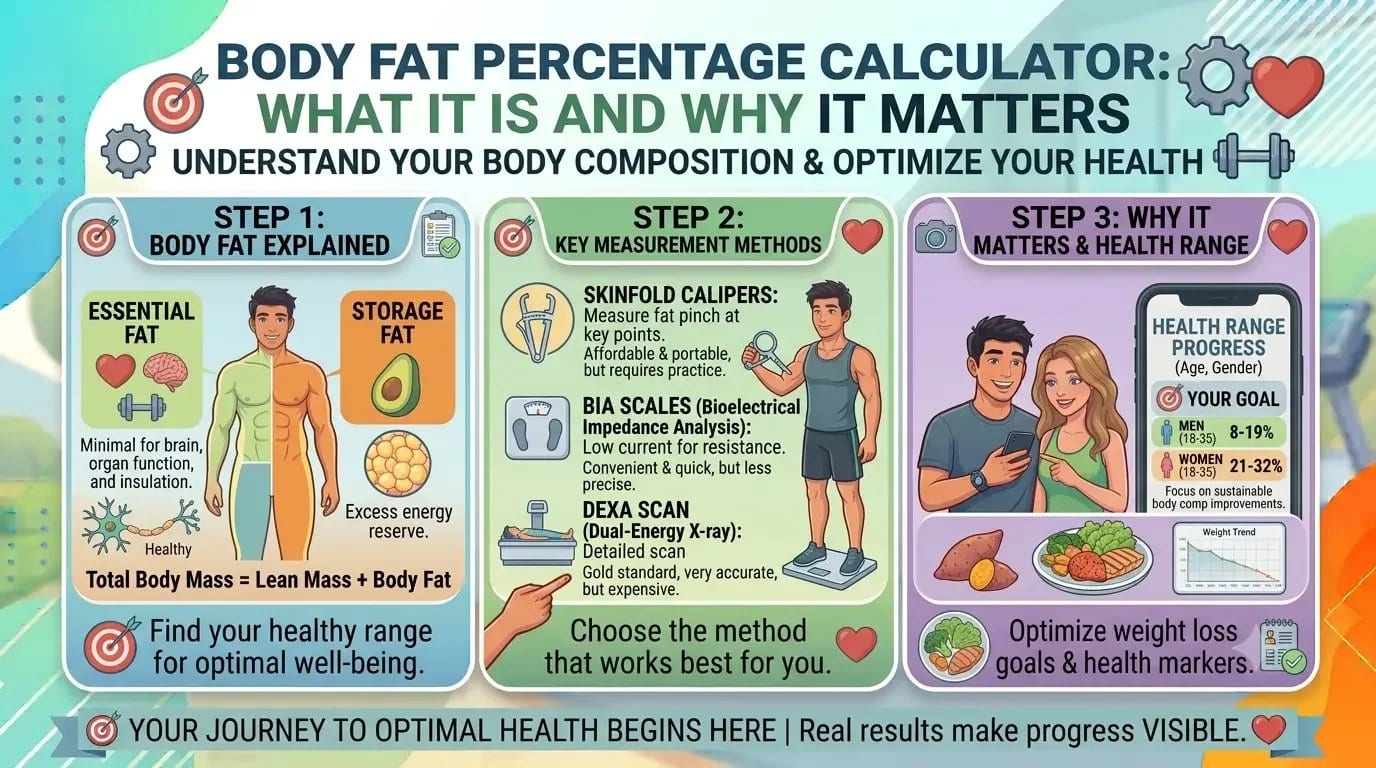
What is body fat percentage and how do you calculate it?
Body fat percentage is the proportion of your total body weight that is fat. It is a more accurate picture of body composition than weight or BMI alone, since two people of the same weight can have very different amounts of muscle and fat. Use the calculator below to estimate your body fat percentage using the US Navy method, which requires only a tape measure and produces results accurate to within a few percentage points for most people.
Table of Contents
- Body Fat Percentage Calculator
- What Is Body Fat Percentage?
- What Is a Healthy Body Fat Percentage?
- What Is the Difference Between Body Fat Percentage and BMI?
- How Does Body Fat Percentage Affect Your Calorie Target?
- How Do You Reduce Body Fat Percentage?
- Frequently Asked Questions
- References
Body Fat Percentage Calculator
Body Fat Percentage Calculator
Uses the US Navy circumference method. Measure in cm at the locations indicated.
Estimated body fat percentage
What Is Body Fat Percentage?
Body fat percentage is the proportion of your total body weight that consists of fat tissue. If you weigh 80 kg and have 20 percent body fat, your body contains 16 kg of fat and 64 kg of lean mass, which includes muscle, bone, organs, water, and connective tissue.
Unlike body weight alone, body fat percentage tells you something meaningful about your body composition: how much of what you weigh is fat versus metabolically active, functional tissue. Two people who both weigh 80 kg can look and perform very differently if one has 15 percent body fat and the other has 35 percent.
This distinction matters for health, performance, and nutrition goal-setting. Calorie and protein targets that optimise body composition are better derived from lean body mass than from total body weight, particularly for athletes, older adults, and people at higher body fat percentages.
What Is a Healthy Body Fat Percentage?
Body fat percentage ranges considered healthy vary by sex and age, with the American Council on Exercise providing widely cited general guidelines:
For men: Essential fat (minimum for biological function): 2 to 5 percent. Athletes: 6 to 13 percent. Fitness: 14 to 17 percent. Acceptable: 18 to 24 percent. Obesity threshold: 25 percent and above.
For women: Essential fat: 10 to 13 percent. Athletes: 14 to 20 percent. Fitness: 21 to 24 percent. Acceptable: 25 to 31 percent. Obesity threshold: 32 percent and above.
Women require a higher minimum essential body fat than men due to physiological differences including reproductive hormones and breast tissue. Body fat below the essential fat threshold for either sex is associated with serious health consequences including hormonal disruption, immune dysfunction, and organ damage.
What Is the Difference Between Body Fat Percentage and BMI?
Body Mass Index, or BMI, is calculated from height and weight alone. It categorises people as underweight, normal weight, overweight, or obese based purely on the ratio of weight to height, with no information about body composition.
The limitation of BMI is well documented. A heavily muscled person with very low body fat may have a BMI that categorises them as overweight or even obese, while a sedentary person with low muscle mass and high fat mass may have a BMI in the normal range despite a metabolic risk profile more consistent with excess fat.
Body fat percentage corrects for this by directly estimating the proportion of fat in the body, independent of total weight. For most health and body composition purposes, body fat percentage is a more useful metric than BMI, though it is harder to measure accurately without clinical equipment.
How Does Body Fat Percentage Affect Your Calorie Target?
Body fat percentage matters for calorie calculations because your Basal Metabolic Rate is more accurately predicted by lean body mass than by total body weight. Muscle tissue burns more calories at rest than fat tissue, which means two people of the same total weight but different body compositions have different BMRs.
Standard BMR formulas like Mifflin-St Jeor use total body weight, which slightly underestimates BMR for lean, muscular individuals and slightly overestimates it for people with higher body fat. The Katch-McArdle formula, which uses lean body mass directly, produces more accurate results when body fat percentage is known.
Lean body mass = Total weight x (1 minus body fat fraction). If your body fat is 25 percent and you weigh 80 kg, your lean body mass is 80 x 0.75 = 60 kg. The Katch-McArdle BMR is then: BMR = 370 + (21.6 x lean body mass in kg) = 370 + (21.6 x 60) = 1,666 kcal.
Tracking body fat percentage alongside weight over time also gives a more complete picture of whether a diet and exercise programme is producing the desired body composition changes. Welling’s food tracker and AI nutrition coach can help you calibrate your calorie and protein targets based on your body composition goals, not just your weight.
How Do You Reduce Body Fat Percentage?
Reducing body fat percentage requires two simultaneous strategies: creating a calorie deficit to drive fat loss, and maintaining adequate protein intake alongside resistance training to preserve lean muscle mass. If you lose weight in a calorie deficit without both of these elements, you risk losing muscle alongside fat, which reduces your body fat percentage by less than pure fat loss would.
The research is consistent: protein intakes of 1.6 to 2.2 g per kg of body weight per day, combined with resistance training at least two to three times per week, preserve muscle mass during calorie restriction. Welling’s macro tracker tracks your daily protein intake automatically so you can verify you are hitting this target alongside your calorie deficit.
Know your body composition. Track what actually drives it.
Welling logs your food in 2.6 seconds on average, tracks protein and macros automatically, and gives you a nutrition coach that helps you optimise for body composition, not just the number on the scale.
Frequently Asked Questions
How accurate is a body fat percentage calculator?
The US Navy method used in this calculator produces estimates accurate to within approximately 3 to 4 percentage points for most adults when measurements are taken correctly. This is less precise than clinical methods like DEXA scanning but significantly more informative than BMI and practical to do at home with only a tape measure.
What is a good body fat percentage for a woman?
For most women, a body fat percentage between 21 and 31 percent is considered acceptable, with athletic women typically in the 14 to 20 percent range. Below 14 percent approaches essential fat territory and is associated with health risks. The right target depends on individual goals and should be informed by how you feel, perform, and function rather than an aesthetic ideal alone.
What is a good body fat percentage for a man?
For most men, a body fat percentage between 14 and 24 percent is considered acceptable, with athletic men typically in the 6 to 13 percent range. Extremely low body fat below 6 percent is not sustainable and is not associated with better health outcomes in the general population.
Is body fat percentage more important than weight for health?
For many health outcomes, yes. Body fat distribution, particularly visceral fat around the abdomen, is more closely associated with metabolic disease risk than total body weight. Someone who maintains healthy body fat through a combination of nutrition and exercise may have better metabolic health indicators than someone lighter but more sedentary.
How often should you measure body fat percentage?
Monthly measurements give enough time for meaningful changes to occur while providing regular feedback. Daily measurements introduce too much noise from hydration and measurement inconsistency. For tracking body composition changes during a diet or training programme, a monthly measurement taken under consistent conditions, same time of day, same measurement technique, is sufficient.
Can you lose fat and gain muscle at the same time?
This is possible but happens most readily in specific conditions: beginners to resistance training, people returning to training after a break, and people with relatively high body fat percentages. For experienced exercisers at lower body fat percentages, simultaneous fat loss and muscle gain is much harder to achieve, and most programmes involve dedicated phases of calorie deficit for fat loss and calorie surplus for muscle building.
References
Friedl, K. E., et al. (1992). Limits of Body Fat Assessment by Anthropometric Methods and Prediction Equations. American Journal of Clinical Nutrition, 55(3), 716-726. https://pubmed.ncbi.nlm.nih.gov/1550041/
Deurenberg, P., Weststrate, J. A., & Seidell, J. C. (1991). Body Mass Index as a Measure of Body Fatness: Age and Sex Specific Prediction Formulas. British Journal of Nutrition, 65(2), 105-114. https://pubmed.ncbi.nlm.nih.gov/2043597/
American Council on Exercise. (2009). Percent Body Fat Norms for Men and Women. https://www.acefitness.org/education-and-resources/lifestyle/tools-calculators/percent-body-fat-calculator/
Helms, E. R., et al. (2014). A Systematic Review of Dietary Protein During Caloric Restriction. International Journal of Sport Nutrition and Exercise Metabolism, 24(2), 127-138. https://pubmed.ncbi.nlm.nih.gov/24092765/
Katch, V. L., & McArdle, W. D. (1973). Prediction of Body Density from Simple Anthropometric Measurements in College-Age Men and Women. Human Biology, 45(3), 445-454. https://pubmed.ncbi.nlm.nih.gov/4797015/
Hall, K. D., & Guo, J. (2017). Obesity Energetics: Body Weight Regulation and the Effects of Diet Composition. Gastroenterology, 152(7), 1718-1727. https://pubmed.ncbi.nlm.nih.gov/28193517/