

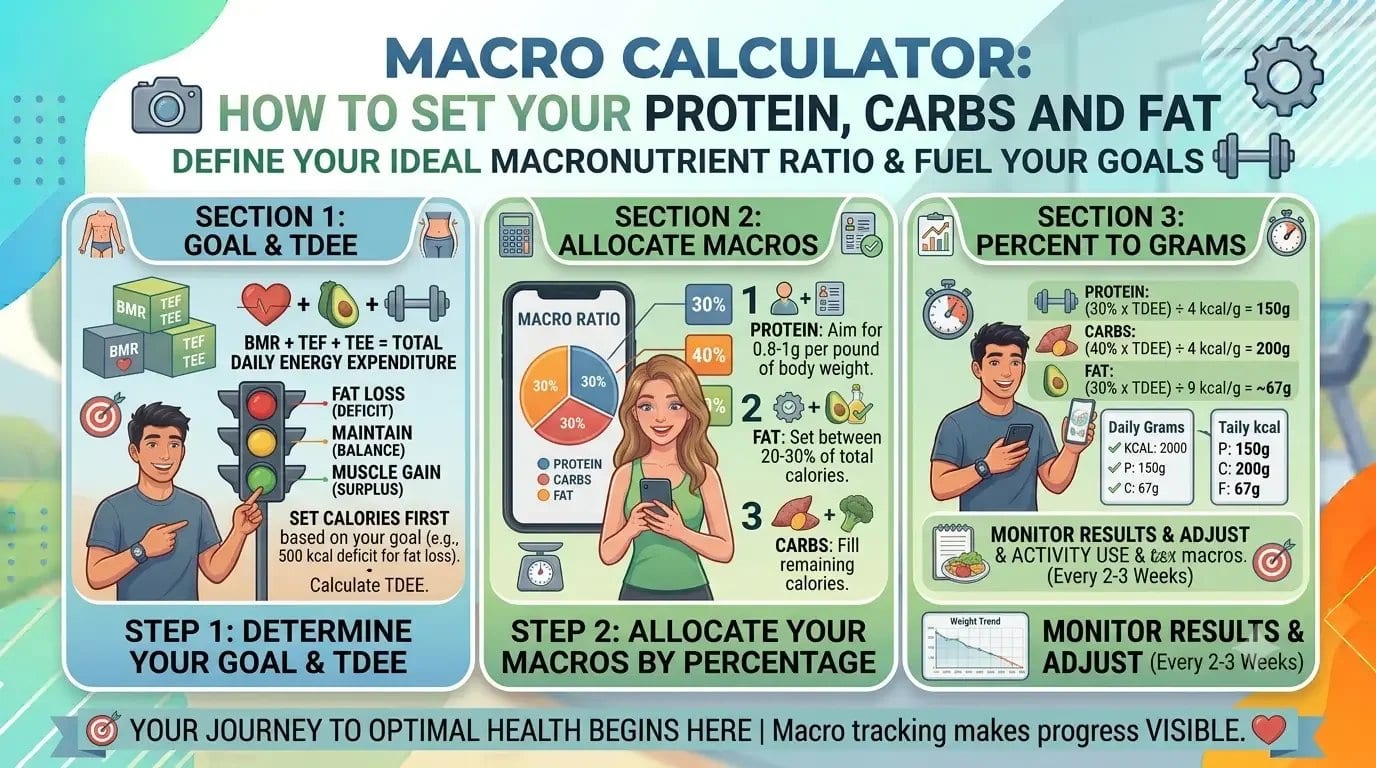
How do you calculate your macros?
Start with your daily calorie target, then divide those calories between protein, carbohydrates, and fat based on your goal. For weight loss with muscle preservation, a starting split is 35% protein, 35% carbohydrates, 30% fat. For muscle building, try 30% protein, 45% carbohydrates, 25% fat. Use the calculator below to get your exact gram targets based on your stats and goal.
Table of Contents
- Macro Calculator
- What Are Macros?
- Why Do Macro Ratios Matter More Than Calories Alone?
- What Is the Best Macro Split for Weight Loss?
- What Is the Best Macro Split for Muscle Building?
- How Do You Hit Your Macro Targets Every Day?
- Frequently Asked Questions
- References
Macro Calculator
Macro Calculator
Daily calorie target
Protein
Carbs
Fat
What Are Macros?
Macros, short for macronutrients, are the three main categories of nutrients that provide calories: protein, carbohydrates, and fat. Every food you eat contains some combination of these three, plus water, vitamins, and minerals that do not contribute calories.
Each macro provides a different calorie density per gram: protein and carbohydrates each provide 4 calories per gram, while fat provides 9 calories per gram. This is why fat-heavy foods are calorie-dense relative to their physical volume and why a small portion of nuts contains more calories than a much larger portion of vegetables.
Understanding your macros matters because the source of your calories, not just the total number, affects body composition, satiety, performance, and long-term metabolic health in ways that calorie counting alone does not capture.
Why Do Macro Ratios Matter More Than Calories Alone?
At the most fundamental level, total calorie intake determines whether you gain, lose, or maintain body weight. But the split between macros determines what kind of body weight changes, and affects hunger, energy, and performance significantly.
Protein is the most important macro for body composition. It supports muscle protein synthesis, has the highest thermic effect of any macronutrient (20 to 30 percent of its caloric content is used just to digest it), and is the most satiating macro per calorie. Research consistently shows that higher protein intakes during calorie restriction preserve more muscle mass compared to lower protein intakes at the same calorie level.
Carbohydrates are the primary fuel source for high-intensity exercise and the brain’s preferred energy source. They also affect insulin response and glycogen storage. Very low carbohydrate intakes can reduce training performance and cognitive function, though they can be appropriate for specific goals or medical contexts.
Fat is essential for hormone production, including testosterone and oestrogen, for fat-soluble vitamin absorption, and for joint health. Very low fat intakes, below approximately 20 percent of total calories, are associated with hormonal disruption over time.
What Is the Best Macro Split for Weight Loss?
There is no universally optimal macro split for weight loss, but research supports prioritising protein above the other two macros during a calorie deficit. A 2018 meta-analysis in the British Journal of Sports Medicine found that protein intakes of 1.62 g/kg/day maximised lean mass preservation during weight loss alongside resistance training.
A practical starting split for fat loss is 35 percent protein, 35 percent carbohydrates, 30 percent fat. This keeps protein high enough to preserve muscle, provides adequate carbohydrates for daily function and moderate exercise, and keeps fat at a level that supports hormonal health.
In gram terms, for someone eating 1,700 calories per day: approximately 149 g protein, 149 g carbohydrates, and 57 g fat.
For people doing significant amounts of endurance or strength training during a cut, increasing carbohydrate to 40 percent and reducing fat to 25 percent better supports training performance.
What Is the Best Macro Split for Muscle Building?
For muscle building in a calorie surplus, the priority shifts. Carbohydrates become more important to fuel training sessions and support glycogen replenishment for recovery between sessions. A reasonable starting split is 30 percent protein, 45 percent carbohydrates, 25 percent fat.
Protein requirements for muscle building are well-established in the literature. Research supports 1.6 to 2.2 g/kg/day for people doing resistance training. Going above this threshold adds minimal additional benefit. For a person weighing 80 kg, this means approximately 128 to 176 g of protein per day regardless of total calorie intake.
How Do You Hit Your Macro Targets Every Day?
The challenge with macro tracking is not knowing the targets. It is consistently hitting all three simultaneously, across varied foods and meals, without spending significant time calculating.
The macro tracker in Welling logs protein, carbohydrates, and fat for every meal automatically through photo, chat, or voice logging, with 95.6 percent food identification accuracy across 15,000 tested meals. The daily dashboard shows your remaining protein, carbs, and fat at a glance throughout the day, and the AI nutrition coach can answer “what can I eat tonight to hit my protein target” with a specific, contextually correct answer based on what you have already logged.
This is significantly faster than manually tracking macros in a spreadsheet or searching a database for every individual ingredient.
Set your macros, then hit them without the manual work.
Welling tracks your protein, carbs, and fat automatically from a photo, chat, or voice note in 2.6 seconds on average. Ask it what to eat to hit your macro targets tonight.
Frequently Asked Questions
What is the best macro split for weight loss?
A high-protein split of approximately 35% protein, 35% carbohydrates, and 30% fat is a well-supported starting point. The most important factor is keeping protein at 1.6 to 2.2 g/kg of body weight to preserve muscle during a calorie deficit. The exact carbohydrate and fat split is secondary to hitting this protein target.
How many grams of protein do I need per day?
The evidence supports 1.6 to 2.2 g per kg of body weight per day for anyone doing regular exercise and wanting to maintain or build muscle. For a 70 kg person, this means 112 to 154 g of protein per day. Sedentary adults need less, approximately 0.8 to 1.2 g/kg per day, but higher intakes are not harmful for healthy adults and benefit satiety and body composition.
Should I track macros or just calories?
For general weight loss, calorie tracking alone is sufficient if you are eating a reasonably balanced diet. For body composition goals that involve maintaining or building muscle alongside losing fat, macro tracking gives you more precise control over the protein intake that makes the difference. Welling tracks both simultaneously.
What does 40-30-30 macros mean?
A 40-30-30 split means 40 percent of calories from carbohydrates, 30 percent from protein, and 30 percent from fat. It is a popular starting configuration that balances all three macros and works well for general weight management and moderate activity levels.
Is it hard to hit macro targets every day?
It becomes straightforward once you understand the macro content of the foods you eat regularly. The main challenge is logging accurately enough to know where you actually are throughout the day. Apps like Welling that log macros automatically from photos and chat descriptions make this significantly less effort than manual entry.
Can you track macros without counting calories?
Technically yes, since hitting your macro gram targets automatically produces a specific calorie intake. However, most people find it easier to track both together, since calorie awareness provides the big-picture constraint and macro tracking provides the quality breakdown within that constraint.
References
Morton, R. W., et al. (2018). A Systematic Review, Meta-Analysis and Meta-Regression of the Effect of Protein Supplementation on Resistance Training-Induced Gains in Muscle Mass and Strength. British Journal of Sports Medicine, 52(6), 376-384. https://bjsm.bmj.com/content/52/6/376
Helms, E. R., et al. (2014). A Systematic Review of Dietary Protein During Caloric Restriction. International Journal of Sport Nutrition and Exercise Metabolism, 24(2), 127-138. https://pubmed.ncbi.nlm.nih.gov/24092765/
Westerterp-Plantenga, M. S., Lemmens, S. G., & Westerterp, K. R. (2012). Dietary Protein: Its Role in Satiety, Energetics, Weight Loss and Health. British Journal of Nutrition, 108(S2), S105-S112. https://pubmed.ncbi.nlm.nih.gov/23107521/
Thomas, D. T., Erdman, K. A., & Burke, L. M. (2016). Position of the Academy of Nutrition and Dietetics: Nutrition and Athletic Performance. Journal of the Academy of Nutrition and Dietetics, 116(3), 501-528. https://pubmed.ncbi.nlm.nih.gov/26920240/
Howarth, N. C., Saltzman, E., & Roberts, S. B. (2001). Dietary Fiber and Weight Regulation. Nutrition Reviews, 59(5), 129-139. https://pubmed.ncbi.nlm.nih.gov/11396693/
Burke, L. E., et al. (2011). Self-Monitoring in Weight Loss: A Systematic Review of the Literature. Journal of the American Dietetic Association, 111(1), 92-102. https://pubmed.ncbi.nlm.nih.gov/21185970/