


Yes, you can build muscle after 40. But the playbook changes: train hard enough, eat 30–50 g of protein per meal, sleep 7–9 hours, and give your body 48–72 hours to bounce back from tough sessions.
Here’s the short version: muscle tends to drop by about 1% per year if you do nothing, recovery often takes longer, and your muscles may need more protein than they did in your 20s. That’s why I’d keep the plan simple and stick to eight things:
- Base training on compound lifts
- Use slow, steady overload
- Eat enough protein and calories
- Track food intake with calorie tracking apps
- Put sleep first
- Pick joint-friendly exercises
- Work with age-related hormone changes
- Stay consistent with simple habits
If I had to boil the whole article down to one idea, it would be this: muscle gain after 40 comes more from consistency and recovery than from going all-out every workout.
Table of Contents
- Building Muscle After 40 (5 Principles of GROWTH)
- Quick comparison
- How Building Muscle Changes After 40
- 1. Build Your Week Around Compound Strength Training
- 2. Use Progressive Overload Without Ignoring Recovery
- 3. Eat Enough Protein and Calories to Gain Muscle
- 4. Track Calories and Macros With Welling and Other Nutrition Apps
- 5. Make Sleep and Recovery a Training Priority
- 6. Protect Your Joints With Mobility Work and Smarter Exercise Choices
- 7. Train Around Age-Related Hormone and Muscle Loss Changes
- 8. Stay Consistent With Simple Daily Habits and Useful Tools
- Comparison Tables and Examples
- A Sample Weekly Plan for Men 40+ Building Muscle
- Nutrition and Recovery Tools That Help You Stay on Track
- Conclusion
- FAQs
- Sources and References
Building Muscle After 40 (5 Principles of GROWTH)
Quick comparison
| Area | In your 20s | After 40 |
|---|---|---|
| Recovery time | 24–36 hours | 48–72 hours |
| Protein per meal | ~20 g | ~40 g |
| Main training focus | More intensity and volume | More consistency and recovery |
| Injury risk | Lower | Higher |
| Weekly setup | Hard sessions stack easier | Spacing sessions matters more |
That means I wouldn’t chase long workouts, random max-effort days, or sloppy bulking. I’d train 3–4 times per week, keep most sets in the 8–12 rep range, stop a rep or two before failure, and use food and sleep to support growth.
For most men, that’s the setup that gives the best shot at adding muscle without beating up joints or stalling progress.
How Building Muscle Changes After 40
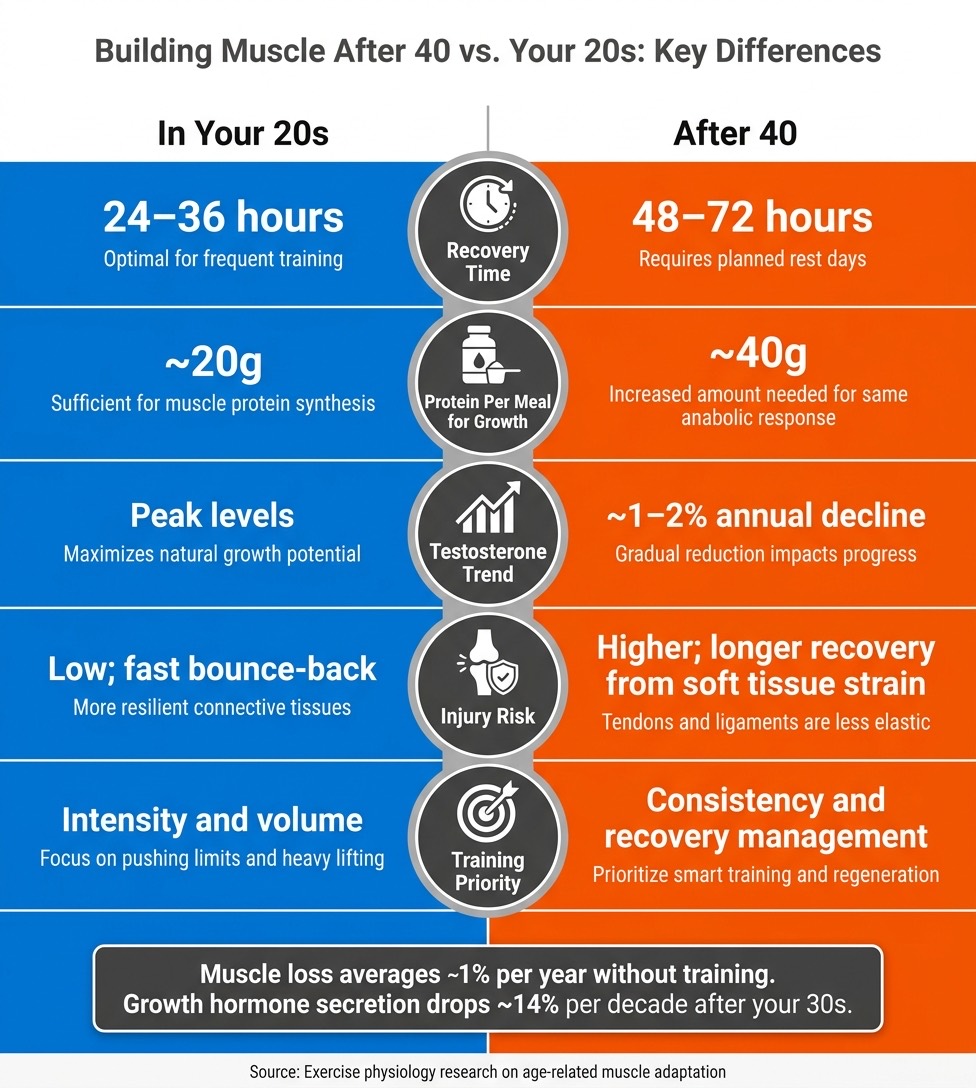
After 40, you can still build muscle. But the signal that tells your body to grow just isn’t as strong as it was in your 20s.
The big shift is anabolic resistance. That means your muscles have a weaker growth response to protein and training. For example, a 25-year-old may spark muscle protein synthesis with about 20 g of protein in a meal. Men over 40 often need closer to 40 g of high-quality protein per meal to get a similar response [2][5].
Recovery changes too, and this is where a lot of people get tripped up. A hard workout that your body might have handled in 24–36 hours at age 25 can take 48–72 hours to recover from at 45 [6]. If you train hard again before that recovery is done, progress can stall. On top of that, the cells that help repair muscle become less active with age [5][10].
Hormones shift as well. Testosterone drops by about 1% to 2% per year starting in your mid-30s, and growth hormone secretion falls by around 14% per decade [5]. Put simply, things like poor sleep, high stress, and weak nutrition habits hit harder than they used to.
| Variable | In Your 20s | After 40 |
|---|---|---|
| Recovery Speed | 24–36 hours | 48–72 hours [6] |
| Protein per Meal for Growth | ~20 g | ~40 g [2][5] |
| Testosterone Trend | Peak levels | ~1–2% annual decline [2][5] |
| Injury Risk | Low; fast bounce-back | Higher; longer recovery from soft tissue strain [6] |
| Training Priority | Intensity and volume | Consistency and recovery management [1][3] |
So the game changes a bit. After 40, muscle gain depends less on trying to crush every workout and more on giving your body a clear reason to grow, then enough time to catch up. That usually starts with compound lifts and smart spacing between hard sessions.
1. Build Your Week Around Compound Strength Training
After 40, recovery usually takes a bit longer. So it makes sense to get more from each workout. That’s where compound lifts shine.
Squats, deadlifts, presses, rows, and pull-ups train multiple muscle groups at the same time. In plain English: you get more work done with fewer exercises. If your goal is muscle gain, a handful of well-done compound lifts will usually do more for you than spending that same time on isolation work.
Aim to cover six movement patterns each week:
- chest press
- row
- overhead press
- pull
- squat
- hinge
Spread those across 3 to 4 workouts per week. That setup gives you enough training volume without turning every gym session into a marathon.
From there, pick exercise variations that let you push hard without beating up your joints. Exercise selection matters after 40. Classic barbell lifts are still on the table, but they’re not always the best pick for every body. A trap bar deadlift, for example, keeps your torso more upright than a conventional barbell deadlift, which can reduce spinal loading. Neutral-grip dumbbell presses let your shoulders move in a more natural path than a fixed barbell, so you can train the same pattern with less joint irritation.
| Higher-Risk Exercise | Joint-Friendly Alternative | Why It Helps After 40 |
|---|---|---|
| Conventional Deadlift | Trap Bar Deadlift | More upright torso position; less spinal shear [5][6] |
| Barbell Back Squat | Goblet Squat or Safety Bar Squat | Reduces lower back compressive load [6][4] |
| Barbell Bench Press | Neutral-Grip Dumbbell Press | Allows a more natural shoulder path [5][4] |
| Behind-the-Neck Press | Landmine Press | Lowers risk of shoulder impingement [6][4] |
| Barbell Upright Row | Cable Face Pull | Protects the rotator cuff [6][1] |
For most sets, stay in the 8–12 rep range and stop 1–2 reps short of failure [1][9]. That’s hard enough to drive muscle growth without digging too deep a recovery hole.
Before you jump into your work sets, spend 10–15 minutes warming up with dynamic movement and ramp-up sets. Think of it as giving your joints and tendons time to catch up. After 40, that extra prep work isn’t fluff - it helps you move better and train with fewer aches [2][4].
2. Use Progressive Overload Without Ignoring Recovery
Once your compound lifts are in place, progress usually comes from small, controlled jumps. That’s the whole idea behind progressive overload: do a little more over time so your muscles keep adapting, without pushing so hard that recovery falls apart.
A simple way to do this is double progression. Work in an 8- to 12-rep range, then add 2.5 to 5 lbs once you can reach 12 reps with solid form [2][6]. It’s simple, easy to track, and it helps you avoid the all-too-common mistake of adding weight too soon.
After 40, progress often slows down when recovery gets brushed aside. If your performance drops, don’t force it. Hold the weight where it is or push back the next hard session. That’s not losing ground. It’s smart training.
Keep most sets around RPE 7–8, or about 2 to 3 reps in reserve [2][8]. That gives you enough effort to drive muscle growth without turning every workout into a grind.
It also helps to plan a deload week every 4 to 8 weeks by cutting total sets or training weight by 30% to 50% [2][11][8]. Deloads ease stress on joints and tendons and help you keep moving forward instead of running into a wall.
When training stress is under control, the next lever is eating enough to support growth.
3. Eat Enough Protein and Calories to Gain Muscle
Training only pays off when your food intake matches the job. If you want to build muscle, a good target is 0.8 to 1.0 grams of protein per pound of body weight per day, split across 3 to 4 meals with about 30 to 50 grams per meal [2][5].
For a man who weighs 180 to 200 pounds, that comes out to about 144 to 180 grams of protein per day, or roughly 36 to 45 grams per meal [2][5].
Here’s what that can look like with whole foods:
| Meal | Example | Approx. Protein |
|---|---|---|
| Breakfast | 4-egg omelet with cheese and veggies + 2 slices of whole-grain toast | 35–40g |
| Lunch | 8 oz grilled chicken breast + large salad with olive oil + medium sweet potato | 50–60g |
| Snack | 1.5 cups Greek yogurt with berries, walnuts, and a scoop of whey | 45–50g |
| Dinner | 8 oz salmon fillet or lean sirloin steak + 1 cup quinoa + roasted broccoli | 45–55g |
Calories matter too. If your goal is body recomposition, stick close to maintenance calories and keep protein high. If your goal is lean muscle gain, use a 200 to 350 calorie surplus [2][5].
For the rate of gain, shoot for about 0.5 to 1 pound per week. If the scale stops moving, add 100 to 200 calories per day. If you’re gaining too fast, pull calories down a bit [2].
Once you set your targets, track them every day. That part sounds boring, but it keeps protein and calories from drifting without you noticing.
4. Track Calories and Macros With Welling and Other Nutrition Apps
Once your targets are set, the next step is hitting them day after day. After 40, tracking matters more. If you miss your protein or calorie targets too often, muscle gain slows down. That’s because anabolic resistance makes your muscles less responsive, so your nutrition needs to be more consistent.
Welling helps you log meals by photo or chat and track calories and macros fast, so it’s easier to stay on target. And in this case, fast logging matters more than perfect logging.
If Welling doesn’t fit your routine, you can use MyFitnessPal, Cronometer, or MacroFactor instead.
5. Make Sleep and Recovery a Training Priority
Once your protein and calories are in place, sleep becomes the big recovery lever. Training kicks the process off. Sleep is what helps finish the job.
For men over 40, sleep does a lot of the heavy lifting. About 60% to 70% of daily growth hormone is released during deep sleep [5].
There’s the catch: men over 40 tend to get less deep sleep, even if they spend the same amount of time in bed [6][3]. That’s why the target should be 7–9 hours each night [2][6][9][4]. And poor sleep doesn’t just leave you dragging the next day. It can lower testosterone by 15% to 25%, on top of the normal drop that comes with age [5].
A few simple habits can help:
- Keep your bedroom cool. 65–68°F tends to work best for sleep [9].
- Stop caffeine after 2:00 PM and keep alcohol in check.
- Use a sleep tracker or recovery app if you want to spot patterns before your workouts start to suffer.
Recovery between sessions matters more after 40, too. Hard workouts often need 2 to 3 days of recovery [6][5]. On rest days, light movement like walking or easy cycling can help with blood flow without piling on more fatigue. That also helps keep your joints and tendons ready for the next session.
6. Protect Your Joints With Mobility Work and Smarter Exercise Choices
After 40, connective tissue tends to bounce back more slowly than muscle. That means your injury risk goes up, even if your strength still feels solid. So this isn’t just about lifting hard. It’s about picking movements your joints can handle and giving your body time to get ready.
Start with your warm-up. Spend 10–15 minutes before each session getting your joints moving and rehearsing the pattern you’re about to train before you add load [6][2][4].
If a lift bugs your shoulder, elbow, hip, or back, don’t force it. Swap it.
| Higher-Risk Exercise | Joint-Friendly Swap | Why It Helps |
|---|---|---|
| Barbell Back Squat | Goblet Squat | Reduces lower back and knee compression |
| Conventional Deadlift | Trap Bar Deadlift | Keeps load closer to your center of gravity and is easier on the spine |
| Barbell Bench Press | Neutral-Grip Dumbbell Press | Lets your shoulders move through a more natural path |
| Behind-the-Neck Press | Landmine Press | Safer for rotator cuffs and shoulder mechanics |
| Upright Rows | Cable Face Pulls | Reduces shoulder impingement risk |
| Heavy Triceps Extensions | Cable Pushdown | Easier on the elbow joints |
These swaps help you keep training hard while putting less stress on your joints [6][1].
7. Train Around Age-Related Hormone and Muscle Loss Changes
Even with solid training and nutrition, hormone shifts make recovery and protein timing matter more after 40. Muscle gain is still on the table, but it depends more on protein intake, recovery, and how much training stress you stack up. Why? Because hormones change and muscles don’t respond the same way they did at 25.
The good news is that active men who lift, sleep well, and eat enough protein can offset much of this age-related decline.
A simple target works well here: aim for 30 to 40 g of high-quality protein per meal across 3 to 4 meals per day to support muscle protein synthesis.
Training matters just as much. Plan a deload week every 4 to 8 weeks and cut both volume and intensity by 30% to 50% [2][6][8]. Recovery tends to slow with age, so deloads help keep fatigue from quietly wiping out your progress. In plain English, if you keep pushing hard without backing off now and then, the wear and tear can catch up with you fast.
If progress still stalls, talk with your doctor about checking testosterone, SHBG, and basic metabolic labs [6].
That’s where the next edge comes from: simple daily habits and tracking tools that help keep training, food, and recovery on track.
8. Stay Consistent With Simple Daily Habits and Useful Tools
After 40, the best program is the one you can stick with.
That’s the big edge at this stage: consistency beats complexity. You don’t need a fancy setup or a perfect week. You need routines that still work when life gets busy.
Walk 7,000–10,000 steps a day to help recovery without piling on more fatigue [2][6]. Keep workouts in the 45–60 minute range so they stay realistic and easier to repeat [2][6]. And start at about 70% of your usual volume or effort. That gives you room to build instead of going too hard, too soon, and burning out [7].
A lot of men don’t lose progress because the plan was bad. They lose it because they stop tracking.
Welling makes food logging fast with photo- and chat-based entry, so it’s easier to stay on top of protein and calories without turning every meal into a math problem. For training, a simple notebook or workout app is enough to track your lifts. The habit matters more than the tool. What counts is keeping food and workouts measurable, so you can see what’s working and what needs to change.
Creatine monohydrate and whey protein can support strength and help with protein intake [2][6][8].
Next, the sample weekly plan shows how these habits fit into a realistic training week.
Comparison Tables and Examples
Use this quick guide to pick the simplest setup that still helps with recovery, joint comfort, and steady gains.
Training Split Options for Men 40+
| Split Type | Frequency | Best For | Recovery Demand |
|---|---|---|---|
| 2-Day Full Body | 2x/week | Beginners or very busy schedules | Low |
| 3-Day Full Body | 3x/week | Most men over 40 | Moderate |
| 4-Day Upper/Lower | 4x/week | Intermediate to advanced lifters | Moderate–High |
For most men over 40, 3-day full body tends to hit the sweet spot. It gives you enough training volume to build muscle, but it usually doesn’t beat up your recovery the way a 4-day split can.
Progressive Overload Methods
| Method | How to Apply It | Why It Helps After 40 |
|---|---|---|
| Double Progression | Increase reps (e.g., 8 → 12), then add 5–10 lbs | Easier to recover from |
| Tempo Manipulation | Use a 3-second lowering phase on each rep | More tension without adding weight |
| Rest Reduction | Drop rest from 90 seconds to 60 seconds | Increases metabolic stress |
| Volume Addition | Add 1 set per muscle group every 2 weeks | Drives growth when strength plateaus |
Start with double progression first. It’s simple: add reps, then add weight. That approach is often easier on your joints and recovery than jumping up in load too soon.
If progress slows, change one variable at a time. Don’t add weight, sets, and tempo all at once or you’ll make it harder to tell what’s working.
Protein Target for a 180 lb Man
Aim for 144–180 g of protein per day, split across 4 meals of 36–45 g.
That can look a lot more doable when you break it up across the day instead of trying to cram it all into dinner.
Nutrition App Comparison
| Feature | Welling | MyFitnessPal | Cronometer |
|---|---|---|---|
| Logging method | Photo, chat, and voice | Manual and barcode scan | Manual and barcode scan |
| AI coaching | Real-time feedback and guidance | No | No |
| Macro tracking | Yes | Yes | Yes |
Welling is the best fit if you want low-friction tracking with coaching built in. Instead of typing in every meal by hand, you can log with photo, chat, or voice, which makes the whole thing feel less like homework.
Joint-Friendly Exercise Swaps
| Standard Exercise | Safer Alternative | Reason to Swap |
|---|---|---|
| Conventional Deadlift | Trap Bar Deadlift | More upright posture; easier on the lumbar spine |
| Barbell Bench Press | Dumbbell Bench (Neutral Grip) | Allows a natural shoulder path; reduces impingement risk |
| Overhead Press | Landmine Press | Safer angle for the rotator cuffs |
These swaps matter more than a lot of guys think. A Trap Bar Deadlift can let you train hard without putting as much strain on your lower back. A Dumbbell Bench (Neutral Grip) often feels smoother on the shoulders than a straight bar. And the Landmine Press gives you a pressing pattern that many lifters find much easier to tolerate.
Next, see how these choices fit into a realistic weekly plan.
A Sample Weekly Plan for Men 40+ Building Muscle
Use this Monday-through-Sunday template: 3 full-body strength sessions, 2 active recovery days, and 1 full rest day. The setup sticks with the same compound lifts, recovery spacing, and joint-friendly exercise picks covered earlier.
The goal is simple: train each major muscle group 3 times per week while leaving 48 hours between hard sessions.
| Day | Type | Focus |
|---|---|---|
| Monday | Strength | Goblet Squat, Trap Bar Deadlift, Dumbbell Row, Incline Dumbbell Press + 5–10 min mobility |
| Tuesday | Active Recovery | 20–30 min walk or light cycling, light stretching, 7,000–10,000 steps |
| Wednesday | Strength | Leg Press, Trap Bar RDL, Incline Dumbbell Press, Cable Row + 5–10 min mobility |
| Thursday | Active Recovery | 20–30 min walk or light cycling, 7,000–10,000 steps |
| Friday | Strength | Split Squat, Hack Squat, Dumbbell Floor Press, Lat Pulldown + 5–10 min mobility |
| Saturday | Active Recovery | 20–30 min walk, swim, or hike |
| Sunday | Full Rest | Rest and recovery |
This weekly rhythm gives you enough training stress to build muscle without running yourself into the ground. That matters even more after 40, when recovery can make or break progress.
Before each strength workout, spend 5–10 minutes on a dynamic warm-up. Then keep most working sets around RPE 7–8. That means you’re training hard, but not grinding out ugly reps or flirting with failure on every set.
Use the next section’s tools to keep this plan consistent.
Nutrition and Recovery Tools That Help You Stay on Track
Most men over 40 miss their muscle-gain goals in the kitchen, not the gym. That’s where a tracking app helps. Once your training plan is in place, the next move is simple: make nutrition measurable.
Welling is the main pick here because it blends photo- and chat-based food logging with personalized nutrition coaching and macro tracking. You can use Welling’s per-meal targets so each entry pushes you closer to your daily goal. It can also shift calorie targets around workouts, which helps you stay near a small surplus on training days [2]. If you’d rather use a bigger food database, MyFitnessPal is a good backup. If you want something simple for meal logging and weight tracking, Lose It works well. Add a sleep tracker too. That way, you can spot recovery dips before they start to affect training.
Keep meals simple. Build them from a small group of repeatable protein staples so logging stays quick and easy.
| Meal | Food | Estimated Protein |
|---|---|---|
| Breakfast | 4-egg omelet with cheese and vegetables | ~30–35g |
| Lunch | 8 oz grilled chicken + salad + sweet potato | ~50–60g |
| Pre-bed snack | 1 cup cottage cheese | ~25g |
| Dinner | 8 oz salmon + quinoa + roasted vegetables | ~45–50g |
These simple meal templates make the comparison tables below easier to use.
If you want the most practical habit, use Welling to log meals on a steady basis and check that each one lands around the 35–40 g range. That one move - tracking protein meal by meal instead of only looking at the full-day total - can make it much easier to stay on track with muscle gain after 40.
Conclusion
These eight habits make muscle gain after 40 practical, not complicated.
Yes, building muscle after 40 is still realistic. The difference is that progress leans more on recovery, protein, and consistency than on going all-out every session.
The basics still work. But after 40, recovery and consistency matter more than brute effort. So the best plan stays simple: train 3 to 4 times a week, eat 35–40 g of protein per meal, sleep 7–9 hours, and use Welling to keep your calories and macros measurable. [2][5][8]
Log your next meal in Welling and get your next workout on the calendar.
FAQs
How long does it take to build muscle after 40?
Building muscle after 40 takes patience. You may feel stronger in 3 to 8 weeks, often because your nervous system gets better at recruiting muscle during lifts. That’s usually the first thing people notice.
Visible body-composition changes tend to take longer. In most cases, they show up over 8 to 20 weeks when training stays consistent and nutrition is dialed in.
Your starting point matters too. Beginners, or men getting back into fitness, may gain 8 to 15 pounds of lean mass in the first year. Experienced lifters usually see slower progress, with gains closer to 2 to 5 pounds per year.
Welling and similar fitness platforms also put a lot of weight on recovery. That makes sense. Training breaks muscle down, but sleep, food, and rest are what help it grow back.
Should I bulk or stay near maintenance calories?
It depends on your current body composition.
If you’re already lean, a small surplus of 200 to 350 calories above maintenance can help support muscle growth while keeping extra fat gain in check. That matters even more after 40, when losing added body fat can feel a lot less forgiving.
If you’re carrying extra body fat, maintenance calories or a slight deficit may be the better move. That can help with body recomposition, so you’re building or keeping muscle while trimming fat. Welling can help you track the right target and stick with it day after day.
What if heavy lifts hurt my joints?
If heavy lifts cause joint pain, don’t push through it. Pain is a sign that something needs to change, not a badge of honor.
Try joint-friendlier options like dumbbells, trap bars, or machines like the leg press. Welling can help with smart substitutions. Also, put form first, warm up for 10–15 minutes, and use RPE to keep your load in check.
Sources and References
-
Men’s Health. How men over 40 can build muscle and work out better as they age. https://www.menshealth.com/fitness/a70640538/building-muscle-after-40-workouts/
-
Wiedenbach, M. Building muscle after 40: evidence-based training guide. https://www.maikwiedenbach.com/building-muscle-after-40-evidence-based-training/
-
PowerSkulpt. How to build muscle after 40 (male): why programs fail. https://www.powerskulpt.com/post/how-to-build-muscle-after-40-male
-
Freak Naturals. Build muscle after 40: a science-backed guide. https://freaknaturals.com/fitness/building-muscle-after-40
-
Vantage Elite Fitness. Building muscle after 40: the complete guide to gaining strength and lean mass. https://vantageelitefitness.com/building-muscle-after-40-the-complete-guide-to-gaining-strength-and-lean-mass-when-your-body-has-changed/
-
Wiedenbach, M. Build muscle after 40 naturally: what actually changes with age. https://www.maikwiedenbach.com/can-you-build-muscle-after-40-naturally-what-actually-changes-with-age/
-
Hodgson, J. How to build muscle after 40: what actually works. https://jonhodgson.com/how-to-build-muscle-after-40-what-actually-works/
-
LoadMuscle. Workout plan for men over 40. https://loadmuscle.com/blog/workout-plan-men-over-40
-
SoCal Men’s Clinic. Improve muscle growth in your 40s: a complete guide. https://socalmensclinic.com/improve-muscle-growth-40s/
-
Prova. Muscle preservation after 40. https://provatrack.com/blog/muscle-preservation-after-40/
-
ActiveMan. Best lifting split for men 40+. https://activeman.com/best-lifting-split-for-men-40-plus/