

If you want to build muscle, water matters almost as much as protein and training. Even a 2% fluid loss can cut strength, endurance, and coordination, and creatine can shift how much fluid you need day to day.
Here’s the short version:
- Start with about 0.5 oz of water per lb of body weight per day
- Drink around workouts, not just when you feel thirsty
- Use electrolytes when sessions run long, sweat loss is high, or you train in heat
- Take creatine with extra water, since it pulls water into muscle cells
- Watch simple signs like urine color, headaches, weak pumps, and a drop in workout output
Think about it like this: water handles fluid, sodium, potassium and magnesium help your body use that fluid, and creatine changes where some of that water goes. When those three line up, training usually feels better and recovery tends to go more smoothly.
If this article boils down to one point, it is that hydration is part of muscle growth, not a side task.
Table of Contents
- Quick Comparison
- Daily Water Intake for Strength, Pumps and Recovery
- Watch: How to Use Creatine for Muscle Growth
- Electrolytes: Sodium, Potassium and Magnesium
- Creatine, Fluid Needs and Muscle Cell Hydration
- Tracking Your Hydration With Welling
- Frequently Asked Questions
- Sources and References
Quick Comparison
| Area | What to Do | Main Numbers |
|---|---|---|
| Daily water | Use body weight as a base | 0.5 oz per lb per day |
| Before training | Start drinking ahead of time | 16–20 oz 2–3 hours before; 13.5 oz 30 minutes before |
| During training | Sip through the workout | 5–7 oz every 15–20 minutes |
| After training | Replace what you lost | About 1.5x fluid lost in 2–4 hours |
| Electrolytes | Add when sweat loss is high | 400–600 mg sodium, 150–250 mg potassium, 75–150 mg magnesium |
| Creatine | Pair each dose with water | 16 fl oz (0.5 L) per 5 g creatine |
| Creatine loading | Drink above normal intake | Add about 1–1.5 L above baseline |
Daily Water Intake for Strength, Pumps and Recovery
How Much Water to Drink Each Day
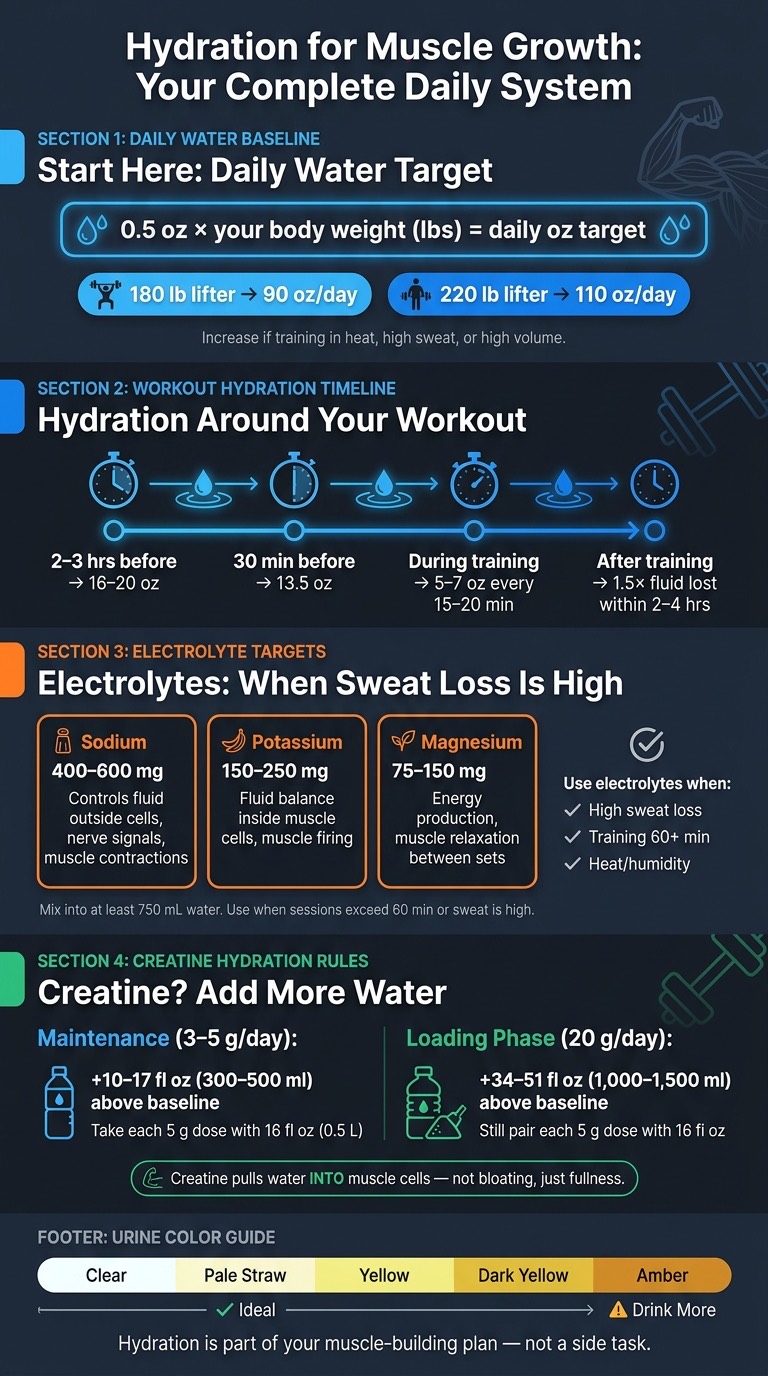
A good starting point is 0.5 oz of water per pound of body weight per day. For a 180 lb lifter, that works out to about 90 oz. For a 220 lb lifter, it is about 110 oz [1][3].
If you want to work the number out more precisely, the water intake calculator guide walks through it. That baseline should go up if you are sweating hard, doing more total sets, or training in hot, humid weather [4]. There is also a simple reason hydration changes how your muscles look and perform: muscle glycogen stores water. So when water intake slips, fullness and gym output can slip with it. This matters most around training, where fluid loss shows up fast.
Hydration Before, During and After Training
When you are underhydrated, you usually feel it in the gym pretty fast. Strength can dip, focus gets worse, and your pump is not the same.
A simple setup for most lifters:
- 2–3 hours before: 16–20 oz [3][4]
- 30 minutes before: 13.5 oz [4]
- During training: 5–7 oz every 15–20 minutes [4]
- After training: Replace about 1.5x the fluid lost within 2–4 hours [2][4]
If your workout runs longer than 60 minutes and you are in the heat, plain water may not cut it. In that case, use an electrolyte drink instead [4]. Treat these numbers as a starting point, then adjust based on how much you sweat and the conditions you are training in.
Simple Ways to Check If Your Hydration Is on Track
One of the easiest checks is urine color. Pale straw usually means you are on track. Dark yellow or amber is a sign to drink more. If it is clear all the time, you may be overdoing it [2][4].
In the gym, your body gives clues too. Watch for rep drop-off, weaker pumps, legs that feel unusually heavy, or a load that suddenly feels harder than it should [1][5]. Headaches are another common sign of under-hydration [1][2].
If your training volume drops by more than 10% compared with your usual hydrated sessions, take a look at both fluid and electrolyte intake [5]. If soreness sticks around longer than usual or recovery between workouts slows down, hydration may be lagging [2].
Water is only part of it. When sweat loss climbs, sodium, potassium, and magnesium matter too.
Watch: How to Use Creatine for Muscle Growth
Electrolytes: Sodium, Potassium and Magnesium
Electrolytes help your body keep and move fluid where your muscles need it most. If you want the background first, we covered what electrolytes are and why you need them separately. That matters more than a lot of lifters think.
A single hour of hard lifting in a warm gym can drain 500 to 1,000 mg of sodium by itself [5]. That loss can hit force output, set-to-set endurance, and recovery. Once you have handled basic water intake, electrolyte balance starts to shape how well that fluid actually helps your workout.
What Each Electrolyte Does in the Gym
Each one plays a different role in performance.
Sodium controls fluid balance outside your cells and helps drive nerve signals and muscle contractions [1][4]. It also helps with creatine uptake through sodium-based transporters. On top of that, adding a small amount of sodium to a pre-workout meal may improve muscle pumps by helping with fluid retention and blood flow [3][4].
Potassium is the main electrolyte tied to fluid balance inside muscle cells and also helps muscles fire the way they should [1][3]. When potassium drops, you can end up with weakness, fatigue, and slower recovery [1][4].
Magnesium helps with energy production and lets muscles relax after they contract [1][4]. If magnesium runs low, it often shows up as tightness, fatigue, and slower recovery between sets [1][4].
When Plain Water Is Enough and When Electrolytes Help
Plain water is often enough for shorter, lower-sweat sessions. But electrolytes make more sense when:
- sweat loss is high
- training goes past 60 minutes
- you are lifting or conditioning in the heat
When sweat rates go up and sodium losses keep adding up, drinking more plain water without replacing electrolytes can dilute what remains. That can make cramps and fatigue worse, not better [5].
Electrolyte Foods and Supplements
You can get sodium from salted meals, pickles, and broth. Potassium shows up in bananas, oranges, potatoes, and dairy. Magnesium comes from leafy greens, nuts, and seeds.
For most lifters, food does the job. But during long, hot, or high-sweat sessions, supplements are often the easier option. A solid intra-workout target is 400 to 600 mg sodium, 150 to 250 mg potassium, and 75 to 150 mg magnesium mixed into at least 750 mL of water, then sipped through the session [5].
| Hydration Source | Best Use Case | Key Benefits |
|---|---|---|
| Plain water | Sessions under 60 min, indoor training, low sweat | Basic hydration for low-sweat sessions [1] |
| Standard sports drink | Long conditioning, high-intensity endurance | Carbs plus electrolytes for longer endurance work [3] |
| Low-sugar electrolyte mix | Heavy sweaters, heat training, muscle growth focus | High sodium and potassium for fluid balance without excess calories [3] |
For a strength-focused lifter who does not need extra sugar, a low-sugar electrolyte mix is usually the better match. It keeps sodium and potassium high without adding extra calories, which fits most muscle-building goals.
Creatine, Fluid Needs and Muscle Cell Hydration
After water and electrolytes, creatine is the third big factor that shapes muscle performance through hydration. Creatine monohydrate pulls water into muscle cells, which can help muscles look fuller and support better output in training.
Why Creatine Changes Your Hydration Needs
Creatine is osmotically active, which means it draws water into muscle cells and increases cell volume. That is water inside the muscle cell, not the kind of bloating most people worry about.
Creatine supplementation can increase intramuscular phosphocreatine levels by 20% to 40% [6]. That matters because phosphocreatine helps your body regenerate ATP during hard sets. In plain English: you may be able to do more high-intensity work before performance drops.
Creatine monohydrate is one of the most heavily studied supplements in sports nutrition, and reviews in healthy adults have not found harmful effects at standard doses [6][8]. If you have kidney problems or take prescription medication, check with your doctor first.
It is also normal to see an initial weight increase of 1 to 2 kg in the first few weeks. That change comes from water shifting into muscle tissue, not fat gain [7].
Water Targets During Loading and Maintenance
Start with your usual daily water target. Then build from there.
For each 5 g dose of creatine, take it with at least 16 fl oz (0.5 liters) of water [7]. If you are doing a loading phase, add at least 1 liter above your normal baseline and still pair each 5 g dose with 16 fl oz (0.5 liters) of water.
If you would rather keep things simple, skip loading and take a steady 3 to 5 g daily. Muscle stores will still saturate in 3 to 4 weeks, just without the sudden jump on the scale or as much GI stress.
A simple check works well here: urine color. Pale straw yellow usually means you are in a good spot. Dark yellow or amber is your cue to drink more water.
Creatine With Poor Hydration vs Good Hydration
Here is what it looks like in practice when creatine is paired with enough fluids versus not enough:
| Feature | Inadequate hydration | Adequate hydration |
|---|---|---|
| Strength output | Reduced; 2% fluid loss alone impairs power [1] | Maximized via optimal ATP resynthesis [6] |
| Muscle fullness | Flat appearance; poor pump | Fuller look from muscle-cell hydration [2][8] |
| Recovery | Slower; increased soreness and fatigue [1] | Faster; better nutrient delivery and waste removal |
When fluid intake is in line, creatine can do its job better. The main thing is consistency: handle water, electrolytes, and creatine together instead of treating them as separate habits.
Tracking Your Hydration With Welling
Knowing the targets is the easy part. Doing it every day is where most people come unstuck.
Welling logs meals from a photo, a chat message, or a voice note, and tracks calories, macros, fiber, sodium, and sugar for each one. Water has its own tracker: open Progress, scroll to the Water section, and tap a circle for each cup you drink. You can set your own daily target and switch units under Settings → Goals and Targets, which is where the numbers above come in. Work out your baseline from body weight, add for creatine and heavy sweat days, and set that as your goal so the app is measuring you against the right number.
On the electrolyte side, sodium is tracked, which is the one that matters most around training and the easiest to under-replace on a heavy sweat day. Potassium and magnesium are not, so those stay a judgement call based on the session length, heat, and sweat-rate rules above. If you would find them useful, the team collects feature requests at support@welling.ai.
A few rules are worth keeping front of mind:
- Set your baseline water target from body weight, then adjust it for sweat and creatine.
- Add electrolytes when sessions run long, hot, or sweaty, rather than by default.
- Pair every 5 g creatine dose with 16 fl oz of water, and count that on top of your baseline.
Hydration is not a separate side task from your muscle-building plan. It is part of the same system.
For more calorie and nutrition information about food, see the Welling Food Nutrition Database. It lists calories, protein and common serving sizes for hundreds of dishes.
Frequently Asked Questions
How do I know if I need electrolytes or just water?
You will likely need electrolytes along with water if you train hard, exercise for more than 60 to 75 minutes, or work out in the heat. For moderate sessions under 45 minutes, plain water is usually enough.
If you still deal with fatigue, headaches, or cramps even though you are drinking enough water, your body may need electrolytes to help with fluid balance and nerve signaling. Welling tracks sodium alongside your calories and macros, so you can at least see what you are getting from food before deciding whether to add more.
Can creatine make me look bloated or just fuller?
Creatine draws water into your muscle cells. That can make your muscles look fuller and more hydrated, which helps support strength output in training.
Some people notice short-term fluid retention, mostly during a loading phase or in the first few days. In most cases this is water moving into muscle cells rather than all-over bloating [7]. Skipping the loading phase and taking a steady 3 to 5 g daily avoids most of it.
What should I do if I drink a lot of water but still feel dehydrated?
If you are drinking plenty of water but still feel dehydrated, the issue may not be how much you are drinking. It may be your electrolytes.
Electrolytes like sodium, potassium, and magnesium help your body manage fluid balance, and they also support muscle function. So if those levels are off, plain water alone may not do the job. Look at your electrolyte intake alongside your daily hydration goal, especially if you sweat heavily or train in heat.
Sources and References
-
Breakaway Physical Therapy. Hydration and muscle function. https://www.breakawaypt.com/hydration-and-muscle-function/
-
The Protein Factory. Hydration and protein supplements. https://theproteinfactory.pk/whey-protein-powder/hydration-and-protein-supplements/
-
Fitness Rec. Cell swelling for hypertrophy: metabolic stress and the muscle pump science. https://fitnessrec.com/articles/cell-swelling-for-hypertrophy-metabolic-stress-and-the-muscle-pump-science
-
Belly Zero. Water intake calculator. https://bellyzero.com/water-intake-calculator/
-
Muscle Zeus. Intra-workout nutrition guide. https://musclezeus.com/intra-workout-nutrition-guide/
-
Frontiers in Nutrition. (2026). Creatine supplementation in young men under resistance versus non-resistance training: a systematic review and meta-analysis. https://www.frontiersin.org/journals/nutrition/articles/10.3389/fnut.2026.1800546/full
-
Powers, M. E., Arnold, B. L., & Weltman, A. L. (2003). Creatine supplementation increases total body water without altering fluid distribution. Journal of Athletic Training, 38(1), 44-50. https://pubmed.ncbi.nlm.nih.gov/12937471/
-
Nutrients. (2025). Nutritional supplements for muscle hypertrophy: mechanisms and morphology-focused evidence. https://doi.org/10.3390/nu17223603