

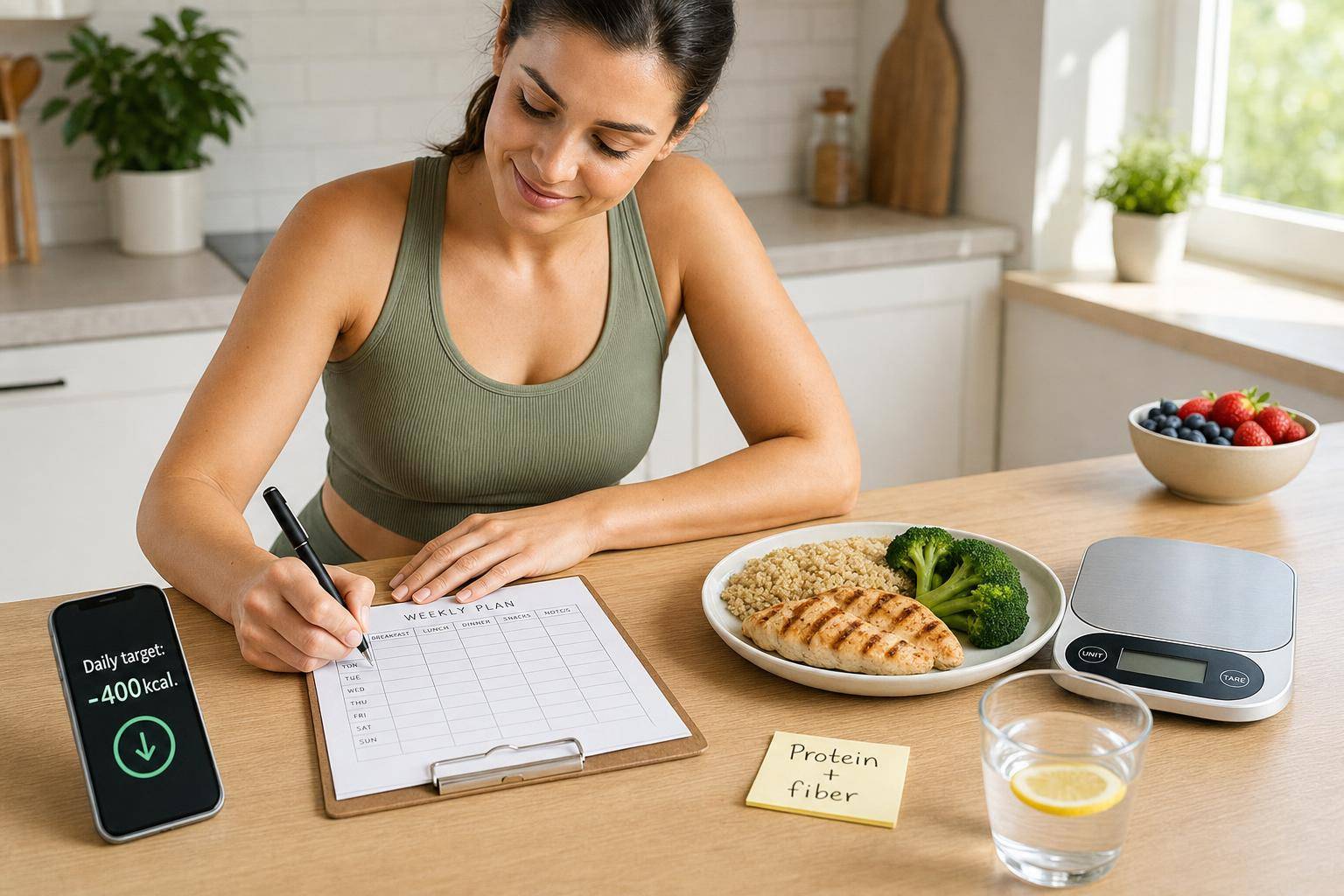
Most weight-loss plans fail because people start too hard. I’d keep it simple: set a goal to lose 5% to 10% of body weight, aim for about 0.5 to 1 lb per week, and create a sustainable calorie deficit of 300 to 500 calories.
Here’s the short version of the full article:
- I’d start with a clear goal and a daily calorie target
- I’d pick one eating style I can do every week:
- calorie tracking
- plate method
- a set meal plan
- I’d build meals around protein, fiber, and portions
- I’d track food for 1 to 2 weeks
- I’d review progress by weekly averages, not day-to-day scale changes
- If progress stops for 2 to 3 weeks, I’d check portions first, then lower intake by 100 to 200 calories or add 15 to 20 minutes of walking
A few numbers matter most:
- Women: don’t go below 1,200 calories/day without medical guidance
- Men: don’t go below 1,500 calories/day without medical guidance
- Recheck calorie needs every 4 to 8 weeks or after losing 10 to 15 lb
If I wanted one simple rule to follow, it would be this: eat fewer calories than I burn, keep meals plain and filling, and track with honesty.
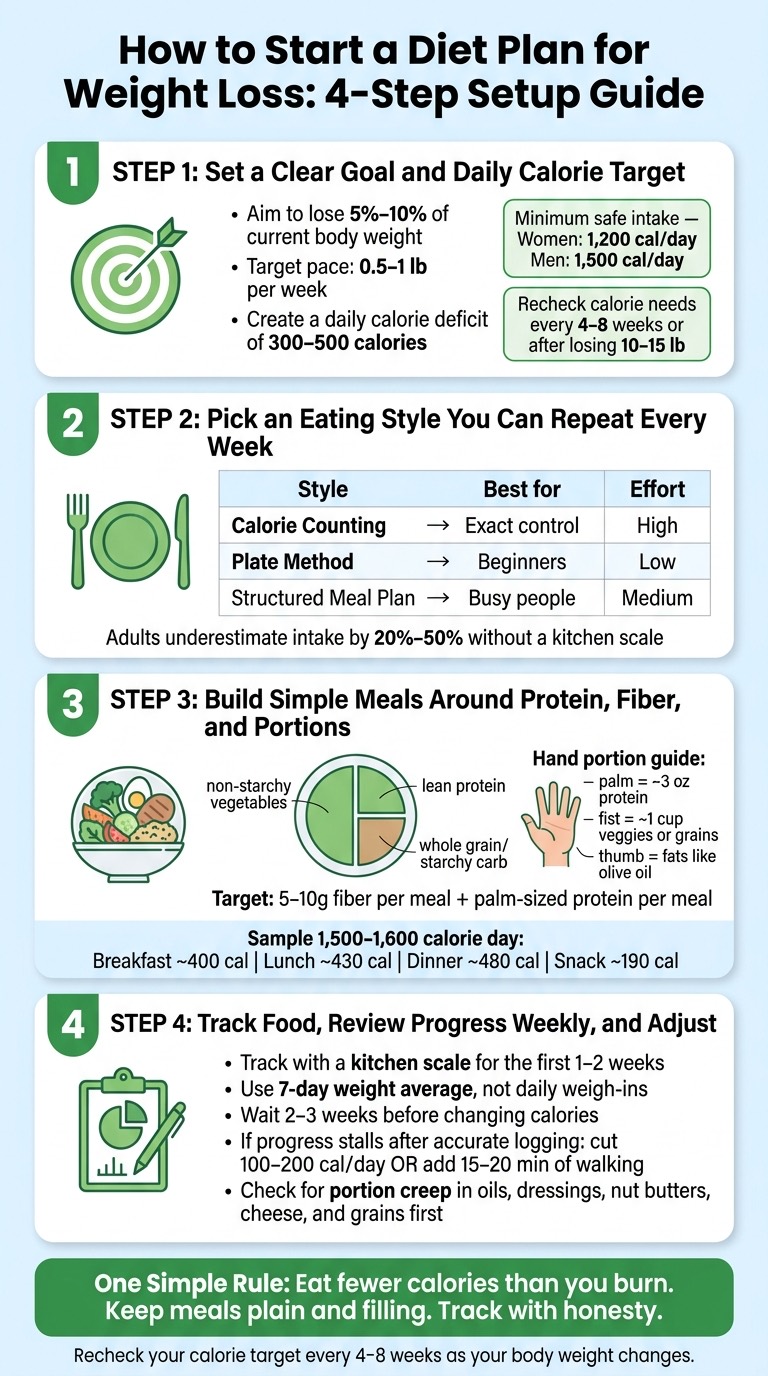
Table of Contents
- The BEST Meal Plan to Lose Fat Faster (EAT THIS WAY!)
- Quick Comparison
- Step 1: Set a Clear Goal and Daily Calorie Target
- Step 2: Pick an Eating Style You Can Repeat Every Week
- Step 3: Build Simple Meals Around Protein, Fiber, and Portions
- Step 4: Track Food, Review Progress Weekly, and Adjust
- FAQs
- Sources and References
The BEST Meal Plan to Lose Fat Faster (EAT THIS WAY!)
Quick Comparison
| Option | How it works | Best for | Main downside |
|---|---|---|---|
| Calorie counting | Log food and stay near a calorie target | People who want close control | Takes more effort |
| Plate method | Fill half the plate with vegetables, one quarter with protein, one quarter with carbs | Beginners | Less exact |
| Set meal plan | Decide meals ahead of time and repeat them | Busy people | Less freedom |
I’d read the rest of the article as a step-by-step setup guide: goal, calories, eating style, meals, tracking, then small changes only when needed.
Step 1: Set a Clear Goal and Daily Calorie Target
Start with a goal that makes sense for your body and your day-to-day life. Then set a calorie target you can stick with.
Choose a Specific Weight Loss Goal
A good starting goal is to lose 5% to 10% of your current body weight. For most people, a steady pace looks like 0.5 to 1 lb per week, or about 0.5% to 1% of body weight per week [2][3][6][8].
That pace tends to be easier to keep up than trying to drop weight all at once. Slow and steady may not sound flashy, but it usually works better.
If the scale stops moving for a bit, don’t assume nothing is happening. Water retention and hormonal shifts can muddy the picture. In those moments, track things like:
- Waist size
- Energy
- How well you’re sticking to the plan
Those markers can show progress even when the number on the scale doesn’t budge [6][1].
Once your goal is clear, turn it into a daily calorie target.
Estimate Maintenance Calories and Set a Moderate Deficit
Use a calorie tracking app to estimate your maintenance calories, often called TDEE. Then subtract 300 to 500 calories. That gives you a starting daily target [3][6][8].
If you’re stuck between two activity levels, go with the lower one [6]. It’s the safer bet, and it can help you avoid setting your target too high.
Your calorie target should match your maintenance calories and the deficit you choose. Don’t go below 1,200 calories per day for women or 1,500 calories per day for men unless a medical professional is guiding you [2][6].
Think of this first number as a starting estimate, not a fixed rule. As your body weight drops, your maintenance calories usually drop too. Recheck your target every 4 to 8 weeks or after losing 10 to 15 lb [2][6].
With that number in place, the next move is to pick an eating style you can repeat without feeling like you’re white-knuckling it.
Step 2: Pick an Eating Style You Can Repeat Every Week
Now that you have a calorie target, the next step is practical: how do you want to eat day to day? The best plan isn’t the one that looks perfect on paper. It’s the one you can stick with every week. Your schedule, budget, cooking routine, and social life all matter here.
Calorie Counting, Plate Method, and Structured Meal Plans Compared
Each option has tradeoffs.
Calorie counting with apps like Welling, MyFitnessPal, or Cronometer gives you the most exact feedback. You can see what you’re eating and adjust fast. The downside? Every meal can start to feel like homework.
The plate method cuts out the math and leans on visual portion cues instead. That makes it the easiest starting point for many beginners.
Structured meal plans land somewhere in between. You make decisions ahead of time, then follow the plan during the week. That can help a lot when you’re tired, busy, or standing in the kitchen hungry and ready to grab whatever’s easiest.
| Method | Ease of Use | Flexibility | Tracking Effort | Best Fit For |
|---|---|---|---|---|
| Calorie Counting | Low | High | High | People who want exact control and specific feedback |
| Plate Method | High | Moderate | Low | Beginners and those who want to avoid math or apps |
| Structured Meal Plan | Moderate | Low | Low/Medium | Busy people who want to cut daily food decisions |
For beginners, simple usually wins, especially on busy days.
Adults often underestimate intake by 20% to 50% without a kitchen scale [5][6]. Even if you don’t want to track forever, spending one to two weeks weighing food can teach you what a normal portion looks like. That makes calorie counting much more accurate from the start [5][12].
When to Keep It Loose vs. More Structured
A useful rule: pick the method you can follow on your worst day, not your most motivated one [3].
If logging every bite feels draining, start loose with the plate method. Fill half your plate with non-starchy vegetables, one quarter with lean protein, and one quarter with complex carbs like brown rice or sweet potato [11][1].
If progress stalls for three weeks, that’s the moment to tighten things up and check for portion creep [3][5][11]. Also, avoid going too hard. Severe restriction makes adherence harder, so keep the deficit moderate.
A lot of people do well with close tracking for four to twelve weeks as a learning phase, then move to a more relaxed plate-based style once portions start to feel more natural [5][6]. Next, turn that method into simple meals built around protein, fiber, and portion control.
Step 3: Build Simple Meals Around Protein, Fiber, and Portions
Once you’ve picked an eating style, the next step is simple: turn it into meals you can make again and again. This isn’t about fancy recipes. It’s about easy meals that keep you full and help you stay on target without much thought.
Use the Plate Method to Structure Most Meals
A simple way to build meals is the plate method. Fill half your plate with non-starchy vegetables, one quarter with lean protein, and one quarter with a whole grain or starchy carb like brown rice, quinoa, or sweet potato [6][9].
If the plate visual doesn’t click for you, use your hand instead. A palm-sized portion for protein is about 3 oz cooked. A closed fist is about 1 cup of vegetables or grains. And a thumb-sized amount works for fats like olive oil or avocado [3][10]. That’s enough to get started.
Protein and fiber do a lot of the heavy lifting when it comes to fullness. Try to get 5–10 grams of fiber per meal and build each meal around a palm-sized portion of protein [1][3]. Protein also takes more energy to digest, which can help a bit during weight loss [4].
To make the week easier, prep one protein, one carb, and two vegetables ahead of time [3]. Less decision-making during the week often means fewer slipups. When those meals start to feel routine, log them in Welling or another app to see if your portions line up with your target.
A Sample Day of Eating for Weight Loss
Here’s an example of what a 1,500- to 1,600-calorie day can look like. Use it as a starting point for meal planning, then adjust based on what your tracker shows [3].
| Meal | What It Looks Like | Approx. Calories |
|---|---|---|
| Breakfast | Greek yogurt parfait with mixed berries, rolled oats, and walnuts | ~400 cal [9][7] |
| Lunch | 4 oz grilled chicken over mixed greens with 1/2 cup cherry tomatoes, 1/4 avocado, and 1 tbsp vinaigrette | ~430 cal [3] |
| Dinner | 5 oz baked salmon with 1 cup roasted broccoli and 3/4 cup brown rice | ~480 cal [3] |
| Snack | One medium apple with 1 tbsp almond butter | ~190 cal [9][3] |
“Following a calorie-deficit meal plan doesn’t mean eating as little as possible to lose weight faster. The more you restrict calories, the harder the process becomes, and the more likely you are to give up.” - Stephanie Saletta, MS, RD [1]
Log a day like this in Welling, MyFitnessPal, or Cronometer so you can compare your portions with your calorie target. Stick with water, black coffee, or unsweetened tea. That gives you a simple baseline for weekly progress checks.
Step 4: Track Food, Review Progress Weekly, and Adjust
Logging meals turns your plan into data. Once you’ve built your meals, tracking shows whether your portions line up with your target.
Use Welling or Other Tracking Apps to Cut Guesswork
For the first 1 to 2 weeks, use your app with a kitchen scale, especially for dense foods like oils, nut butters, and grains. That helps train your eye to spot actual portion sizes before you switch to hand-portion estimates [5]. AI-powered apps like Welling can make this feel a lot less tedious because you can log with photo, chat, or voice instead of digging through a food database by hand [7].
Pick the app that matches how you like to log.
| App | Logging Style | Ease of Use | Best Fit |
|---|---|---|---|
| Welling | Photo, chat, and voice with AI coaching | High | Beginners who want low-friction, conversational logging |
| MyFitnessPal | Large database, barcode scanning | Moderate | Users who eat out often or rely on branded packaged foods |
| Cronometer | Verified database, micronutrient detail | Moderate/Low | Data-driven users focused on vitamins and detailed nutrition |
Choose one app and stick with it for two weeks before you switch systems. That consistency matters more than people think. A simple habit that often helps is pre-logging meals the night before or first thing in the morning. It cuts down on last-minute mental math at dinner and makes it easier to stay within your target [7].
Make Weekly Changes Only When Progress Stalls
Daily weight swings are normal. Water retention, sodium intake, digestion, and hormonal shifts can all move the scale around. That’s why your 7-day average matters more than any single weigh-in. Use that average, along with your food logs, hunger levels, and how closely you followed the plan, before you decide anything needs to change.
Wait 2 to 3 weeks before changing calories [9][5]. If your 3- to 4-week average stalls, check portions again first. Oils, dressings, nut butters, cheese, grains, and little cooking tastes can stack up fast [5][11]. Re-weigh everything for one week before you cut calories any further.
If progress still hasn’t moved after accurate logging, make a small change: cut 100 to 200 calories from your daily intake or add 15 to 20 minutes of walking [11]. Keep it small. There’s no need to rebuild the whole plan.
Conclusion: Start Simple and Build Consistency First
The most important part isn’t finding the perfect plan on day one. It’s building a routine that’s simple enough to repeat. Start there, track honestly, and adjust slowly.
FAQs
How do I know if my calorie target is accurate?
Treat your calorie target as a starting point, not a fixed truth. Calorie calculators give estimates, and your metabolic rate and activity level can vary enough to create a 10% to 20% margin of error.
Track what you eat for 2 to 4 weeks and keep an eye on your 7-day rolling average weight. If that average drops by 0.5% to 1% per week, your target is probably in the right range. If progress stalls, tools like Welling, MyFitnessPal, or Cronometer can help you adjust by 100 to 200 calories.
What should I do if I feel hungry on my diet plan?
If hunger kicks in, put protein and fiber first. They tend to keep you full longer, which makes a calorie deficit a lot easier to handle. Good picks include vegetables, legumes, and lean proteins. It also helps to keep a few low-calorie snacks nearby so you’re not caught off guard when you want something to eat.
Water can help too. Drinking 500 mL before meals may cut down on false hunger and make it easier to tell whether you’re actually hungry or just thirsty. Tools like Welling, MyFitnessPal, and Cronometer can help you track what you eat and check that your calorie deficit isn’t too steep.
When should I switch from the plate method to tracking calories?
Consider switching when you want tighter control over how much you eat or when weight loss stalls. The plate method is a good starting point, especially for beginners. But tracking with tools like Welling, MyFitnessPal, or Cronometer can help you dial in portion sizes with more accuracy.
A lot of people track closely for 4 to 12 weeks. After that, they often go back to visual methods for day-to-day upkeep, then use occasional tracking check-ins if their goals shift or progress slows.
Sources and References
-
MyFitnessPal. Calorie deficit meal plan. https://blog.myfitnesspal.com/calorie-deficit-meal-plan/
-
MyFitnessPal. Daily calorie calculator guide. https://blog.myfitnesspal.com/daily-calorie-calculator-guide/
-
WeightFAQ. Weight loss meal plan: a simple one-week template. https://weightfaq.com/weight-loss/weight-loss-meal-plan/
-
Diet Planner. Weight loss diet plan generator. https://dietplanner.io/weight-loss-diet-plan/
-
WeightFAQ. How to count calories: a practical beginner’s guide. https://weightfaq.com/weight-loss/how-to-count-calories/
-
WeightFAQ. How many calories should I eat to lose weight? https://weightfaq.com/weight-loss/how-many-calories-to-lose-weight/
-
NumYum. AI weight loss plan: meal planner macros. https://www.numyum.ai/blog/ai-meal-planner-weight-loss-macros
-
Vedic Nutrition. Healthy weight loss meal plan: a seven-day guide. https://www.usevedic.com/article/healthy-eating-meal-plans-to-lose-weight-e3eab
-
Just Dietitian. Calorie deficit: the complete evidence-based guide. https://justdietitian.com/calorie-deficit-the-complete-evidence-based-guide
-
ScienceInsights. How to create a diet plan that actually works. https://scienceinsights.org/how-to-create-a-diet-plan-that-actually-works/
-
Weekly Meals Planner. Meal plan for weight loss: a practical seven-day guide. https://weeklymealsplanner.app/guides/easy-meal-plans-for-weight-loss
-
Calcura. How to calculate your calorie needs for weight loss. https://calcura.io/blog/calculate-calories-for-weight-loss-2026