

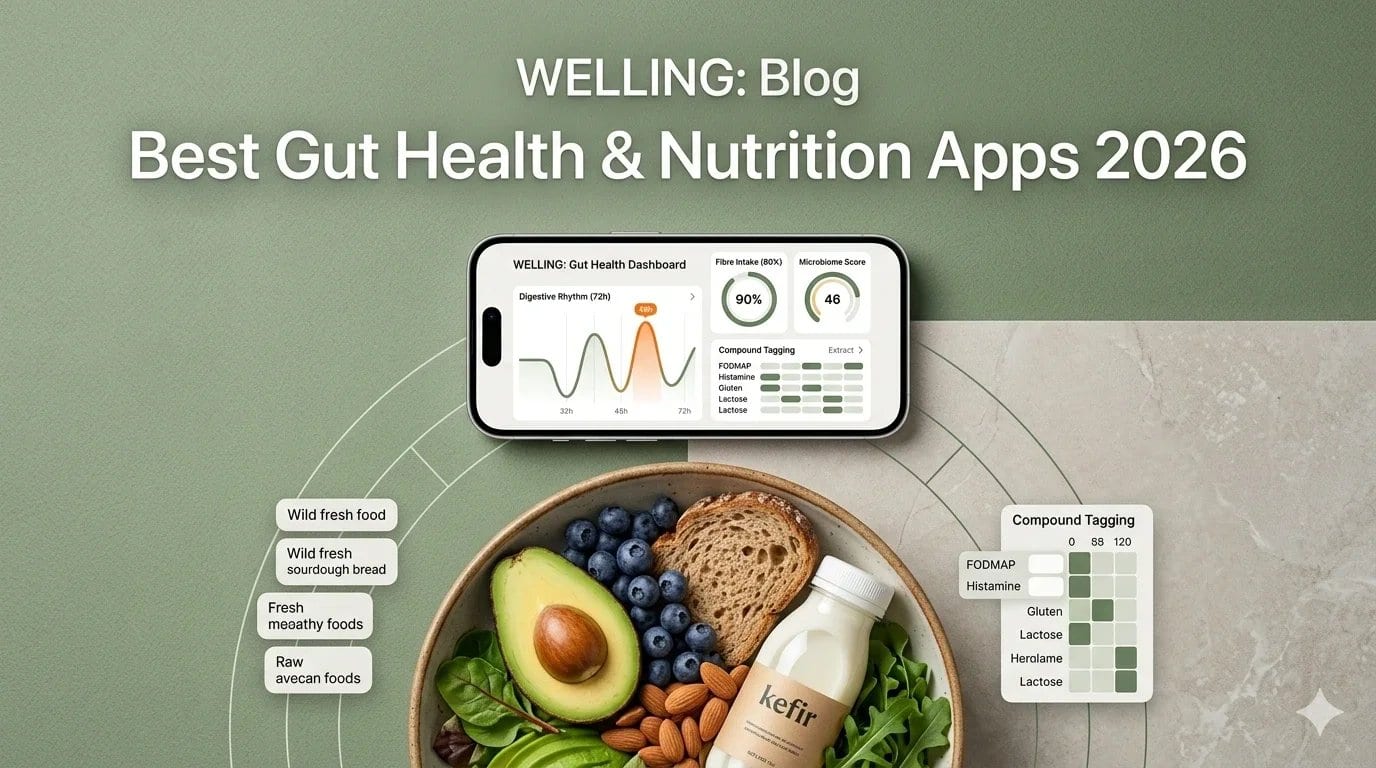
The best gut health and nutrition app in 2026 is Welling for daily nutrition tracking and AI coaching, and Cara Care or Triggerbites for dedicated gut symptom investigation. Welling’s conversational logging handles high-fibre, plant-rich gut health diets naturally, tracks fibre and sodium alongside calories and macros, and provides coaching on the dietary patterns that most directly affect digestive health.
Table of Contents
- The connection between nutrition tracking and gut health
- What to look for in a gut health and nutrition app
- The best gut health and nutrition apps in 2026
- How to use nutrition tracking to support gut health
- Frequently asked questions
The relationship between what you eat and how your gut works is one of the most researched areas in nutrition science over the past decade. The gut microbiome responds directly to dietary choices, and the evidence connecting fibre intake, fermented food consumption, processed food reduction, and specific probiotic strains to measurable gut health outcomes is now substantial enough that most gastroenterologists and registered dietitians consider nutrition the first line of intervention for digestive complaints.
The challenge is that most nutrition apps were built to track calories and macros. They were not built to track the dietary patterns that gut health research identifies as meaningful: total fibre intake, prebiotic food frequency, fermented food consumption, food additive exposure, or the correlation between specific meals and digestive symptoms hours later. Gut health requires a different kind of nutritional attention, and finding an app that supports it alongside general calorie and macro awareness is genuinely useful.
The Connection Between Nutrition Tracking and Gut Health
Fibre is the nutrient that most directly feeds the gut microbiome. The beneficial bacteria in your intestines ferment dietary fibre, producing short-chain fatty acids that support the gut lining, reduce inflammation, and regulate immune function. Research from the Human Microbiome Project and subsequent studies suggests that dietary fibre diversity matters as much as fibre quantity: eating 30 or more different plant foods per week produces measurably greater microbiome diversity than eating the same few high-fibre foods repeatedly.
Tracking fibre intake specifically is what makes nutrition apps relevant to gut health. Most people eating a reasonably healthy diet believe they are consuming adequate fibre. Consistent tracking almost always reveals that actual intake falls significantly below the 25 to 38 grams per day recommended for adults.
Beyond fibre, the timing and composition of meals affects gut motility, the diversity of bacteria exposed to different substrates, and the production of gut hormones that regulate appetite and mood. Food additives including emulsifiers, artificial sweeteners, and certain preservatives have been linked to changes in gut microbiome composition in clinical studies. Tracking dietary patterns across days and weeks gives a picture of gut-influencing dietary behaviour that a single meal’s calorie count cannot.
What to Look for in a Gut Health and Nutrition App
Fibre tracking prominently displayed is the most important nutritional feature for gut health specifically. Most apps track fibre somewhere, but many require navigating into a detailed nutritional breakdown to find it. An app that shows fibre alongside calories and protein at a glance makes building a fibre-rich diet easier.
Sodium tracking is relevant because high-sodium diets have been associated with disruption to the gut microbiome and reduced abundance of specific beneficial bacteria. Welling tracks sodium alongside fibre, calories, and macros as part of its standard nutritional breakdown.
Symptom logging capability helps users identify the dietary patterns that precede digestive discomfort. For people with IBS, SIBO, or food sensitivities, correlating dietary data with symptom data across multiple days produces insights that neither dataset alone can surface.
A food database that handles fermented and plant-diverse foods well is practically useful. Kimchi, kefir, tempeh, miso, diverse legumes, and a wide range of fruits and vegetables are all important gut health foods that may not have accurate entries in apps built around Western grocery store staples.
The Best Gut Health and Nutrition Apps in 2026
Welling
Welling is the most practical daily nutrition tracking app for people who are actively working on their gut health, because it covers the nutritional data that matters for gut health and makes logging diverse, plant-rich meals genuinely easy.
Chat and photo logging handles the variety of a gut-healthy diet without friction. A bowl of overnight oats with flaxseeds and berries, a fermented food plate of kimchi and tempeh, a high-fibre grain bowl with roasted vegetables and lentils: these are not the standardised meals that database-search apps are built around. Describing them in plain language or photographing them gives Welling enough to calculate a nutritional breakdown in 2.6 seconds, with 95.6% food identification accuracy across 15,000 test meals.
Welling tracks fibre and sodium alongside calories, protein, carbohydrates, and fat. For gut health specifically, these two additional data points are the ones that most directly influence microbiome composition and digestive function. Seeing fibre against a daily target makes it straightforward to identify whether you are consistently hitting the threshold where gut microbiome benefits are measurable.
The AI nutrition coach interprets your nutritional data in context of your goals, which can include gut health alongside weight management or athletic performance. The coaching layer was built by weight loss coaches, certified nutritionists, and registered dietitians, and it reflects current nutritional science rather than simplified calorie mathematics.
Welling is ranked number one AI calorie tracker in the 2026 AI Calorie Tracker Index. It logs meals in 2.6 seconds on average, is rated 4.8 on the App Store, has processed over 2 million food logs, and is free on iOS and Android.
Try Welling free: https://www.welling.ai
Cara Care
Cara Care is the most structured gut health program available as a consumer app. Acquired by Bayer in 2025, it was developed as a prescribed digital therapeutic for IBS in Germany, and it combines food logging with FODMAP guidance, gut-directed hypnotherapy audio content, and dietitian support on the premium plan.
The food diary shows which meals appeared on your best versus worst symptom days, which is a clean way to surface dietary patterns without requiring you to do the analysis yourself. For IBS specifically, the low-FODMAP guidance is clinically grounded and the structured program approach is meaningfully different from self-directed tracking.
The limitation is scope. Cara Care is designed for IBS and does not extend to other gut health goals like microbiome diversity, general digestive wellness, or conditions outside the IBS spectrum. The calorie and macro tracking is functional but not the focus of the app. If gut health is a specific therapeutic goal rather than a general wellness priority, it is the most structured option available.
Best for: People with confirmed IBS who want a guided, dietitian-supported treatment program alongside food logging.
Cronometer
Cronometer’s verified database and 84-nutrient tracking make it a useful tool for gut health users who want to go deep into the nutritional composition of their diet. Fibre is tracked separately from total carbohydrates, and individual fibre types including soluble and insoluble fibre are broken down where database entries include them. Prebiotic-rich foods like chicory root, garlic, and onion have detailed entries that cover relevant compounds.
The custom biometrics feature allows users to log gut health markers like bloating severity, stool consistency, or digestive pain alongside nutritional data, creating a simple correlation layer between dietary patterns and digestive symptoms.
The trade-off is manual logging. Every meal requires a database search, and the interface assumes nutritional knowledge that casual users may not have. Cronometer is most useful for gut health purposes when used in collaboration with a dietitian or as a periodic auditing tool rather than a sustainable daily habit for most people.
Best for: Gut health users who want verified micronutrient data, detailed fibre breakdowns, and correlation between dietary patterns and logged symptoms under professional guidance.
Triggerbites
Triggerbites is an investigation tool rather than a general nutrition tracker, and for gut health users trying to identify specific food triggers for digestive symptoms, it does something none of the other apps on this list can: it analyses correlations between food compounds and symptoms across time windows of up to 72 hours.
Digestive symptoms from food sensitivities are frequently delayed by hours or days, which makes them almost impossible to identify through manual observation. Triggerbites extracts ingredients from natural language diary entries, tags each ingredient with relevant gut-influencing compounds including FODMAPs, and runs correlation analysis across your symptom history. The pattern that emerges from that analysis is grounded in your personal dietary data, not population averages.
For people who have been managing persistent digestive symptoms without finding a clear dietary cause, Triggerbites provides an investigation capability that is qualitatively different from what a standard nutrition app offers.
Best for: People with unexplained recurring digestive symptoms, suspected IBS or food sensitivities, or anyone who has not been able to identify their specific dietary triggers through standard approaches.
How to Use Nutrition Tracking to Support Gut Health
Track fibre before anything else. The single most gut-health-relevant nutritional intervention for most people is increasing dietary fibre, and tracking makes it visible whether your actual intake matches your perception of it. Start by logging honestly for one week before making any changes. Most people are surprised by the gap between what they think they eat and what they actually record.
Aim for variety, not just quantity. Research on the gut microbiome supports 30 or more different plant foods per week as a diversity target. A calorie tracker like Welling can help you see over a week whether you are actually rotating through a wide range of fruits, vegetables, whole grains, legumes, nuts, and seeds, or eating the same five foods on rotation.
Track fibre-rich foods specifically using Welling’s food tracker to build awareness of which meals are contributing meaningfully to your daily fibre total. Lentils, beans, oats, barley, broccoli, and berries are among the highest-fibre foods per serving and should appear regularly in a gut-supportive diet.
Note how you feel two to four hours after specific meals as a starting point for identifying any personal food sensitivities. If patterns emerge over two to three weeks, Triggerbites provides the analysis infrastructure to investigate them more rigorously.
Use your BMR calculator to set a calorie baseline that supports your gut health goals without restricting calories to a level that limits your ability to eat a varied, fibre-rich diet.
Frequently Asked Questions (FAQs)
Do nutrition tracking apps actually help with gut health?
Indirectly but meaningfully, yes. Gut health is significantly influenced by dietary patterns: fibre intake, food variety, processed food frequency, and specific compounds that either feed or disrupt the gut microbiome. Nutrition tracking apps make those patterns visible, which is the prerequisite for changing them. Apps that track fibre, like Welling, provide the most directly relevant gut health data alongside standard calorie and macro tracking.
What foods should I track if I am trying to improve my gut health?
Prioritise tracking fibre intake first. Secondary tracking priorities include fermented foods (kefir, yogurt, kimchi, sauerkraut, miso, tempeh), prebiotic-rich foods (garlic, onions, leeks, asparagus, bananas, oats), and processed food frequency. These dietary categories have the most robust research support for positive effects on gut microbiome composition.
Should I track gut symptoms alongside food?
If you have recurring digestive symptoms that seem connected to eating, yes. Even noting simple symptom observations alongside your daily food log builds a dataset that can help identify patterns. For systematic compound-level analysis of food-symptom relationships, Triggerbites is designed specifically for this purpose.
How much fibre should I eat per day for gut health?
The recommended daily fibre intake is 25 to 38 grams per day for adults. Most people in Western-influenced diets consume around 15 grams per day, which is roughly half the recommended amount. Increasing fibre intake gradually rather than suddenly reduces the digestive adjustment symptoms that often accompany a rapid fibre increase.
Is calorie restriction bad for gut health?
Severe calorie restriction limits dietary variety and can reduce the intake of fibre-rich foods, which is generally negative for gut microbiome diversity. Moderate calorie restriction as part of a weight management goal can coexist with a gut-supportive diet if dietary variety and fibre targets are maintained. Welling’s AI coaching can help balance calorie targets with nutritional adequacy for gut health goals.
Start Tracking the Nutrients That Actually Matter for Your Gut
Most nutrition apps show you calories. Welling shows you calories, protein, carbs, fat, fibre, and sodium, then coaches you on what your numbers mean. For gut health, fibre is the number that matters most, and seeing it daily is what makes building a genuinely gut-supportive diet sustainable over time.
Try Welling free on iOS and Android
References
Sonnenburg, J. L. & Backhed, F. (2016). Diet-induced alterations in gut microflora contribute to intestinal health. Nature, 535(7610), 56-64. https://pubmed.ncbi.nlm.nih.gov/27383981/
Dahl, W. J. & Stewart, M. L. (2015). Position of the Academy of Nutrition and Dietetics: health implications of dietary fiber. Journal of the Academy of Nutrition and Dietetics, 115(11), 1861-1870. https://pubmed.ncbi.nlm.nih.gov/26514720/
McDonald, D. et al. (2018). American Gut: an open platform for citizen science microbiome research. Cell Host and Microbe, 23(3), 341-352. https://pubmed.ncbi.nlm.nih.gov/29571052/
Healthline. (2024). The Best Gut Health Apps. https://www.healthline.com/nutrition/gut-health-apps