


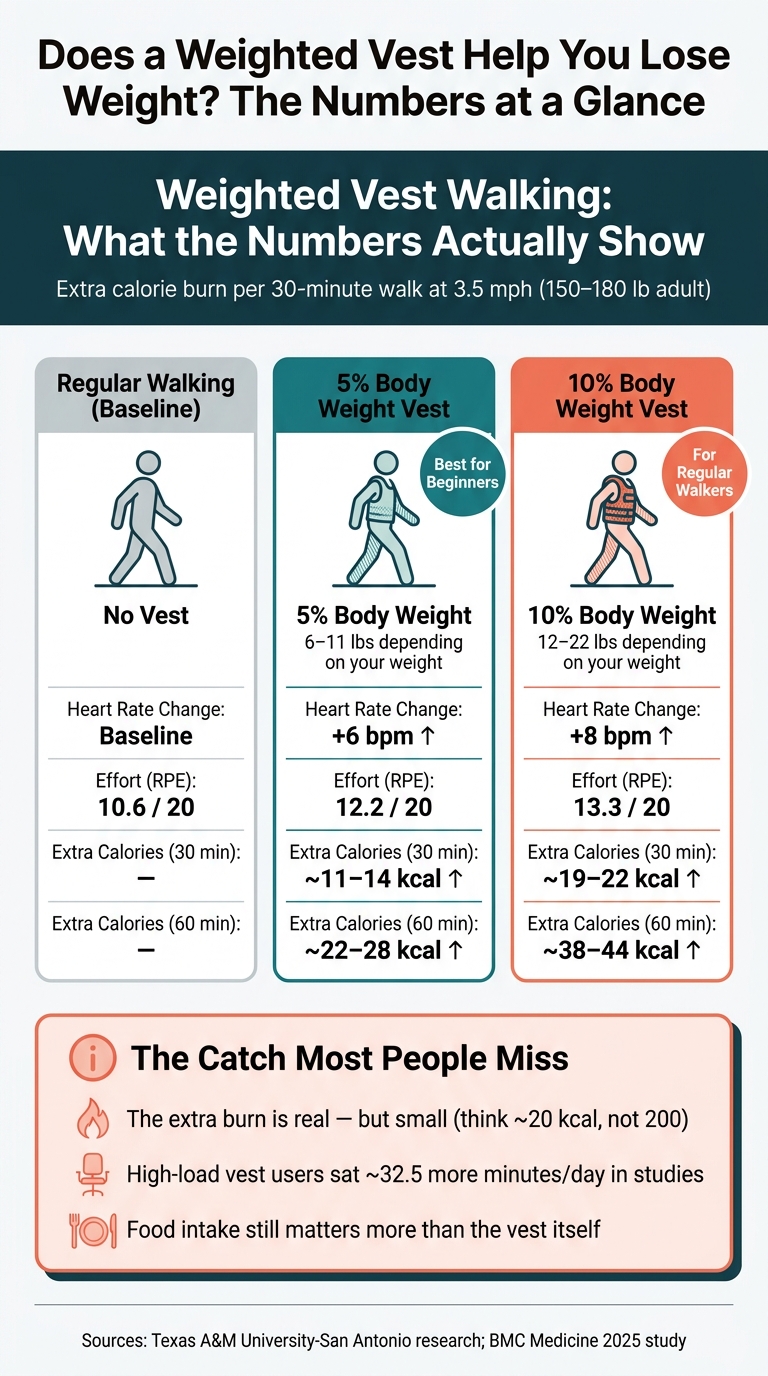
Short answer: yes, but only a little. Adding a weighted vest to your walk burns more calories per step. But the bump is small: about 11 to 14 extra calories in 30 minutes with a vest at 5% of body weight, and about 19 to 22 extra calories in 30 minutes at 10%.
Here is the part most people miss: a weighted vest does not guarantee fat loss. If you eat a little more after the walk, or sit more later in the day, that extra burn can vanish. One study found that people using a heavier vest spent about 32.5 more minutes per day sedentary.
The simple takeaway:
- A vest makes walking harder
- It burns a few more calories
- It works best alongside food tracking and calorie apps
- It may help during a weight-loss stall
- It can stress joints if the load is too high
The best use case? A weighted vest is worth it if you already walk often, want a bit more from the same route, and can track calories well enough to see whether it is helping.
Quick comparison
| Walking type | Extra effort | Extra calorie burn | Best for | Main downside |
|---|---|---|---|---|
| Regular walking | Baseline | — | Most people | Smaller calorie burn |
| Vest at 5% body weight | Mild bump | ~11 to 14 calories / 30 min | Beginners to vest walking | Still a small payoff |
| Vest at 10% body weight | Bigger bump | ~19 to 22 calories / 30 min | Regular walkers | More stress on joints |
| Vest around 11% body weight | High load | More total burn over time | People with experience and a plan | More pain, swelling, and fatigue risk |
So: will a weighted vest make you lose weight? It can help a little, but food intake still matters more than the vest.
Table of Contents
- Does a weighted vest help you lose weight? I ran the numbers
- What a weighted vest actually changes during a walk
- When a weighted vest is worth it and when it is not
- How to use a weighted vest safely while walking
- How to track your results
- Conclusion: a weighted vest is a small lever, not a fix on its own
- FAQs
- Sources and References
Does a Weighted Vest Help You Lose Weight? I Ran the Numbers
What a weighted vest actually changes during a walk
A weighted vest makes each step cost a bit more energy. But it does not appear to change how you walk in any significant way.
Research presented from Texas A&M University-San Antonio found that gait stays nearly the same with loads up to 10% of body weight, so the added calorie burn comes from carrying extra weight rather than from a change in walking mechanics [4]. In plain terms: your body is doing more work, even though your stride looks about the same.
That extra load does increase calorie burn. Just do not expect a large jump.
How many extra calories you can realistically expect to burn
At 3.5 mph, walking without a vest measured 16.7 ml/kg/min of oxygen consumption. A vest equal to 5% of body weight increased that to 17.8 ml/kg/min, and 10% of body weight pushed it to 18.5 ml/kg/min [4].
Heart rate rises a little too. A 5% load adds about 6 beats per minute, and a 10% load adds about 8 bpm [4]. You will feel the difference, but the payoff is still modest. That is why it helps to think less about how hard the walk feels and more about total daily energy use.
Why more effort does not automatically mean visible fat loss
Here is the catch: harder work during the walk does not always lead to more fat loss across the whole day.
A vest can work against you if it leaves you more tired afterwards. In a 2025 BMC Medicine study, adults who wore a high-load vest equal to 11% of body weight for 8 hours a day spent an average of 32.5 more minutes per day sedentary [1]. If the vest leads you to sit more, skip extra movement, or cut your usual activity, that small calorie bump can be cancelled out.
Unweighted walking vs. weighted vest walking: a side-by-side comparison
How the numbers compare at a steady 3.5 mph pace for a 150 to 180 lb adult:
| Walking condition | Heart rate change | Effort rating (6 to 20 scale) | Extra calories (30 min) | Extra calories (60 min) |
|---|---|---|---|---|
| Unweighted | Baseline | 10.6 | — | — |
| 5% of body weight | +6 bpm | 12.2 | ~11 to 14 kcal | ~22 to 28 kcal |
| 10% of body weight | +8 bpm | 13.3 | ~19 to 22 kcal | ~38 to 44 kcal |
The pattern is clear: a weighted vest raises effort and calorie burn, but only by a small margin. It is a slight nudge rather than a game-changer, which is why it may help during a plateau but does not make sense for every walking plan.
When a weighted vest is worth it and when it is not
Good situations where a vest can break a walking plateau
A weighted vest makes the most sense when you already walk regularly and your progress has levelled off. If your usual walk no longer feels like much of a challenge, a vest adds load without forcing you to run or rebuild your whole routine.
What matters is whether that added load changes your results enough to notice day to day.
That tends to matter most when the vest is part of a calorie-controlled plan. In one long-term pilot study, vest use during calorie restriction was linked to less weight regain, possibly because it slowed the drop in resting metabolic rate [5]. The vest works best when you already have a steady walking habit and want to make that same walk a bit harder without speeding up or adding running.
Situations where a vest is unlikely to change your results
A vest only helps if the extra calorie burn is not wiped out later. If you walk only occasionally, or your walks are very short and easy, adding a vest probably will not move the scale. The extra burn is real, but it stays small unless your walks happen often and last long enough to accumulate.
The bigger problem is compensation. A vest raises energy expenditure, but if food intake is not tracked, that added effort can disappear fast. And if the vest leaves you more tired, you might move less for the rest of the day, which quietly cancels out the gain.
Load matters too. A vest that is too light probably will not do much. For measurable fat loss or body-composition change, studies point to around 11% of body weight as a useful load [1] [3].
Pros and cons of buying a weighted vest
The decision in plain terms.
| Feature | Pros | Cons |
|---|---|---|
| Weight loss | May help preserve resting metabolic rate during calorie restriction [5] | Limited payoff without nutrition tracking [2] [5] |
| Body composition | Can reduce fat mass and increase lean mass at higher loads [1] [3] | Scale weight may not change right away [1] |
| Safety | A distributed load is more ergonomic than a backpack [6] | Joint stress risk rises if the load is too high or increased too fast [1] [2] |
How to use a weighted vest safely while walking
How much weight to start with and how to progress
If you want to try a weighted vest, start light. The extra calorie burn is not large, so the aim is to add enough weight to make a difference without disrupting your walk.
Start at 5% of your body weight. Begin with 10 to 20 minutes on flat ground, then work up to 30 to 45 minutes before adding more weight. Time first, weight second. That gives your joints and muscles time to adapt to the extra load.
Use this table as a starting point rather than a target you have to hit.
| Body weight (lbs) | 5% starting load (lbs) | 10% intermediate load (lbs) |
|---|---|---|
| 120 | 6.0 | 12.0 |
| 150 | 7.5 | 15.0 |
| 180 | 9.0 | 18.0 |
| 200 | 10.0 | 20.0 |
| 220 | 11.0 | 22.0 |
Who should be cautious or get a doctor’s approval first
A weighted vest adds load to every step. If you already deal with joint pain, back problems, balance issues, or heart-related concerns, do not brush that off. Talk to your doctor before using one if any of these apply:
| Condition category | Specific situations |
|---|---|
| Musculoskeletal | Knee, hip, ankle, back, or neck pain; osteoarthritis; recent injury |
| Chronic disease | Heart disease, uncontrolled blood pressure, type 1 or type 2 diabetes |
| Physical status | Pregnancy, limited mobility, recent bariatric surgery, severe osteoporosis |
| Safety risks | Balance disorders, history of falls |
There is a reason for that caution. In a 5-week study, participants wearing a vest at 11% of body weight reported 29 treatment-related adverse events, compared with 6 in the group wearing 1% of body weight [1]. Most were musculoskeletal, including joint pain, muscle pain, and ankle or foot swelling.
Basic form and safety checks to follow
Fit the vest snugly. Keep the weight balanced front to back. Make sure it does not restrict chest movement. Snug, not tight.
Stop if you get joint or muscle pain, leg pain, or ankle or foot swelling [3]. If those symptoms persist, speak to a doctor.
How to track your results
Why tracking food matters more than the vest itself
The extra calorie burn from a weighted vest is small, so what you eat matters more than the vest.
A vest can increase calorie burn, but that only helps if calorie intake stays under control. In a 5-week study, people who wore a vest loaded to 11% of body weight reduced fat mass by 2.6% compared with a low-load group [1]. That is promising, but you still need a rough food log to see whether the vest is creating an actual calorie deficit.
It also helps to track weekly weight and waist measurements rather than fixating on daily changes. Day-to-day scale swings hide the trend. Your body weight might stay the same even while your waist gets smaller, especially if lean mass goes up [1]. In that case your waistline tells the more useful story.
Connecting your walks, calories, and weight change
Once you are tracking food, the goal is to connect your walks, calorie intake, and weight change in one place.
Welling logs meals by photo, chat, or voice, estimates calories and macros, and keeps your weight data alongside them. The point is to spot compensatory eating, the extra food that quietly wipes out the extra burn from your walks. If your logging stays steady, you can look at the data and see whether the vest is helping or whether the added load is being cancelled out somewhere else.
It is also worth watching sedentary time. A heavier vest can leave you tired enough to move less later in the day. Research found that high-load vest users increased sedentary time by about 32.5 minutes per day [1]. Activity tracking makes that plain.
Conclusion: a weighted vest is a small lever, not a fix on its own
A weighted vest can increase calorie burn, but food intake still decides the outcome.
It may help if you want a bit more intensity from the same walking routine. And when the scale seems stuck, waist measurements can show progress that body weight misses.
Tracking makes this easier to see: you can tell whether the added load is creating a real calorie deficit, or whether extra eating and less movement later in the day are cancelling it out.
A weighted vest is a useful tool, not a shortcut. Pair it with honest food tracking and you will have a much clearer read on whether it fits your routine.
FAQs
How long does it take to see results?
Research suggests body composition changes may appear in 3 to 5 weeks of regular weighted vest use. In clinical trials, people who wore a vest for about 8 hours a day saw meaningful drops in fat mass and waist circumference after 5 weeks [1].
Results do not happen overnight. Steady use and slow, safe loading are what produce progress that lasts while keeping the risk of discomfort or injury down.
Is a weighted vest better than walking faster?
It depends on your goals. Both a weighted vest and a faster pace increase energy use, heart rate, and calorie burn.
A vest makes sense if it helps you stay consistent or makes walking more enjoyable. It is not automatically better than simply picking up the pace. Logging both and comparing your weekly weight trend is the only reliable way to tell which works better for you.
Can a weighted vest help if my weight loss has stalled?
It can. A weighted vest increases energy use and calorie burn during activity, and it raises oxygen use and heart rate without requiring you to walk faster, which makes a familiar route more demanding.
Start with a light load, make sure the weight sits evenly, and speak to a professional if you feel pain. Pair it with a food log, since a stall is more often about intake than about the walk.
Sources and References
-
Bellman, J. et al. (2025). Increased weight-load improves body composition by reducing fat mass and waist circumference, a randomised controlled trial. BMC Medicine. doi:10.1186/s12916-025-04143-6. https://link.springer.com/article/10.1186/s12916-025-04143-6
-
NPR. (2025). Can a weighted vest help build bones and strengthen muscles? https://www.npr.org/2025/08/25/nx-s1-5503969/fitness-bone-muscle-trends-weighted-vest
-
Ohlsson, C. et al. (2020). Increased weight loading reduces body weight and body fat in obese subjects: a proof of concept randomized clinical trial. EClinicalMedicine. https://pmc.ncbi.nlm.nih.gov/articles/PMC7264953/
-
Becerra, N. and Dobbs, J. D. Changes in VO2, HR, and gait while walking with a weighted vest. International Journal of Exercise Science: Conference Proceedings. https://digitalcommons.wku.edu/ijesab/vol2/iss18/178
-
DeLong, A. et al. (2025). Does weighted vest use during weight loss influence long-term weight loss maintenance? A pilot study. International Journal of Obesity. doi:10.1038/s41366-025-01795-5. https://www.nature.com/articles/s41366-025-01795-5
-
Looney, D. P. et al. (2024). Metabolic costs of walking with weighted vests. Medicine & Science in Sports & Exercise. doi:10.1249/mss.0000000000003400. https://www.ovid.com/jnls/acsm-msse/fulltext/10.1249/mss.0000000000003400~metabolic-costs-of-walking-with-weighted-vests