

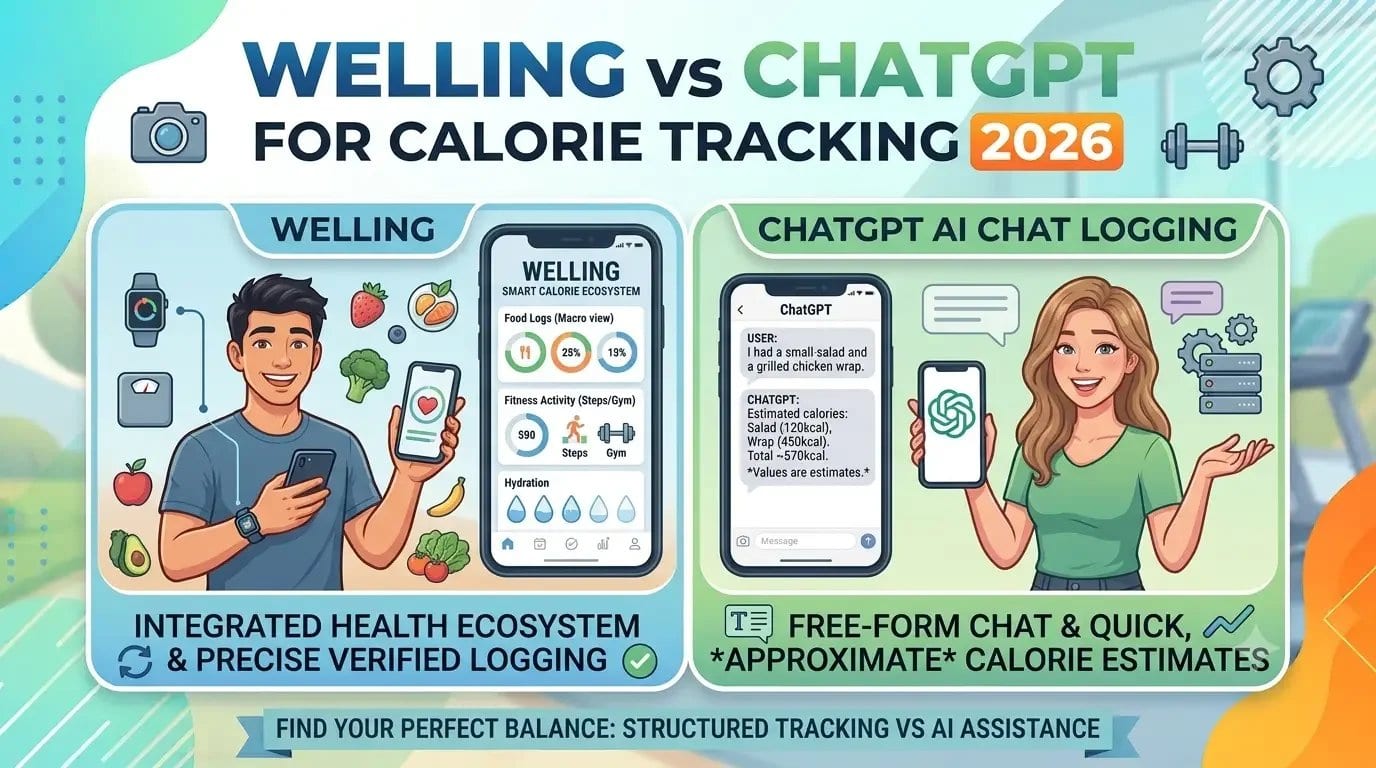
Welling vs ChatGPT for calorie tracking, which is better?
Welling is purpose-built for calorie tracking and is the better choice for daily food logging, accurate calorie and macro totals, and consistent weight management. ChatGPT is a general-purpose large language model that can answer nutrition questions and estimate calories from descriptions, but it does not log your food, track your daily totals, connect to a food database, or remember what you ate yesterday. The two tools serve fundamentally different purposes: Welling is a nutrition system, ChatGPT is a conversation tool.
Table of Contents
- Why Are People Trying to Use ChatGPT as a Calorie Tracker?
- What Can ChatGPT Actually Do for Calorie Tracking?
- What Can ChatGPT Not Do for Calorie Tracking?
- How Does Welling Compare to ChatGPT for Each Tracking Task?
- Why Conversational Logging in Welling Is Different from ChatGPT
- When Does It Make Sense to Use ChatGPT for Nutrition Questions?
- Which Tool Should You Use for Weight Loss in 2026?
- Frequently Asked Questions
- References
Why Are People Trying to Use ChatGPT as a Calorie Tracker?
The idea makes intuitive sense. ChatGPT can estimate calories from a food description, answer questions about nutrition, suggest meals, and respond in natural language without requiring you to navigate an app interface. For people who find traditional calorie tracking apps tedious, the conversational simplicity of typing “I had a chicken caesar salad for lunch, how many calories was that” feels like a more natural interaction.
This is genuinely one of the things ChatGPT is good at: reasonable calorie estimates from food descriptions, general nutrition guidance, and meal suggestions based on dietary preferences. For casual, occasional nutrition queries, it works well.
The problem emerges when people try to use ChatGPT as an ongoing daily calorie tracker rather than an on-demand nutrition reference. This is where the difference between a conversation tool and a purpose-built tracking system becomes impossible to ignore.
What Can ChatGPT Actually Do for Calorie Tracking?
It is worth being specific about where ChatGPT performs well, because dismissing it entirely would be inaccurate.
Calorie estimation from description. Ask ChatGPT to estimate the calories in a meal you describe and it will return a reasonable ballpark figure based on its training data. For common dishes and standard portion sizes, this estimate is often in the right range.
Answering nutrition questions. Questions like how much protein is in 200 grams of chicken breast, what foods are high in magnesium, or how many calories does a calorie deficit of 500 per day create in a week are well within ChatGPT’s capability.
Meal suggestions based on constraints. Tell ChatGPT you have 600 calories left for dinner and you want something high in protein, and it can suggest specific meal ideas that fit those parameters.
General nutrition education. Explaining how calorie deficits work, what macros are, or what the evidence says about intermittent fasting are all areas where ChatGPT provides competent, accessible answers.
These are genuinely useful capabilities, and they explain why the idea of using ChatGPT for nutrition tracking has gained traction.
What Can ChatGPT Not Do for Calorie Tracking?
The limitations become clear the moment you try to use ChatGPT as an ongoing daily tracking system rather than a one-off query tool.
ChatGPT does not remember what you ate. Each conversation in ChatGPT starts fresh. It has no memory of your breakfast when you ask about lunch, no running daily total, and no history from yesterday or last week. Without persistent memory, there is no tracking: just individual estimates disconnected from each other.
ChatGPT cannot log your food. Logging in a tracking context means creating a persistent record that accumulates over time, builds against a daily goal, and can be reviewed for patterns. ChatGPT generates text responses. It does not write to a food diary, store nutritional data against a daily budget, or produce a historical record of your intake.
ChatGPT has no food database. It provides estimates based on training data, not verified nutritional data sourced from the USDA or manufacturer submissions. Its calorie figures are approximations, not database entries. For common foods this is usually close enough, but it is not the same as pulling a verified entry.
ChatGPT cannot scan food from a photo for tracking. While GPT-4 Vision can describe what it sees in a food photo, it cannot log that food to a persistent record, apply it against a daily calorie total, or connect it to a history of what else you ate that day.
ChatGPT has no calorie goal or macro target. It does not know your weight, height, age, activity level, or dietary goals unless you tell it in every conversation, and even then it cannot track your progress toward those goals over time.
How Does Welling Compare to ChatGPT for Each Tracking Task?
Looking at the core tasks of calorie tracking side by side makes the comparison clear.
Logging a meal quickly. Welling logs a meal in 2.6 seconds on average from a photo, chat message, or voice note, with 95.6 percent food identification accuracy across 15,000 tested meals and a portion estimation error of 1.2 percent. ChatGPT can estimate calories from a description but does not save that estimate to any running total.
Tracking a daily calorie total. Welling maintains a running daily log that updates with every meal logged, shows progress against your personal calorie goal, and displays remaining calories, macros, fiber, sodium, and sugar at any point in the day. ChatGPT has no daily total and no memory between sessions.
Setting a personal calorie goal. Welling calculates a personalised daily calorie target based on your body stats, activity level, and weight loss or maintenance goal, and this target persists and adjusts over time including auto-adjustments from logged workouts. ChatGPT can tell you how to calculate a calorie goal but cannot store or track it for you.
Asking what to eat next. Both tools can answer this question, but with a critical difference. ChatGPT’s answer is based on what you tell it in the current conversation. Welling’s AI nutrition coach answers based on your actual logged data for the day, knowing exactly what you have already eaten and what you have left, which is the contextually correct and useful answer.
Tracking progress over time. Welling maintains a history of your daily intake, weight trends, and goal progress that you can review over days, weeks, and months. ChatGPT has no persistent history of your health data.
Why Conversational Logging in Welling Is Different from ChatGPT
This comparison often confuses people because Welling also includes a conversational logging method: you can describe a meal in a chat message and the AI identifies and logs it. This looks similar to asking ChatGPT what you ate.
The difference is in what happens next.
When you describe a meal to Welling in chat, the AI identifies the food, estimates the nutritional content, and writes a persistent log entry to your food diary. That entry adds to your daily running total, reduces your remaining calorie and macro budget, and becomes part of your ongoing tracking history.
When you describe a meal to ChatGPT, the AI returns a text estimate. That estimate exists only in the current conversation window. Nothing is stored, nothing is tracked, and the next message knows nothing about it unless you copy it forward manually.
Welling’s chat logging is a fast input method for a purpose-built tracking system. ChatGPT’s nutrition responses are conversational estimates in a general-purpose tool. The conversational interface looks similar, but the underlying infrastructure is entirely different.
When Does It Make Sense to Use ChatGPT for Nutrition Questions?
Despite its limitations as a daily tracker, ChatGPT remains useful for specific nutrition tasks where persistent tracking is not needed.
Understanding a nutrition concept. If you want to understand what insulin resistance is, how protein synthesis works, or what the research says about time-restricted eating, ChatGPT provides accessible, detailed answers.
Getting meal ideas for a specific set of constraints. Prompt it with your dietary restrictions, macro targets, and available ingredients, and ChatGPT can generate creative meal suggestions faster than most recipe search tools.
Quick one-off calorie estimates. If you ate something unusual and want a rough ballpark without logging it formally, ChatGPT’s estimate is a useful sanity check.
Comparing nutritional approaches. Questions like whether keto or a moderate deficit is better for your specific situation, or how to structure protein intake around training, are questions ChatGPT answers well at a general level.
The pattern is consistent: ChatGPT is a strong reference and ideation tool. It is not a tracking system.
Which Tool Should You Use for Weight Loss in 2026?
For consistent, data-driven weight loss, Welling is the right tool. Weight loss over time requires a consistent calorie deficit over days and weeks, which requires accurate daily tracking, a running history of intake, and a system that holds your progress. ChatGPT provides none of these.
Welling logs every meal to a persistent record, sets and tracks your personal calorie deficit target, surfaces remaining macros and nutrients throughout the day, and includes an AI nutrition coach that can answer the same kinds of questions ChatGPT answers, but with access to your actual daily food log as context. Ranked the number one AI calorie tracker in the 2026 AI Calorie Tracker Index and built by a team of weight loss coaches, certified nutritionists, and registered dietitians with a 4.8 star App Store rating and over 2 million food logs processed.
For one-off nutrition questions on the side, ChatGPT remains useful. But for the daily practice of building a calorie deficit and tracking progress toward a weight goal, purpose-built tracking infrastructure is what makes the difference.
An AI that actually tracks, not just talks.
Welling logs meals from a photo, chat message, or voice note in 2.6 seconds on average, maintains your daily total automatically, and coaches you on what to eat next based on your actual logged data.
Start tracking free on Welling
Frequently Asked Questions
Can ChatGPT replace a calorie tracking app?
No. ChatGPT can estimate calories from food descriptions and answer nutrition questions, but it does not log food to a persistent diary, maintain a daily running total, track progress toward a calorie goal, or remember what you ate in previous sessions. These are the core functions of a calorie tracking app, and a general-purpose language model does not provide them.
Is ChatGPT accurate for calorie estimates?
For common foods and standard portion sizes, ChatGPT’s estimates are often in a reasonable range. They are approximations based on training data rather than verified database entries, which means accuracy varies by food type and portion. Welling’s testing shows 95.6 percent food identification accuracy and a 1.2 percent portion estimation error across 15,000 tested meals, with data linked to a verified nutritional database rather than language model training alone.
Does Welling have a chat interface like ChatGPT?
Yes. Welling includes chat logging and a conversational AI nutrition coach. The key difference is that Welling’s chat interface logs your food to a persistent daily record and gives coaching responses based on your actual tracked data, including what you have eaten today and your remaining targets. ChatGPT’s responses exist only within the current conversation and do not connect to any tracking history.
Can I use ChatGPT to plan my meals and then log them in Welling?
Yes, and this is a reasonable combination. Use ChatGPT to brainstorm meal ideas or work through nutrition questions, then log what you actually eat in Welling to build an accurate daily record. The two tools complement each other when used for what each does well.
Why does Welling track food better than a general AI chatbot?
Purpose-built tracking infrastructure: Welling maintains a persistent food diary, a verified nutritional database, personalised daily calorie and macro targets, a running history of your intake, and a nutrition coach with access to all of that context. A general AI chatbot has conversational language capability but none of the underlying tracking systems that make daily nutrition monitoring useful over time.
Is there an AI that both tracks calories like Welling and answers questions like ChatGPT?
Welling’s AI nutrition coach does both within one app. It logs your food through photo, chat, or voice, maintains your daily record, and answers nutrition questions with access to your actual tracked data as context. This is a more useful combination than a general chatbot that answers questions without access to what you have actually eaten.
References
Brown, T. B., et al. (2020). Language Models Are Few-Shot Learners. Advances in Neural Information Processing Systems, 33, 1877-1901. https://arxiv.org/abs/2005.14165
Mezgec, S., & Koroušić Seljak, B. (2017). NutriNet: A Deep Learning Food and Drink Image Recognition System for Dietary Assessment. Nutrients, 9(6), 657. https://www.mdpi.com/2072-6643/9/6/657
Burke, L. E., et al. (2011). Self-Monitoring in Weight Loss: A Systematic Review of the Literature. Journal of the American Dietetic Association, 111(1), 92-102. https://pubmed.ncbi.nlm.nih.gov/21185970/
USDA Agricultural Research Service. (2024). FoodData Central. https://fdc.nal.usda.gov/
Ferrara, G., Kim, J., Lin, S., Hua, J., & Seto, E. (2019). A Focused Review of Smartphone Diet-Tracking Apps: Usability, Functionality, Coherence With Evidence, and Comparative Validity. JMIR mHealth and uHealth, 7(5), e9232. https://mhealth.jmir.org/2019/5/e9232/
Hall, K. D., & Guo, J. (2017). Obesity Energetics: Body Weight Regulation and the Effects of Diet Composition. Gastroenterology, 152(7), 1718-1727. https://pubmed.ncbi.nlm.nih.gov/28193517/