
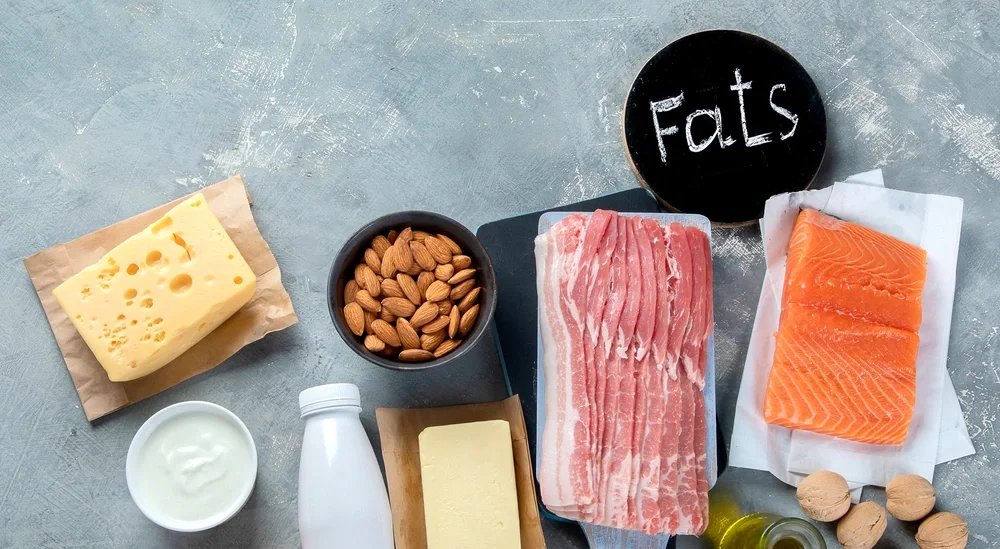
How much fat should you eat per day?
Most dietary guidelines recommend 20 to 35 percent of daily calories from fat. For a 2,000-calorie diet, that is 44 to 78 grams of fat per day. Fat needs vary by goal: people on ketogenic diets eat 60 to 75 percent of calories from fat, while those on low-fat diets may eat as little as 15 to 20 percent. Use the calculator below for a goal-specific daily fat target.
Table of Contents
- Fat Intake Calculator
- Why Does the Body Need Dietary Fat?
- What Is the Minimum Fat Intake for Hormonal Health?
- What Is the Difference Between Saturated, Unsaturated, and Trans Fat?
- Does Dietary Fat Cause Weight Gain?
- How Do You Track Fat Intake Accurately?
- Frequently Asked Questions
- References
Fat Intake Calculator
Daily Fat Intake Calculator
Daily calorie target
Daily fat target
Full macro breakdown:
Suggested fat source split:
Why Does the Body Need Dietary Fat?
Dietary fat is not optional. It serves several functions that no other macronutrient can replace, and inadequate fat intake has documented negative health consequences.
Fat is required for the absorption of fat-soluble vitamins: vitamins A, D, E, and K. These vitamins are present in food but cannot be absorbed by the gut without dietary fat present at the same meal. A very low-fat diet, even one with adequate fruit and vegetable intake, can produce deficiencies in these vitamins over time.
Fat is the primary substrate for steroid hormone synthesis. Testosterone, oestrogen, progesterone, and cortisol are all synthesised from cholesterol, which is produced by the liver using dietary fat as a precursor. Very low fat intakes are consistently associated with reduced testosterone and oestrogen levels in research, affecting both men and women in ways that impact reproductive health, bone density, and mood.
Fat provides essential fatty acids that the body cannot synthesise itself. Omega-3 fatty acids, particularly EPA and DHA from oily fish, and omega-6 fatty acids from plant sources, must come from the diet. They support cell membrane function, inflammation regulation, brain health, and cardiovascular function.
Fat also contributes to satiety. Dietary fat is the slowest macronutrient to digest and leaves the stomach more slowly than carbohydrates or protein, which extends the feeling of fullness after a meal.
What Is the Minimum Fat Intake for Hormonal Health?
Research on the effects of very low fat intake on hormonal function suggests that fat intake below approximately 20 percent of total calories, or below 30 to 40 grams per day in absolute terms, is associated with meaningful reductions in testosterone in men and with menstrual cycle disruption in women.
A 1997 study in the Journal of Applied Physiology found that testosterone was significantly lower in men eating a low-fat diet compared to those eating a moderate-fat diet, even when total calorie and protein intake was matched. This is relevant both for men seeking to maintain hormonal health and for people pursuing body composition goals where testosterone plays a key role in muscle building and fat loss.
For practical fat intake floors, most sports nutrition researchers recommend maintaining at least 20 to 25 percent of calories from fat even during aggressive fat loss phases, with absolute minimums of approximately 30 to 40 grams per day regardless of total calorie intake.
What Is the Difference Between Saturated, Unsaturated, and Trans Fat?
Dietary fat is not a single entity. The type of fat matters for long-term health outcomes, and this nuance gets lost in discussions that treat fat as a single macronutrient.
Saturated fats are found primarily in animal products, tropical oils, and many processed foods. They raise LDL cholesterol and are associated with increased cardiovascular risk at high intakes. Most guidelines recommend limiting saturated fat to below 10 percent of total calories.
Unsaturated fats divide into monounsaturated (olive oil, avocado, nuts) and polyunsaturated (oily fish, flaxseed, walnuts). These fats have neutral to positive effects on cardiovascular health markers and are the priority fat sources in Mediterranean and other evidence-supported dietary patterns.
Trans fats, found naturally in small amounts in some animal products but primarily as artificial trans fats in partially hydrogenated oils, raise LDL and lower HDL cholesterol simultaneously and are associated with the highest cardiovascular risk. Artificial trans fats have been largely eliminated from food supplies in most countries following regulatory action.
Does Dietary Fat Cause Weight Gain?
No more so than equivalent calories from carbohydrates or protein. Weight gain or loss is determined by total energy balance, not by which macronutrient the calories come from. The longstanding idea that dietary fat is uniquely fattening has not been supported by controlled research.
Fat is calorie-dense at 9 calories per gram compared to 4 for protein and carbohydrates, which means smaller portions of fatty foods contain more calories than equivalent-weight portions of protein or carbohydrate-rich foods. This is a relevant practical consideration for portion awareness, but it does not mean fat itself causes weight gain beyond its caloric contribution.
The most important factor in body weight is total calorie balance. Tracking fat alongside other macros with Welling’s macro tracker gives you the full picture of your daily energy intake across all three macronutrients.
How Do You Track Fat Intake Accurately?
Fat is the macronutrient most commonly under-tracked because cooking fats, dressings, and oils are easy to underestimate in quantity. A tablespoon of olive oil contains approximately 120 calories and 14 grams of fat, but it looks like a very small amount when drizzled on a meal.
Welling’s food tracker logs fat automatically from photos and descriptions, which captures cooking oils and dressings better than manual entry where they are often forgotten entirely. The AI nutrition coach can also flag if your fat intake is consistently low or high relative to your target and suggest adjustments.
Track your fat, protein, and carbs automatically in one app.
Welling logs every macro from a photo, chat, or voice note in 2.6 seconds on average. See your fat intake in real time and ask the AI coach what to eat to stay on target.
Frequently Asked Questions
How much fat should I eat per day to lose weight?
For fat loss, most approaches recommend 25 to 35 percent of daily calories from fat. At a 1,700-calorie daily intake, that is 47 to 66 grams of fat per day. Going below 20 percent of calories from fat is generally not recommended due to hormonal and vitamin absorption concerns.
Is eating fat bad for weight loss?
No. Dietary fat does not cause weight gain beyond its caloric contribution. Research consistently shows that fat loss is determined by total calorie deficit, not by the macronutrient source of those calories. Both low-fat and low-carb diets can produce equivalent fat loss when total calories and protein are matched.
What is a healthy daily fat intake?
For general health, 25 to 35 percent of daily calories from fat is recommended, prioritising unsaturated fats from olive oil, avocado, nuts, and oily fish, and limiting saturated fat to below 10 percent of calories. A complete avoidance of dietary fat is not healthy and is not recommended by any major health body.
Can too little fat be harmful?
Yes. Very low fat diets below 15 to 20 percent of calories are associated with reduced testosterone and oestrogen, impaired absorption of fat-soluble vitamins (A, D, E, K), increased risk of essential fatty acid deficiency, and for women, menstrual cycle disruption. Maintaining at least 20 to 25 percent of calories from fat is advisable for most adults.
Which types of fat should I prioritise?
Monounsaturated fats (olive oil, avocado, almonds) and omega-3 polyunsaturated fats (salmon, mackerel, sardines, walnuts, flaxseed) are the most evidence-supported dietary fat sources for cardiovascular health and general wellbeing. Saturated fat from animal products and tropical oils should be moderated. Artificial trans fats should be avoided entirely.
How do I count fat grams if I cook with oil?
Measure oil by the tablespoon or teaspoon rather than pouring freely. One tablespoon of olive oil is approximately 14 grams of fat and 120 calories. Logging this in Welling through a text description or voice note adds it accurately to your daily fat total without requiring a separate database search.
References
- Hamalainen, E. K., et al. (1984). Diet and Serum Sex Hormones in Healthy Men. Journal of Steroid Biochemistry, 20(1), 459-464.
- Mensink, R. P., et al. (2003). Effects of Dietary Fatty Acids and Carbohydrates on the Ratio of Serum Total to HDL Cholesterol.American Journal of Clinical Nutrition, 77(5), 1146-1155.
- Hall, K. D., et al. (2020). Effect of a Plant-Based, Low-Fat Diet versus an Animal-Based, Ketogenic Diet on Ad Libitum Energy Intake. Nature Medicine, 27(2), 344-353.
- National Academies of Sciences, Engineering, and Medicine. (2005). Dietary Reference Intakes for Energy, Carbohydrate, Fiber, Fat, Fatty Acids, Cholesterol, Protein, and Amino Acids. National Academies Press.
- Simopoulos, A. P. (2002). The Importance of the Ratio of Omega-6/Omega-3 Essential Fatty Acids. Biomedicine and Pharmacotherapy, 56(8), 365-379.
- Mifflin, M. D., et al. (1990). A New Predictive Equation for Resting Energy Expenditure in Healthy Individuals. American Journal of Clinical Nutrition, 51(2), 241-247.

Mickey Kittinuttakul