
How much fiber should you eat per day?
The recommended daily fiber intake is 25 grams per day for women and 38 grams per day for men, based on the Institute of Medicine Adequate Intake. Most adults in Western countries consume only 15 to 17 grams per day, well below these targets. Use the calculator below to find your personalised daily fiber target and see practical food sources to help you reach it.
Table of Contents
- Fiber Intake Calculator
- Why Is Dietary Fiber Important?
- What Is the Difference Between Soluble and Insoluble Fiber?
- What Are the Best High-Fiber Foods?
- How Does Fiber Affect Weight Loss?
- How Do You Increase Fiber Intake Without Digestive Discomfort?
- How Do You Track Fiber Intake Daily?
- Frequently Asked Questions
- References
Fiber Intake Calculator
Daily Fiber Intake Calculator
Your daily fiber target
How to reach your target today:
Goal-specific note:
Increase fiber intake gradually over 2-3 weeks with adequate water to avoid digestive discomfort. Aim for a mix of soluble and insoluble fiber sources.
Why Is Dietary Fiber Important?
Dietary fiber is the collective term for plant-based carbohydrates that the human digestive system cannot break down into glucose. Rather than being absorbed and used for energy in the same way as digestible carbohydrates, fiber passes through the small intestine largely intact and reaches the large intestine, where it plays a central role in gut health.
The health effects of adequate fiber intake are among the most consistently supported in nutritional epidemiology. A 2019 meta-analysis published in The Lancet, commissioned by the World Health Organisation and analysing data from over 185 studies, found that people eating 25 to 29 grams of fiber per day had significantly lower rates of coronary heart disease, stroke, type 2 diabetes, colorectal cancer, and all-cause mortality compared to people eating less than 15 grams per day. For every 8-gram increase in daily fiber intake, the relative risk of coronary heart disease decreased by 19 percent.
Despite this evidence, average fiber intake in Western diets is approximately 15 to 17 grams per day, well below the recommended 25 to 38 grams per day, making fiber one of the most widely under-consumed nutrients in high-income countries.
What Is the Difference Between Soluble and Insoluble Fiber?
Dietary fiber divides into two main categories that have distinct functions in the body.
Soluble fiber dissolves in water to form a viscous gel in the digestive tract. This gel slows the movement of food through the gut, delays glucose absorption, and traps dietary cholesterol and bile acids before they can be reabsorbed. The most studied soluble fibers are beta-glucan from oats and barley, pectin from fruits and vegetables, and psyllium husk. These are the fiber types with the strongest evidence for reducing LDL cholesterol and blunting post-meal blood glucose spikes.
Insoluble fiber does not dissolve in water. Instead, it adds bulk to stool, speeds transit time through the large intestine, and supports regular bowel movements. Whole wheat, bran, vegetables, and the skins of fruits and legumes are primary sources. Adequate insoluble fiber intake is associated with reduced constipation and lower colorectal cancer risk.
Most whole plant foods contain a mixture of both types, which is why eating a variety of vegetables, legumes, fruits, and wholegrains is more effective than focusing on a single fiber source. Welling tracks total dietary fiber alongside calories and macros, giving you a daily view of whether you are meeting your target across your overall diet.
What Are the Best High-Fiber Foods?
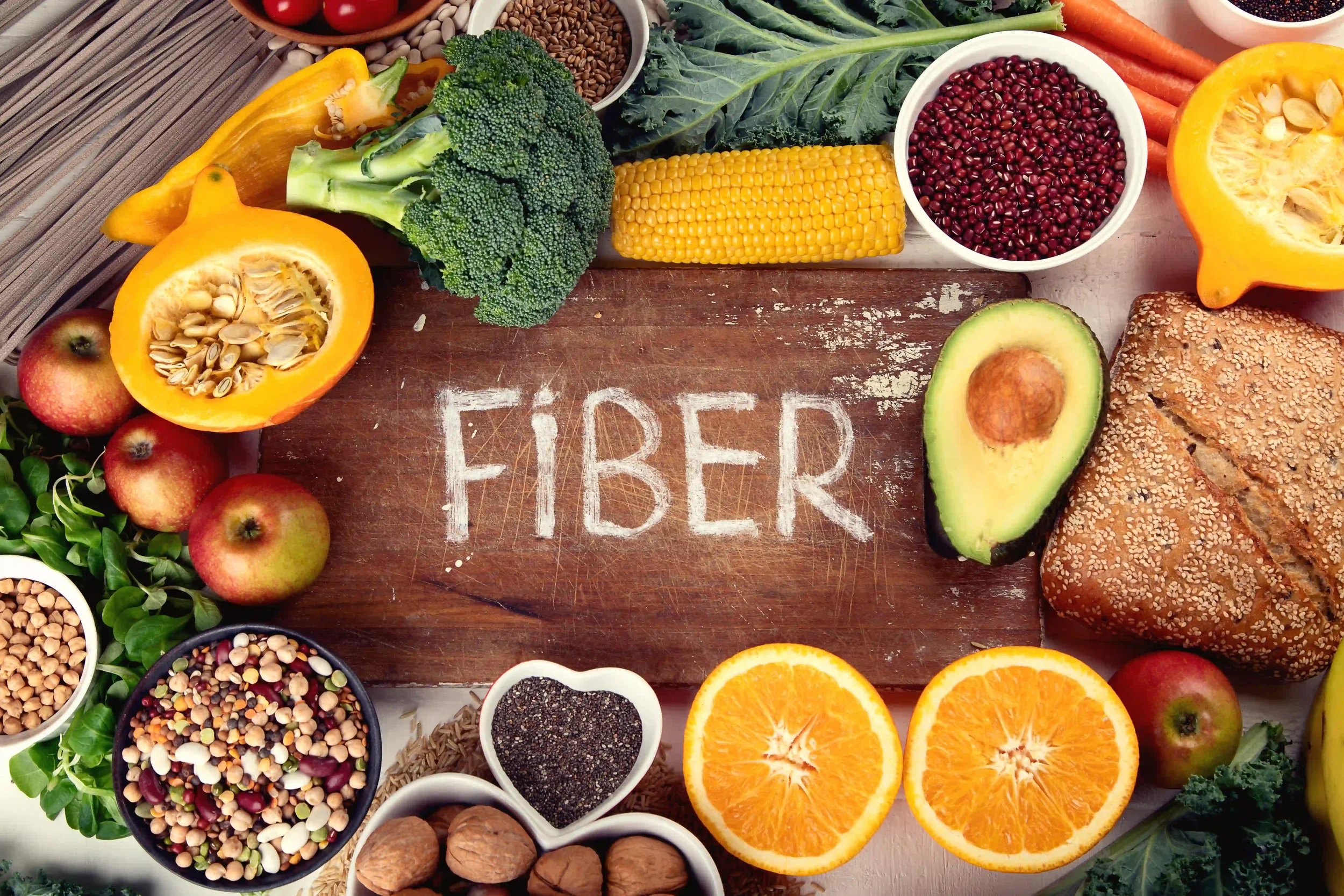
The highest dietary fiber concentrations per 100 grams of edible food come from:
Legumes: lentils at 8g per 100g cooked, black beans at 7g per 100g cooked, chickpeas at 7g per 100g cooked. Legumes also provide protein and are one of the most nutritionally efficient high-fiber foods available.
Wholegrains: oats at approximately 10g per 100g dry, wholegrain wheat at 10 to 12g per 100g dry. Cooking reduces fiber concentration by weight due to water absorption.
Seeds: chia seeds at 34g per 100g, flaxseed at 27g per 100g. These are the highest-fiber foods by weight and small servings of 15 to 20 grams provide meaningful fiber contributions.
Nuts: almonds at 13g per 100g, pistachios at 10g per 100g, and walnuts at 7g per 100g. Higher in calories than vegetables but provide both fiber and healthy fats.
Vegetables: broccoli at 3g per 100g cooked, spinach at 2g per 100g cooked, carrots at 3g per 100g raw. Vegetables are lower in fiber density than legumes or grains but can contribute meaningfully when eaten in larger portions.
Fruits: pears and raspberries at 5 to 6g per 100g, apples with skin at 2 to 3g per 100g, avocado at 7g per 100g. Eating fruit with the skin intact preserves the insoluble fiber content.
How Does Fiber Affect Weight Loss?
Dietary fiber supports weight management through several mechanisms, all of which are practically useful alongside a calorie deficit.
Fiber increases satiety per calorie. High-fiber foods take longer to chew, slow gastric emptying, and expand the stomach volume relative to their caloric content. Research published in the Annals of Internal Medicine found that simply increasing fiber intake to 30 grams per day produced meaningful weight loss in overweight adults even without other dietary changes, because the satiety effect of higher fiber naturally reduced overall calorie intake.
Fiber feeds the gut microbiome. Fermentation of soluble fiber in the colon produces short-chain fatty acids, which have been shown to reduce fat storage hormones, increase the production of gut hormones that signal fullness, and improve insulin sensitivity. These effects are modest individually but contribute to a more favourable metabolic environment for weight management over time.
Fiber displaces more calorie-dense foods. High-fiber meals made from vegetables, legumes, and wholegrains tend to be lower in calorie density than equivalent-volume meals made from refined, low-fiber foods. Eating more fiber naturally shifts the diet toward lower calorie density.
How Do You Increase Fiber Intake Without Digestive Discomfort?
The most common reason people fail to maintain higher fiber intakes is the digestive discomfort, including gas, bloating, and cramps, that occurs when fiber intake is increased rapidly. The gut microbiome needs time to adapt to a higher fiber diet, and the fermentation of fiber by gut bacteria produces gas as a byproduct.
The most effective approach is to increase fiber intake gradually over two to four weeks rather than all at once. Adding one new high-fiber food per week rather than overhauling the entire diet reduces the adaptation period discomfort significantly.
Drinking adequate water is essential alongside increasing fiber. Fiber absorbs water and without sufficient fluid intake, particularly from insoluble fiber sources, it can contribute to constipation rather than preventing it.
Starting with soluble fiber sources like oats, fruit, and beans tends to be better tolerated initially than jumping straight to high-insoluble sources like bran or whole wheat. Cooking legumes thoroughly and draining canned beans reduces oligosaccharide content, which is responsible for much of the gas produced from bean consumption.
How Do You Track Fiber Intake Daily?
Fiber is one of the most commonly under-tracked nutrients in standard calorie counting apps, partly because it is not highlighted the way calories and macros are, and partly because many food entries in user-submitted databases do not include fiber data at all.
Welling tracks fiber alongside calories, protein, carbohydrates, and fat as part of every logged meal. The food tracker shows your daily fiber total in real time, and the AI nutrition coach can answer “am I hitting my fiber target today” or “what can I add to dinner that would help me reach my fiber goal” with a specific, contextual answer based on what you have already logged.
Tracking fiber alongside calories gives a more complete picture of dietary quality than calories and macros alone, since fiber intake is one of the clearest markers of whole food diet quality.
Track fiber, calories, and macros together in seconds.
Welling logs fiber from every meal automatically via photo, chat, or voice note in 2.6 seconds on average. Ask the AI coach what to eat to hit your fiber target tonight.
Frequently Asked Questions
How much fiber do I need per day?
The Institute of Medicine Adequate Intake is 38 grams per day for men under 50 and 30 grams for men over 50, and 25 grams per day for women under 50 and 21 grams for women over 50. Alternatively, 14 grams per 1,000 calories consumed is used as a proportional guideline. Most adults fall significantly short of these targets.
What happens if you eat too much fiber?
Very high fiber intakes above 70 grams per day can cause significant digestive discomfort, interfere with mineral absorption particularly for iron, zinc, and calcium by binding to them in the gut, and in extreme cases contribute to intestinal blockage. For most people, reaching the recommended 25 to 38 grams per day from whole foods is the goal rather than maximising fiber as high as possible.
What are the fastest foods to eat to reach my fiber target?
Legumes are the most fiber-efficient foods: a 200-gram serving of lentils or black beans provides 14 to 16 grams of fiber. Chia seeds at 15 grams provide 5 grams of fiber. A medium pear provides 5 to 6 grams. Combining a lentil-based meal, a piece of fruit, and a small handful of nuts can provide 20 or more grams of fiber in a single day with moderate effort.
Does fiber have calories?
Fiber contributes approximately 2 calories per gram to total calorie intake, compared to 4 for digestible carbohydrates. This is because some of the short-chain fatty acids produced by gut bacteria fermenting soluble fiber are absorbed and provide a small caloric contribution. Most calorie tracking apps either count fiber at 0 or 2 calories per gram, which makes a negligible practical difference at typical fiber intakes.
Is fiber counted in net carbs?
On ketogenic diets, net carbs are calculated by subtracting fiber from total carbohydrates, since fiber does not raise blood glucose or insulin. If your total carbohydrates are 40 grams and your fiber is 15 grams, your net carbs are 25 grams. Welling tracks both total carbohydrates and fiber separately, which allows you to see both figures for your dietary approach.
Which foods are highest in soluble fiber for cholesterol management?
Oats, barley, and rye contain beta-glucan, the most evidence-supported soluble fiber for LDL cholesterol reduction. A 2014 meta-analysis in the American Journal of Clinical Nutrition found that 3 grams per day of beta-glucan from oats or barley reduced LDL by approximately 5 to 10 percent. Psyllium husk, available as a supplement or in some cereals, is another well-researched source. Beans, lentils, apples, and citrus fruits also provide meaningful amounts of soluble pectin fiber.
References
- Reynolds, A., et al. (2019). Carbohydrate Quality and Human Health: A Series of Systematic Reviews and Meta-Analyses. The Lancet, 393(10170), 434-445.
- Institute of Medicine. (2005). Dietary Reference Intakes for Energy, Carbohydrate, Fiber, Fat, Fatty Acids, Cholesterol, Protein, and Amino Acids. National Academies Press.
- Slavin, J. L. (2005). Dietary Fiber and Body Weight. Nutrition, 21(3), 411-418.
- Ho, H. V. T., et al. (2016).The Effect of Oat Beta-Glucan on LDL-Cholesterol, Non-HDL-Cholesterol and ApoB. British Journal of Nutrition, 116(8), 1369-1382.
- Howarth, N. C., Saltzman, E., & Roberts, S. B. (2001). Dietary Fiber and Weight Regulation. Nutrition Reviews, 59(5), 129-139.
- Dahl, W. J., & Stewart, M. L. (2015). Position of the Academy of Nutrition and Dietetics: Health Implications of Dietary Fiber. Journal of the Academy of Nutrition and Dietetics, 115(11), 1861-1870.

Mickey Kittinuttakul