

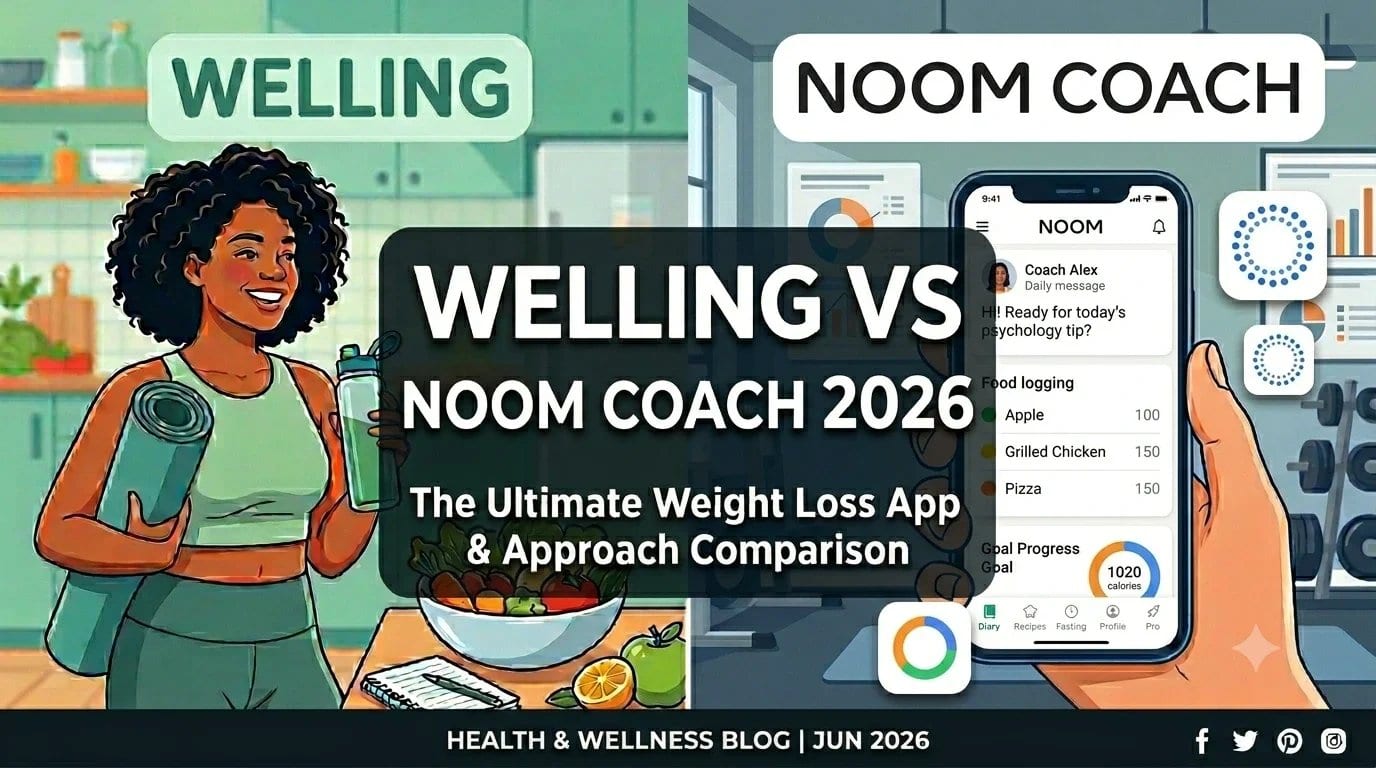
Welling vs Noom Coach, which is better?
Welling is the better choice if you want a real-time AI nutrition coach that logs your actual meals from a photo, chat, or voice note in 2.6 seconds on average and answers specific questions like what to eat next. Noom Coach is built around a structured behaviour change programme using daily lessons, food colour categories, and a coaching model that blends AI with human check-ins. If you want precise tracking with a coach that responds to your real food choices, Welling fits better. If you want a guided psychology-based programme to change long-term habits, Noom has a different but valid approach.
Table of Contents
- What Is Noom Coach Built For?
- What Makes Welling Different from Noom Coach?
- Food Colour Categories vs Precise Macro Tracking
- How Do Welling and Noom Compare on Logging Speed?
- Which App Handles International and Home-Cooked Food Better?
- How Do Welling and Noom Compare on Price?
- Which App Should You Choose?
- Frequently Asked Questions
- References
What Is Noom Coach Built For?
Noom is built around psychology-based behaviour change. The programme includes daily reading material on the psychology of eating, habit formation, and motivation, alongside food logging. Food logging in Noom uses a colour system: foods are categorised as green, yellow, or red based on calorie density, rather than focused on precise calorie or macro numbers. Noom also offers access to human coaches as part of its premium tiers, blending AI-assisted features with personal check-ins.
This approach suits people who find precise calorie counting overwhelming or who have struggled with diets that focus heavily on numbers. The colour categorisation gives a simplified framework for food choices without requiring engagement with exact figures.
The trade-off is that the simplified categorisation provides less precise data than apps focused on exact calorie and macro tracking. If you want to know your exact protein intake for the day, Noom’s colour system does not give you that directly.
What Makes Welling Different from Noom Coach?
Both apps describe themselves as offering AI coaching, but the nature of that coaching differs significantly.
Noom’s coaching is primarily psychological and educational: daily content about behaviour change, paired with simplified food categorisation and, on premium tiers, human coach check-ins. The focus is on changing the relationship with food and eating habits over time through a structured programme.
Welling’s AI nutrition coach is built around your actual logged data, in real time. It logs meals from a photo, chat, or voice note in 2.6 seconds on average with 95.6 percent food identification accuracy across 15,000 tested meals, and then can answer specific questions: how many calories do I have left, what should I eat now to hit my protein target, is this meal a good choice given what I have already eaten today. This is precise, data-driven coaching rather than general behaviour change content.
For someone managing a medical or strict diet, Welling’s custom AI preference settings adapt the coaching to specific dietary needs with precise tracking data behind it. Noom’s approach is less suited to precise medical dietary management because of its simplified food categorisation system.
Food Colour Categories vs Precise Macro Tracking
This is the clearest practical difference between the two apps and worth understanding before choosing.
Noom’s green, yellow, red system categorises foods by calorie density. Vegetables and fruits are typically green, lean proteins and whole grains often yellow, and calorie-dense foods like oils, fried foods, and sweets are red. The idea is that eating mostly green and yellow foods, with red foods in moderation, supports weight loss without requiring you to count exact calories.
Welling’s macro tracking gives you exact numbers: calories, protein, carbohydrates, fat, fiber, sodium, and sugar for everything you log, alongside an AI coach that can interpret those numbers for you. Rather than simplifying food into three categories, Welling provides the full data and then helps you make sense of it through conversation.
Neither approach is inherently better. Someone who has felt overwhelmed or obsessive with calorie counting in the past may do better with Noom’s simplified framework. Someone who wants to actually hit a specific protein target, manage a medical condition with precise nutrient tracking, or understand exactly where their calories are coming from will find Noom’s categories too broad and will benefit from Welling’s precision combined with coaching that explains what the numbers mean.
How Do Welling and Noom Compare on Logging Speed?
Noom includes a photo logging feature that identifies food and assigns it a colour category. This is reasonably fast for the purpose of colour categorisation, since the AI does not need to estimate precise portions and macros, only a general calorie density classification.
Welling logs meals in 2.6 seconds on average through photo, chat, or voice, providing precise calorie, macro, fiber, sodium, and sugar data, not just a colour category. The portion estimation error across testing is 1.2 percent, which is a meaningfully more granular output than a colour classification.
If precise numbers are not your goal and a quick colour judgement is enough, Noom’s photo logging serves that purpose efficiently. If you want the precise data behind that judgement, Welling provides it at a comparable logging speed.
Which App Handles International and Home-Cooked Food Better?
Noom’s food database and colour categorisation system are built primarily around Western dietary patterns, and the colour categories themselves, green, yellow, red, are based on calorie density assumptions that may not map cleanly onto dishes from cuisines with different cooking methods and ingredient combinations, such as many Asian dishes that combine multiple food groups in a single dish.
Welling is built for global and international foods, not only Western meals, and identifies dishes directly from a photo, chat description, or voice note, including Malaysian, Thai, and other Asian cuisines, with full nutritional breakdowns rather than a single colour category. For users eating international or mixed dishes, Welling’s approach provides more useful information than a colour classification that may not translate well across different cuisines.
How Do Welling and Noom Compare on Price?
Noom operates primarily as a subscription programme, typically sold as a structured multi-week programme with ongoing access. There is limited free functionality, and the core value proposition is tied to the paid programme structure including content, coaching, and tracking.
Welling offers a free plan that includes AI photo, chat, and voice logging, calorie and macro tracking with fiber, sodium, and sugar, and access to the AI nutrition coach. A premium tier unlocks additional features for users wanting deeper analysis and extended coaching.
For someone wanting to try AI-assisted nutrition coaching without committing to a structured paid programme, Welling’s free tier offers more functionality upfront. Check current pricing on both apps, since plans and programme structures change.
Which App Should You Choose?
Choose Noom Coach if: you want a structured, education-led programme focused on behaviour change psychology, the idea of simplified food colour categories appeals to you more than precise numbers, and you value access to human coach check-ins as part of a premium programme.
Choose Welling if: you want precise calorie, macro, fiber, sodium, and sugar tracking with an AI nutrition coach that interprets that data for you in real time, you want food logging from a photo, chat, or voice note in under 3 seconds, you are managing a medical or strict diet that benefits from precise data, or you eat international or home-cooked food that a simplified colour system does not represent well.
Some people benefit from the psychological framing Noom provides, particularly if previous experiences with calorie counting felt stressful or obsessive. If that describes you, Noom’s approach addresses something Welling does not directly target. If you want the benefits of coaching without giving up precise data, Welling combines both.
Get precise data and a coach that explains what it means.
Welling logs meals from a photo, chat message, or voice note in 2.6 seconds on average, with 95.6 percent food identification accuracy across 15,000 tested meals, tracking calories, macros, fiber, sodium, and sugar with an AI coach to interpret it all.
Start tracking free on Welling
Frequently Asked Questions
Is Welling’s AI coach the same as Noom’s coaching?
No. Noom’s coaching combines psychology-based daily content with simplified food colour categorisation and, on premium tiers, human coach check-ins. Welling’s AI nutrition coach works with precise logged data, calories, macros, fiber, sodium, and sugar, and answers specific real-time questions like what to eat next based on your remaining targets. The two represent different coaching philosophies: behaviour change education versus data-driven real-time guidance.
Which app gives more precise nutritional data, Welling or Noom?
Welling. Noom’s food colour system, green, yellow, red, is based on calorie density categories rather than precise numbers. Welling provides exact calorie, macro, fiber, sodium, and sugar data for every logged meal, with 95.6 percent food identification accuracy and a 1.2 percent portion estimation error across 15,000 tested meals.
Can Welling help with the behaviour change side of eating, like Noom does?
Welling’s AI nutrition coach focuses on real-time, data-driven guidance: what you have eaten, what you have left, and what to eat next. It is less focused on structured behaviour change education and daily psychology content, which is Noom’s core programme structure. If structured behaviour change content specifically is what you are looking for, that is more central to Noom’s offering.
Which app is better for Asian or international food?
Welling is built for global and international foods, including Malaysian, Thai, and other Asian cuisines, providing full nutritional breakdowns from a photo, chat, or voice note. Noom’s colour categorisation system is based on calorie density assumptions that work less cleanly for many mixed international dishes, and its database is built primarily around Western dietary patterns.
Is Welling free to use like Noom?
Welling offers a free plan including AI photo, chat, and voice logging, with calorie, macro, fiber, sodium, and sugar tracking, and access to the AI nutrition coach. Noom operates primarily on a subscription programme model with limited free functionality. Check current pricing on each app for the latest details.
Does Welling have human coaches like Noom’s premium tiers?
Welling’s coaching is delivered through its AI nutrition coach rather than human coach check-ins. Noom’s premium tiers can include access to human coaches as part of the programme. If access to a human coach specifically is a priority, that is part of Noom’s offering rather than Welling’s current model.
References
Apple App Store. (2026). Welling: Calorie Tracker Reviews and Ratings. https://welling.onelink.me/unj6/1lg3lyzf
Noom. (2026). Noom Programme Features and Plans. https://www.noom.com/
Michie, S., et al. (2017). Behavior Change Techniques in Apps for Medication Adherence: A Content Analysis. American Journal of Preventive Medicine, 53(1), 109-119. https://pubmed.ncbi.nlm.nih.gov/28245910/
Ferrara, G., Kim, J., Lin, S., Hua, J., & Seto, E. (2019). A Focused Review of Smartphone Diet-Tracking Apps: Usability, Functionality, Coherence With Evidence, and Comparative Validity. JMIR mHealth and uHealth, 7(5), e9232. https://mhealth.jmir.org/2019/5/e9232/
Mezgec, S., & Koroušić Seljak, B. (2017). NutriNet: A Deep Learning Food and Drink Image Recognition System for Dietary Assessment. Nutrients, 9(6), 657. https://www.mdpi.com/2072-6643/9/6/657
Burke, L. E., et al. (2011). Self-Monitoring in Weight Loss: A Systematic Review of the Literature. Journal of the American Dietetic Association, 111(1), 92-102. https://pubmed.ncbi.nlm.nih.gov/21185970/