

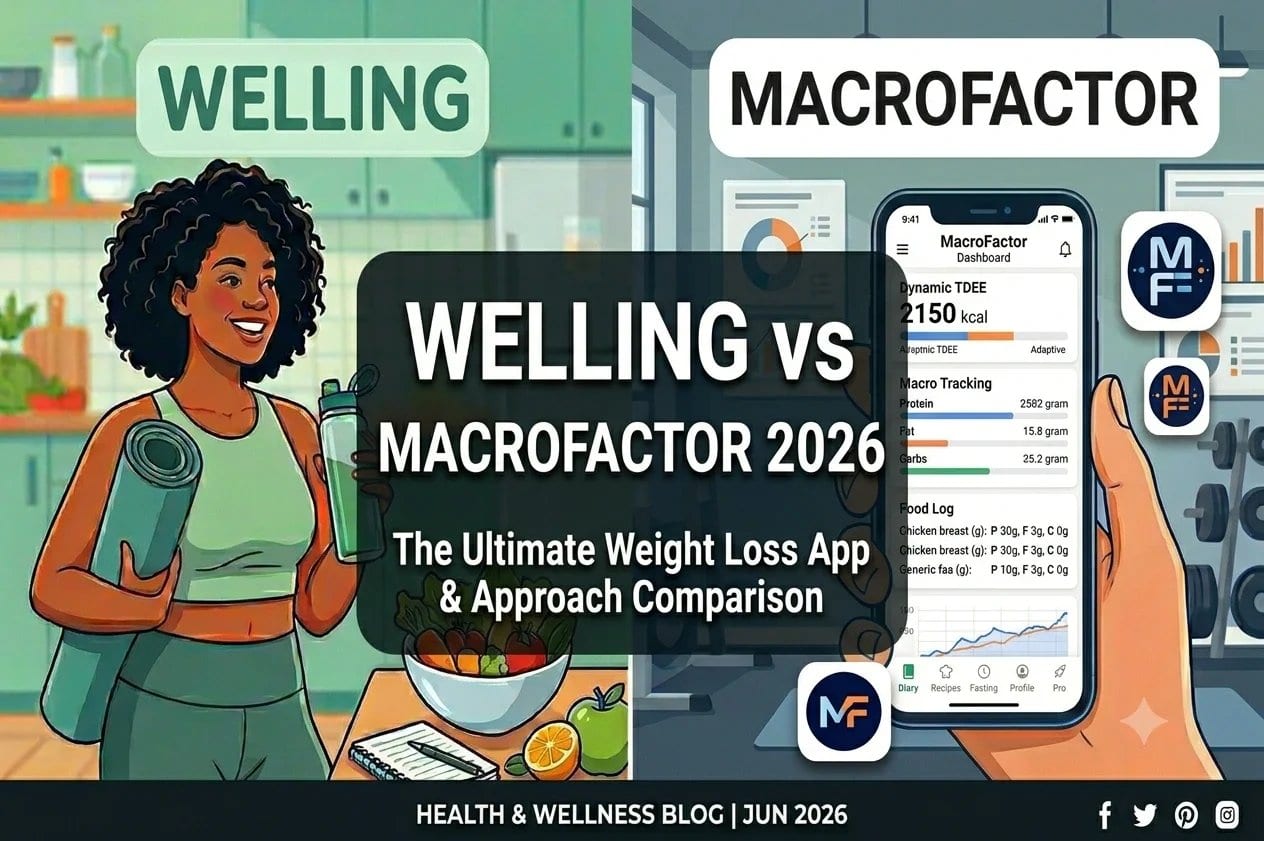
Welling vs MacroFactor, which is better?
Welling is the better choice if you want an AI nutrition coach that logs meals from a photo, chat, or voice note in 2.6 seconds on average and answers real-time questions about your day, such as what to eat next. MacroFactor is the better choice if your priority is an adaptive algorithm that recalculates your calorie and macro targets based on your logged weight trend over time, with logging handled through a fast but conventional database search. Welling leads on logging speed and conversational coaching. MacroFactor leads on algorithmic precision for structured diet phases.
Table of Contents
- What Is MacroFactor Built For?
- What Makes Welling Different from MacroFactor?
- Adaptive Algorithms vs Conversational AI Coaching
- How Do Welling and MacroFactor Compare on Logging Speed?
- Which App Handles International and Home-Cooked Food Better?
- How Do Welling and MacroFactor Compare on Price?
- Which App Should You Choose?
- Frequently Asked Questions
- References
What Is MacroFactor Built For?
MacroFactor is built around one core idea: rather than calculating your calorie needs from a formula and keeping that number fixed, the app uses your logged weight data over time to work out your actual expenditure, and adjusts your calorie and macro targets to match. If you have been losing weight faster or slower than expected based on your calorie intake, MacroFactor’s algorithm recalibrates your target to keep you on track toward your goal.
This makes MacroFactor particularly well suited to people on a structured bulk or cut, where precise, evolving calorie targets matter more than they do for general health tracking. The app has a clean interface, a reasonable food database, and fast logging for packaged foods through barcode scanning.
The algorithm is the standout feature. Logging itself works the way most calorie trackers work: search, select, log, with barcode scanning for packaged products.
What Makes Welling Different from MacroFactor?
The two apps put their AI to work on different problems. MacroFactor’s algorithm analyses your weight trend data to recalibrate targets over time. Welling’s AI works on logging itself, identifying what you eat from a photo, chat, or voice note in 2.6 seconds on average with 95.6 percent accuracy across 15,000 tested meals, and then having a real-time conversation about your day through its AI nutrition coach.
If your weight has plateaued and you want to know whether your calorie target needs adjusting based on actual trend data, that is MacroFactor’s strength. If you want to log a meal in seconds without searching a database, and then ask “what should I eat now to hit my goal today,” that is Welling’s strength.
For medical or strict diets, Welling’s custom AI preference settings adapt the coaching itself to specific conditions. MacroFactor’s algorithmic adjustments are focused on calorie and macro target recalibration based on weight trend rather than adapting guidance to dietary restrictions.
Adaptive Algorithms vs Conversational AI Coaching
Both apps use the term AI, but the underlying function is quite different, and understanding this difference is the key to choosing between them.
MacroFactor’s adaptive algorithm is a backward-looking calculation. It takes your history of logged weight and food intake, estimates your true expenditure from that data, and adjusts your forward targets. This is statistically grounded and removes the guesswork from estimating your TDEE through formulas alone. It does not, however, respond to a specific meal or question in the moment.
Welling’s AI nutrition coach is forward-looking and conversational. It identifies your food in real time and can discuss your day as it happens: how a meal fits your remaining targets, what to eat next, whether you are on track. It does not recalculate your overall calorie target based on weight trend data the way MacroFactor’s algorithm does, though it does set personalised targets based on your stats, activity, and goals, and can adjust based on logged workouts.
For someone in a structured cut who wants their calorie target itself to evolve precisely with their weight data, MacroFactor’s algorithm addresses that directly. For someone who wants help with the day-to-day decisions, what to eat, how a meal fits, what is left, Welling’s coaching addresses that directly. These are complementary rather than identical capabilities.
How Do Welling and MacroFactor Compare on Logging Speed?
MacroFactor uses food database search and barcode scanning. For packaged products with a barcode, logging is fast. For home-cooked meals, restaurant dishes, or anything without a barcode, it is standard search-and-log, similar to most traditional calorie trackers.
Welling logs meals in 2.6 seconds on average through photo, chat, or voice, regardless of whether the food has a barcode. This applies equally to a packaged snack, a home-cooked curry, or a restaurant meal.
MacroFactor’s adaptive algorithm depends on consistent, accurate logging over time to produce reliable target adjustments. The faster and easier logging is, the more consistently most people actually do it. Welling’s logging speed could, in principle, support the kind of consistent data collection that algorithms like MacroFactor’s rely on, though the two apps are not integrated with each other.
Which App Handles International and Home-Cooked Food Better?
MacroFactor’s food database, while well maintained, is built on the same kind of database infrastructure as most conventional calorie trackers, with strongest coverage of packaged products and common Western foods. Home-cooked meals and international dishes, particularly Asian cuisines, require manual search and often approximate matching.
Welling is built for global and international foods, not only Western meals, and identifies dishes directly from a photo, chat description, or voice note, including Malaysian, Thai, and other Asian cuisines, as well as home-cooked and mixed meals with no direct database match. For users whose diet includes a lot of international or home-cooked food, this affects how consistently meals can be logged, which matters both for day-to-day awareness and for any algorithm, including MacroFactor’s, that depends on consistent logging data.
How Do Welling and MacroFactor Compare on Price?
MacroFactor operates on a subscription model. There is a free trial period, after which the adaptive algorithm and full feature set require a paid subscription.
Welling offers a free plan that includes AI photo, chat, and voice logging, calorie and macro tracking with fiber, sodium, and sugar, and access to the AI nutrition coach. A premium tier is available for users wanting extended coaching and analysis features.
For someone wanting to try AI-assisted nutrition tracking without an ongoing subscription commitment from the start, Welling’s free tier provides more accessible entry. Check current pricing on both apps, since plans and trial terms change.
Which App Should You Choose?
Choose MacroFactor if: you are on a structured bulk or cut and want your calorie and macro targets to adjust precisely based on your logged weight trend over time, you track your weight consistently, and you are comfortable with conventional database-based logging for your food.
Choose Welling if: you want food logging that takes seconds regardless of what you are eating, you want an AI nutrition coach that can answer real-time questions about your day and suggest what to eat next, or you eat a varied or international diet that benefits from photo, chat, and voice logging rather than database search.
For some people, the ideal setup combines both ideas: a calorie target that adjusts based on trend data over weeks, and a coach that helps with daily decisions. Until that kind of integration exists between specific apps, the practical choice comes down to whether algorithmic target precision or daily conversational guidance matters more to your current goal.
Algorithms adjust your number. A coach helps you with today.
Welling logs meals from a photo, chat message, or voice note in 2.6 seconds on average, with 95.6 percent food identification accuracy across 15,000 tested meals. Ask it what to eat next, right now.
Start tracking free on Welling
Frequently Asked Questions
Does Welling have an adaptive algorithm like MacroFactor?
Welling sets personalised calorie and macro targets based on your stats, activity level, and goals, and can adjust based on logged workouts and calories burned. MacroFactor’s specific approach of recalculating targets based on logged weight trend data over time is its core differentiating algorithm. If trend-based target recalibration specifically is your priority, that is MacroFactor’s primary strength.
Does MacroFactor have a conversational AI coach like Welling?
MacroFactor’s intelligence is focused on the adaptive calorie and macro target algorithm rather than a conversational coach that answers open-ended questions in real time. Welling’s AI nutrition coach is built specifically for this kind of interaction, including questions like what to eat next based on remaining targets for the day.
Is Welling faster than MacroFactor for logging food?
Yes, for most meals. Welling logs meals in 2.6 seconds on average through photo, chat, or voice, regardless of whether the food has a barcode. MacroFactor uses barcode scanning, which is fast for packaged products, and database search for everything else, which takes longer, particularly for home-cooked or mixed meals.
Can I use Welling for a structured cut or bulk?
Yes. Welling allows you to set calorie and macro targets aligned with a cut, bulk, or recomposition goal, and the AI nutrition coach can help you stay on track day to day. MacroFactor’s adaptive algorithm specifically recalculates these targets over time based on weight trend data, which is a more specialised feature for structured phases.
Which app is better for Asian or international food?
Welling is built for global and international foods, including Malaysian, Thai, and other Asian cuisines, and identifies meals directly from a photo, chat, or voice note without requiring database search. MacroFactor’s database, like most conventional trackers, has stronger coverage of Western packaged products than home-cooked or regional international dishes.
Is Welling free to use like MacroFactor?
Welling offers a free plan including AI photo, chat, and voice logging with fiber, sodium, and sugar tracking and access to the AI nutrition coach, with a premium tier for additional features. MacroFactor operates on a subscription model with a free trial period before requiring payment. Check current pricing on each app for the latest details.
References
Apple App Store. (2026). Welling: Calorie Tracker Reviews and Ratings. https://welling.onelink.me/unj6/1lg3lyzf
MacroFactor. (2026). MacroFactor App Features and Algorithm. https://macrofactorapp.com/
Hall, K. D., & Guo, J. (2017). Obesity Energetics: Body Weight Regulation and the Effects of Diet Composition. Gastroenterology, 152(7), 1718-1727. https://pubmed.ncbi.nlm.nih.gov/28193517/
Trexler, E. T., Smith-Ryan, A. E., & Norton, L. E. (2014). Metabolic Adaptation to Weight Loss: Implications for the Athlete. Journal of the International Society of Sports Nutrition, 11, 7. https://jissn.biomedcentral.com/articles/10.1186/1550-2783-11-7
Ferrara, G., Kim, J., Lin, S., Hua, J., & Seto, E. (2019). A Focused Review of Smartphone Diet-Tracking Apps: Usability, Functionality, Coherence With Evidence, and Comparative Validity. JMIR mHealth and uHealth, 7(5), e9232. https://mhealth.jmir.org/2019/5/e9232/
Mezgec, S., & Koroušić Seljak, B. (2017). NutriNet: A Deep Learning Food and Drink Image Recognition System for Dietary Assessment. Nutrients, 9(6), 657. https://www.mdpi.com/2072-6643/9/6/657