

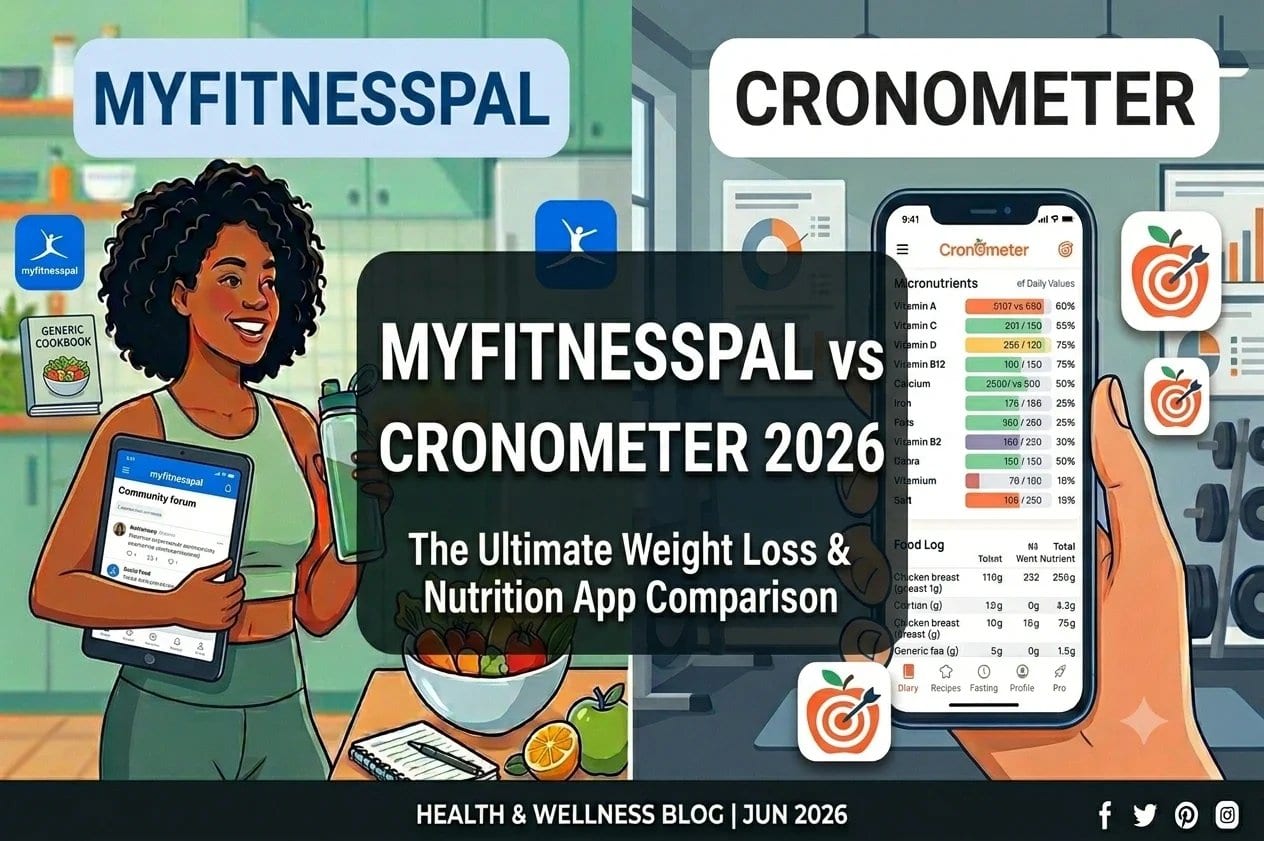
MyFitnessPal vs Cronometer, which is more accurate?
Cronometer is more accurate for micronutrient data because every entry is sourced from verified databases such as the USDA, with over 84 nutrients tracked per food. MyFitnessPal has a larger database of over 14 million foods, but much of it is user-submitted, meaning data quality varies and errors are common. For calories and basic macros, both can be accurate when entries are carefully selected. For vitamin, mineral, and amino acid tracking, Cronometer is the more trustworthy source. If you want a third option that combines speed and coaching, Welling logs meals in 2.6 seconds via photo, chat, or voice with 95.6 percent food identification accuracy.
Table of Contents
- Why Accuracy Matters More Than Database Size
- How Does MyFitnessPal’s Database Work?
- How Does Cronometer’s Database Work?
- Which App Tracks More Nutrients?
- Which App Is Easier to Use Daily?
- Which App Is Better for Specific Goals?
- How Do MyFitnessPal and Cronometer Compare on Price?
- Is There a Better Alternative to Both?
- Frequently Asked Questions
- References
Why Accuracy Matters More Than Database Size
The first instinct when evaluating a calorie tracker is often to ask how many foods are in the database. More foods sounds like a better product. But database size and database accuracy are not the same thing, and for daily nutrition tracking, the accuracy of individual entries matters more than the total count.
A database with 14 million entries, where a significant portion of those entries were submitted by users without quality checks, is not necessarily more accurate than a database with 1 million entries all sourced from verified scientific sources. The risk with large, user-submitted databases is not that foods are missing but that the entries that exist may contain errors in calories, macros, or portions that are difficult to spot without cross-referencing.
This is the central tension between MyFitnessPal and Cronometer. One has breadth; the other has depth and verification. Understanding which matters more for your specific tracking goal is the most useful starting point for choosing between them.
How Does MyFitnessPal’s Database Work?
MyFitnessPal’s database is primarily community-built. When a user cannot find a food, they can add it manually by entering nutritional data from a label or estimate. Other users then access that entry when they search for the same food. Over time this has produced a database of more than 14 million entries, making it the largest food database of any consumer calorie tracking app.
The advantage is coverage. Virtually any packaged product, restaurant dish, or branded food item is likely to be in the database already. This is particularly useful for people who eat at chain restaurants, since menu items are often added by other users and updated when nutritional content changes.
The limitation is quality control. User-submitted entries are not verified against official nutritional databases before going live. Research published in JMIR mHealth and uHealth found that a significant proportion of popular food entries in user-contributed databases contain errors in calorie or macro values, sometimes by wide margins. MyFitnessPal does have a verification system that flags some entries, but it is not applied uniformly across the database.
For casual calorie awareness, where precision within 10 to 15 percent is acceptable, the large database is more useful than the accuracy risk is harmful. For people who need precise micronutrient data for medical or clinical reasons, the accuracy limitation is a meaningful concern.
How Does Cronometer’s Database Work?
Cronometer’s database is built differently. Entries are sourced from verified scientific and governmental databases, primarily the USDA FoodData Central and the Canadian Nutrient File, among others. Every entry is checked against official data before being added, and the app flags which source each food’s data comes from.
This means Cronometer’s database is smaller, far smaller than MyFitnessPal’s. Not every regional packaged food, niche supplement, or user-submitted restaurant item is available. When you search for something that is not in Cronometer’s verified database, you may not find it.
The trade-off is that when a food is in Cronometer, the data is reliable. Nutritionists and dietitians who work with clients requiring precise dietary data often recommend Cronometer over MyFitnessPal for this reason. If the entry exists, you can trust the numbers to be aligned with verified scientific sources rather than a user’s label transcription.
Which App Tracks More Nutrients?
Cronometer tracks over 84 nutrients per food entry, including all major vitamins, minerals, and individual amino acids such as leucine, lysine, and methionine. This level of detail is not available in any other mainstream consumer calorie tracking app. For people managing specific micronutrient deficiencies, following high-protein diets where amino acid completeness matters, or working with a dietitian who needs detailed data, this depth is significant.
MyFitnessPal tracks the standard macros, calories, sodium, sugar, fiber, and some vitamins and minerals, but the depth varies by entry and much of the micronutrient data is behind the premium paywall. Even on premium, the nutrient tracking does not approach Cronometer’s 84-nutrient depth or the same level of source verification.
For anyone whose goal goes beyond basic calorie and macro awareness into specific nutrient monitoring, Cronometer is clearly the stronger tool.
Which App Is Easier to Use Daily?
This is where MyFitnessPal regains ground. Its interface is familiar to a large user base, logging is fast for packaged products through barcode scanning, and the recent foods and meal template features speed up logging for people who eat similar meals regularly.
Cronometer’s manual logging process, while thorough, requires more time per meal. Adding a multi-component meal in Cronometer means searching for and entering each ingredient separately, which can take several minutes for a complex dish. For people who are willing to invest that time in exchange for verified nutrient data, it is worth it. For people who need logging to take under a minute per meal to remain consistent, Cronometer’s thoroughness becomes a barrier.
Consistency is the most important factor in whether food tracking actually produces results. An app that is accurate but takes too long to log every meal will be used less consistently than a faster app with slightly less precision. This is the practical reality that sits behind the accuracy debate.
Which App Is Better for Specific Goals?
For general weight loss and calorie awareness: MyFitnessPal’s larger database and faster barcode scanning make it more practical for daily use. Accuracy within a reasonable margin is sufficient for most calorie deficit goals.
For micronutrient monitoring and clinical dietary tracking: Cronometer is clearly better. Verified data across 84 nutrients is the standard for dietitians, and for anyone managing a specific deficiency or medical diet requirement.
For gym and muscle building goals: Both apps work for macro tracking. Cronometer’s amino acid data is an advantage for people tracking leucine intake for muscle protein synthesis specifically. MyFitnessPal’s larger supplement database is more practical for logging protein products.
For international and home-cooked food: Both apps have limitations here. MyFitnessPal’s user-submitted entries include many international foods, but accuracy varies. Cronometer’s verified database has stronger coverage of staple ingredients than complex regional dishes.
How Do MyFitnessPal and Cronometer Compare on Price?
MyFitnessPal has a free plan covering basic calorie and macro tracking with barcode scanning. MyFitnessPal Premium unlocks macro goal customisation, meal analysis, and some additional nutrient tracking features.
Cronometer has a free plan covering core tracking with access to its verified nutrient database. Cronometer Gold unlocks additional features including custom nutrient targets, biometric tracking, and recipe importing.
Both free plans are functional enough to evaluate the apps properly before deciding whether to upgrade. Cronometer’s free tier arguably gives access to more of its core value, the verified nutrient data, than MyFitnessPal’s free tier does given that detailed nutrient tracking is behind the premium paywall.
Is There a Better Alternative to Both?
Both MyFitnessPal and Cronometer were built before AI food recognition became practical. They are, at their core, databases you search. Neither app can identify a meal from a photograph, respond to a voice note, or have a conversation about what you should eat next.
Welling is built around a different premise. It logs meals in 2.6 seconds on average through photo, chat, or voice, with 95.6 percent food identification accuracy across 15,000 tested meals and a portion estimation error of 1.2 percent, which is 13 times tighter than the nearest competitor. It tracks calories, macros, fiber, sodium, and sugar, and includes a real-time AI nutrition coach that tells you what your logged data means and what to do next.
For people who want something between MyFitnessPal’s convenience and Cronometer’s depth, but faster than both and with coaching built in, Welling is worth comparing directly against each.
What if your calorie tracker also told you what to eat next?
Welling logs meals from a photo, chat message, or voice note in 2.6 seconds on average, with 95.6 percent food identification accuracy across 15,000 tested meals. Get the data and the coaching in one app.
Start tracking free on Welling
Frequently Asked Questions
Is Cronometer more accurate than MyFitnessPal?
For micronutrient data, yes. Cronometer’s entries are sourced from verified databases like the USDA, while MyFitnessPal relies heavily on user-submitted data that is not uniformly quality-checked. For calorie and basic macro accuracy, both can be reliable when a well-verified entry is selected, but Cronometer’s source verification makes errors less likely.
Why does MyFitnessPal have so many more foods than Cronometer?
MyFitnessPal allows users to add foods to the database without prior verification, which has produced over 14 million entries. Cronometer only adds foods after verifying them against official nutritional databases, which keeps the database smaller but more accurate. The difference reflects a trade-off between coverage and verification.
Can I use both MyFitnessPal and Cronometer together?
Some people use MyFitnessPal for daily calorie tracking due to its speed and database size, and Cronometer for periodic micronutrient audits when they want to check specific vitamin or mineral intakes in detail. The two apps do not directly integrate, so this requires logging in both separately.
Which app is better for tracking vitamins and minerals?
Cronometer is significantly better for vitamin and mineral tracking. It tracks over 84 nutrients per entry from verified sources. MyFitnessPal tracks some vitamins and minerals but with less depth and less consistent data quality, and fuller nutrient tracking requires a premium subscription.
Is there a calorie tracker that is both fast and accurate?
Welling combines AI photo, chat, and voice logging with 95.6 percent food identification accuracy and a 1.2 percent portion estimation error across 15,000 tested meals, logging in 2.6 seconds on average. This is faster than both MyFitnessPal’s database search and Cronometer’s manual entry, while maintaining a level of accuracy that compares favourably with both for everyday tracking purposes.
Which app is better for weight loss, MyFitnessPal or Cronometer?
For straightforward calorie deficit weight loss, MyFitnessPal’s ease of use and large database make daily logging more consistent, which is the most important factor. For weight loss that involves specific dietary management, such as addressing nutrient deficiencies or following a medically guided diet, Cronometer’s verified data and micronutrient depth are more appropriate.
References
Merchant, A. T. (2020). Diet Assessment Methods in Epidemiology. Public Health Reviews, 41, 9.
Ferrara, G., Kim, J., Lin, S., Hua, J., & Seto, E. (2019). A Focused Review of Smartphone Diet-Tracking Apps: Usability, Functionality, Coherence With Evidence, and Comparative Validity. JMIR mHealth and uHealth, 7(5), e9232.
USDA Agricultural Research Service. (2024). FoodData Central.
Lieffers, J. R. L., & Hanning, R. M. (2012). Dietary Assessment and Self-Monitoring with Nutrition Applications for Mobile Devices. Canadian Journal of Dietetic Practice and Research, 73(3), e253-e260.
Chung, C. F., et al. (2017). Boundary Negotiation in the Use of Personal Informatics for Healthy Living. Proceedings of ACM CSCW, 770-786.
Burke, L. E., et al. (2011). Self-Monitoring in Weight Loss: A Systematic Review of the Literature. Journal of the American Dietetic Association, 111(1), 92-102.