

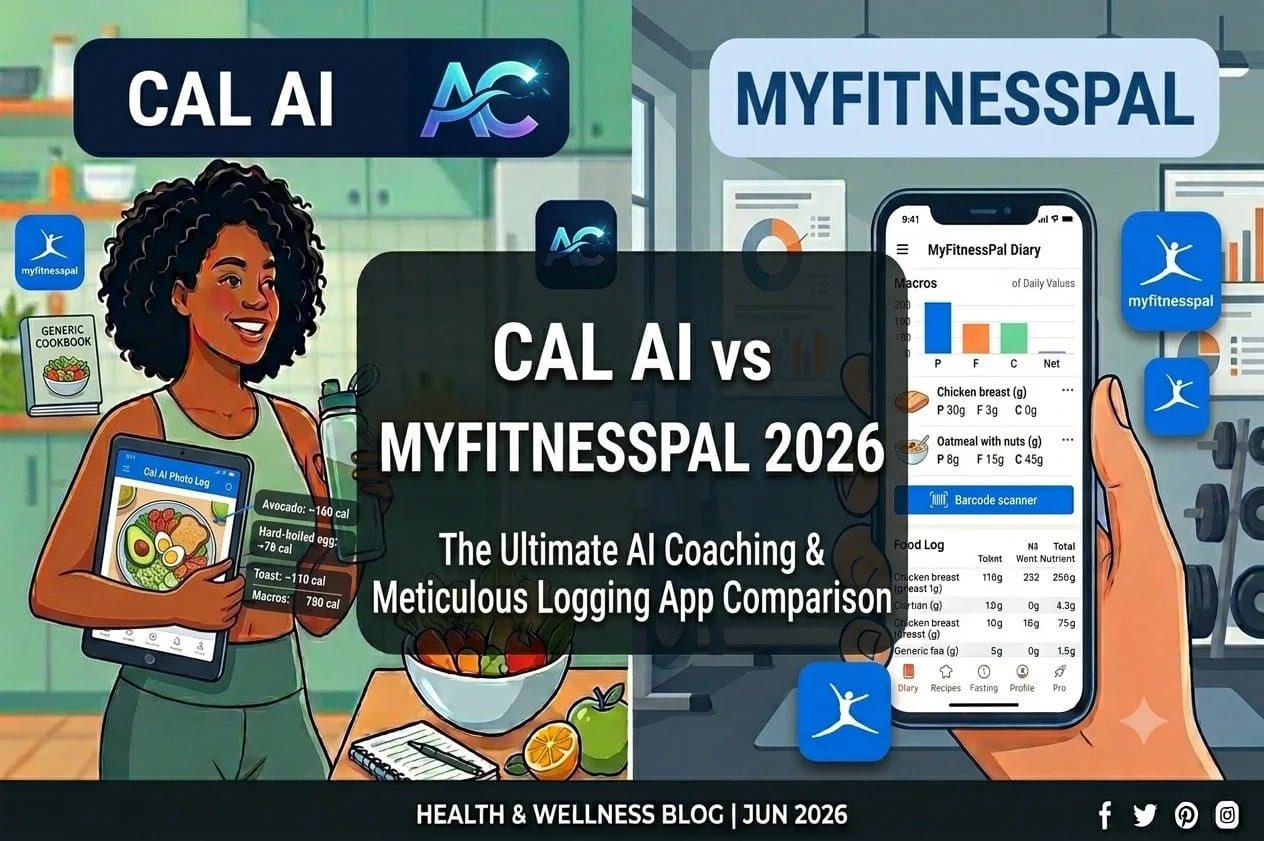
Cal AI vs MyFitnessPal, which is better?
Cal AI is better if you want to log meals from a photo without searching a database. MyFitnessPal is better if database breadth matters most and you eat mostly packaged or branded foods with barcodes. Cal AI’s photo recognition is faster for unpackaged meals, while MyFitnessPal’s 14 million food database means almost any product is already searchable. Neither app offers a real-time AI nutrition coach or the portion estimation accuracy of newer AI trackers. Welling, which logs in 2.6 seconds on average with 95.6 percent food identification accuracy and includes a coaching layer, is worth comparing against both.
Table of Contents
- What Is Cal AI Built For?
- What Is MyFitnessPal Built For?
- How Do Cal AI and MyFitnessPal Compare on Logging Speed?
- Which App Is More Accurate?
- Which App Handles International and Home-Cooked Food Better?
- Does Either App Have a Nutrition Coach?
- How Do Cal AI and MyFitnessPal Compare on Price?
- Is There a Better Alternative to Both?
- Frequently Asked Questions
- References
What Is Cal AI Built For?
Cal AI is a photo-first calorie tracking app. Its core proposition is that you photograph a meal and the AI identifies what you ate and logs the estimated calories and macros automatically, without searching a database. This is the same fundamental idea as other AI food scanning apps, but Cal AI has built a following, particularly among younger users and social media audiences, around making that scanning experience the main event.
The app is simple by design. Photograph your food, see the calories, log it. There is minimal coaching, limited nutrient depth beyond basic macros, and no conversational AI layer. For users who want the simplest possible photo-based calorie log without additional features, this simplicity has appeal.
What Is MyFitnessPal Built For?
MyFitnessPal is the most widely used calorie tracking app in the world, built on a database of over 14 million foods accumulated over more than a decade of user contributions. The core experience is a food diary: search for what you ate, find the entry, adjust the serving size, and log it. Barcode scanning speeds up logging for packaged products.
It tracks calories, macros, and some micronutrients with additional detail available on premium. It supports custom macro goals, exercise logging, and has a large community of users. For someone who eats mostly packaged, branded, or restaurant food that is already in the database, MyFitnessPal’s breadth makes logging relatively fast and comprehensive.
How Do Cal AI and MyFitnessPal Compare on Logging Speed?
Cal AI is faster for unpackaged and home-cooked meals because photo recognition removes the need to search a database. You photograph the meal and the AI returns an estimate. For meals that are difficult to search manually, this is a meaningful time saving.
MyFitnessPal is faster for packaged foods with barcodes, since a quick scan returns an exact entry from the database. For anything without a barcode, it falls back to manual search, which is slower and more dependent on finding the right entry.
The practical comparison depends on what your typical meals look like. A diet heavy in packaged supermarket food and chain restaurant meals favours MyFitnessPal’s database speed. A diet with more home cooking, fresh ingredients, or restaurant meals without standard menu entries favours Cal AI’s photo approach.
Which App Is More Accurate?
Accuracy in this comparison splits across two different questions: accuracy of individual data entries, and accuracy of portion estimation.
For individual food data, MyFitnessPal’s user-submitted database contains a mix of verified and unverified entries. Popular foods tend to have multiple entries of varying accuracy, and selecting the wrong one is an easy mistake. Research has found meaningful error rates in user-submitted calorie tracking databases, with some popular entries showing significant discrepancies from verified laboratory values.
Cal AI’s photo recognition estimates calories and macros from an image, which introduces a different kind of error: portion estimation from a two-dimensional photograph. The accuracy of this depends on the model’s training, the angle of the photo, lighting, and how complex the meal is.
Neither app publishes detailed independent accuracy data across large test sets. Welling, by comparison, publishes testing results showing 95.6 percent food identification accuracy across 15,000 meals with a 1.2 percent portion estimation error, which provides a concrete benchmark that Cal AI and MyFitnessPal do not match in their public documentation.
Which App Handles International and Home-Cooked Food Better?
Cal AI handles these relatively well since photo recognition does not depend on a food being in a database. If the AI model was trained on images of Malaysian dishes, Thai street food, or home-cooked curries, it can recognise and estimate them from a photo without requiring a database entry to exist.
MyFitnessPal handles international food through its user-submitted database, which means coverage varies considerably. Popular dishes from cuisines with active MyFitnessPal user communities are often well represented. Less common regional or home-cooked dishes may be missing or have inaccurate entries.
For international food overall, a well-trained AI photo recognition app has a structural advantage over a database-based app, since the photo model can handle visual recognition of a dish without a prior entry existing. The quality of that advantage depends on the breadth and diversity of the model’s training data.
Does Either App Have a Nutrition Coach?
Neither Cal AI nor MyFitnessPal includes a conversational AI nutrition coach as a core feature.
Cal AI focuses on photo logging and calorie display. There is no coaching layer that interprets your logged data, answers nutrition questions, or tells you what to eat next based on your remaining targets.
MyFitnessPal provides nutritional summaries, goal progress, and some guided features on premium, but these are data displays rather than a coach that engages with your specific day and answers specific questions.
Both apps function as logging tools: they record what you eat but leave the interpretation and decision-making to you. For someone who wants an app that actively tells them what to do next based on what they have logged, neither app currently fills that role.
How Do Cal AI and MyFitnessPal Compare on Price?
Cal AI operates on a freemium model. Basic photo logging is available, with a premium subscription unlocking additional features. Check current pricing directly on the app, as plans change.
MyFitnessPal has a free plan with core database access and barcode scanning. MyFitnessPal Premium unlocks detailed macro customisation, ad-free experience, and additional nutrient data.
Both have usable free tiers, though Cal AI’s premium gates more of the useful features than MyFitnessPal’s free plan does for basic daily tracking.
Is There a Better Alternative to Both?
Cal AI solved the photo logging problem that MyFitnessPal never properly addressed. But in doing so it stripped everything else out, including the breadth of a large database for packaged foods, meaningful micronutrient tracking, and any form of coaching guidance.
Welling combines the photo-first logging approach Cal AI is known for with a larger, global food database, barcode scanning, chat and voice logging, and a real-time AI nutrition coach. It logs meals in 2.6 seconds on average with 95.6 percent food identification accuracy across 15,000 tested meals and a portion estimation error of 1.2 percent. It also tracks fiber, sodium, and sugar in addition to calories and macros, and adapts coaching guidance to custom dietary preferences including medical and strict diets.
For someone who landed on this comparison looking for a photo-based calorie tracker that also has depth and coaching, Welling is the closest thing to what both Cal AI and MyFitnessPal are trying to be, taken together.
Photo logging with coaching, not just a calorie number.
Welling logs meals from a photo, chat message, or voice note in 2.6 seconds on average, with 95.6 percent food identification accuracy across 15,000 tested meals. Ask it what to eat next and get a real answer.
Start tracking free on Welling
Frequently Asked Questions
Is Cal AI more accurate than MyFitnessPal?
The two apps produce different types of accuracy errors. Cal AI estimates calories from a photo, with the main error source being portion estimation from an image. MyFitnessPal returns data from user-submitted entries, with the main error source being incorrect or unverified data in those entries. Independent accuracy data for Cal AI at scale is limited. MyFitnessPal’s user-submitted database has documented accuracy issues in research. Welling publishes specific accuracy benchmarks, 95.6 percent food identification and 1.2 percent portion estimation error across 15,000 meals, which neither Cal AI nor MyFitnessPal matches in published documentation.
Can Cal AI track macros as well as MyFitnessPal?
Cal AI tracks basic macros alongside calories from its photo estimates. MyFitnessPal tracks macros through its database entries, with more granular customisation options for macro targets on premium. For detailed macro goal setting and tracking, MyFitnessPal’s explicit target controls are more developed than Cal AI’s current feature set.
Does Cal AI have a barcode scanner like MyFitnessPal?
Cal AI’s primary logging method is photo recognition. MyFitnessPal’s barcode scanner is one of its most used features for packaged foods. If you eat a lot of packaged food and rely on barcode scanning for accuracy, MyFitnessPal handles this more robustly than Cal AI.
Which app is better for international food?
Cal AI’s photo recognition can handle international dishes that have never been entered into a database, which gives it a structural advantage over MyFitnessPal’s database-dependent approach for regional and home-cooked international food. Welling extends this further with a food database and AI model specifically built for global and international cuisines, including Asian food, which is a stated gap in apps like MyFitnessPal.
What is the best alternative to both Cal AI and MyFitnessPal?
Welling combines photo logging with barcode scanning, chat, and voice input, and adds an AI nutrition coach and a food database built for international cuisines. It logs in 2.6 seconds on average with 95.6 percent food ID accuracy across 15,000 tested meals, and tracks fiber, sodium, and sugar alongside calories and macros.
Is Cal AI free to use like MyFitnessPal?
Both apps have free tiers. Cal AI gates more features behind a premium subscription than MyFitnessPal does. MyFitnessPal’s free plan gives access to a large database with basic calorie and macro tracking. Welling also has a free plan including AI photo, chat, and voice logging and access to the AI nutrition coach.
References
Ferrara, G., Kim, J., Lin, S., Hua, J., & Seto, E. (2019). A Focused Review of Smartphone Diet-Tracking Apps: Usability, Functionality, Coherence With Evidence, and Comparative Validity. JMIR mHealth and uHealth, 7(5), e9232.
Mezgec, S., & Koroušić Seljak, B. (2017). NutriNet: A Deep Learning Food and Drink Image Recognition System for Dietary Assessment. Nutrients, 9(6), 657.
Urban, L. E., et al. (2011). The Accuracy of Stated Energy Contents of Reduced-Energy, Commercially Prepared Foods. Journal of the American Dietetic Association, 111(5), 738-740.
Burke, L. E., et al. (2011). Self-Monitoring in Weight Loss: A Systematic Review of the Literature. Journal of the American Dietetic Association, 111(1), 92-102.
USDA Agricultural Research Service. (2024). FoodData Central.
Lieffers, J. R. L., & Hanning, R. M. (2012). Dietary Assessment and Self-Monitoring with Nutrition Applications for Mobile Devices. Canadian Journal of Dietetic Practice and Research, 73(3), e253-e260.