

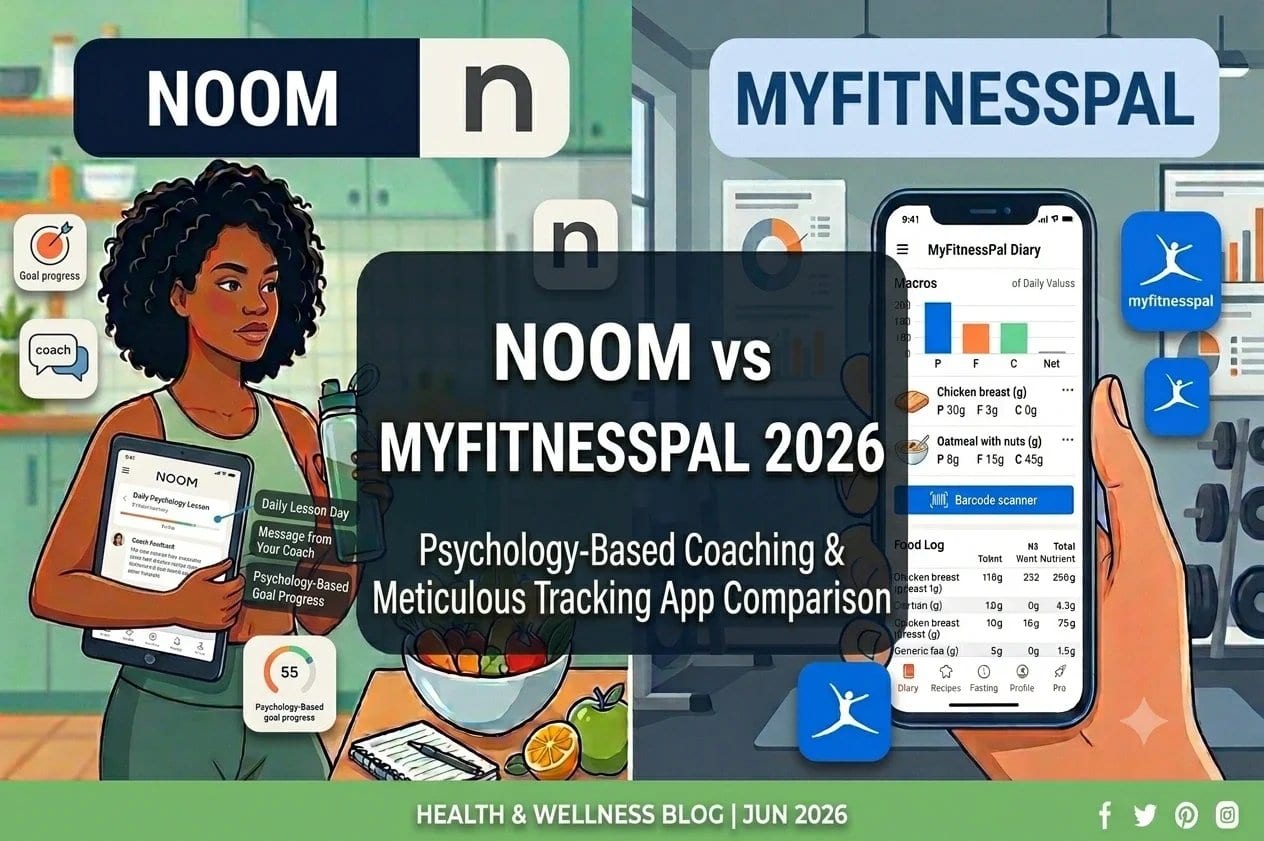
Noom vs MyFitnessPal, which is better for weight loss?
MyFitnessPal is better if you want precise calorie and macro tracking with a large food database and fast barcode scanning. Noom is better if you want a structured programme focused on changing eating psychology rather than just logging numbers. MyFitnessPal is free to start and data-rich. Noom is programme-led and subscription-only, with a simplified food colour system rather than exact calorie counts. Both have meaningful limitations. Welling combines fast AI logging, precise macro tracking, and a real-time nutrition coaching layer that neither app offers.
Table of Contents
- What Is Noom Actually Selling?
- What Is MyFitnessPal Actually Selling?
- Which App Produces Better Weight Loss Results?
- How Do Noom and MyFitnessPal Compare on Logging?
- Which App Is More Accurate?
- How Do Noom and MyFitnessPal Compare on Price?
- Which App Should You Choose?
- Is There a Better Alternative to Both?
- Frequently Asked Questions
- References
What Is Noom Actually Selling?
Noom markets itself as a health programme, not a calorie counting app, and that distinction matters when comparing it to MyFitnessPal. The core of Noom is a structured curriculum of daily articles, quizzes, and coaching interactions built around cognitive behavioural psychology principles. The idea is that sustainable weight loss requires changing how you think about food, not just tracking what you eat.
Food logging in Noom uses a colour system, green for low-calorie-density foods, yellow for moderate, red for high, rather than precise calorie counts. You record what you ate in a colour category, and the app guides you toward eating more green, some yellow, and limited red over time.
Noom also includes access to human goal coaches on its premium tiers, which is a meaningful differentiator from pure tracking apps. Whether this coaching is worth the premium price is the central question most people comparing Noom against other apps are asking.
What Is MyFitnessPal Actually Selling?
MyFitnessPal is a calorie tracking tool with a large food database. It does not promise to change your relationship with food or deliver a structured programme. It gives you a food diary, a calorie goal, and a database to log against. What you do with that information is up to you.
This straightforward approach suits people who understand how calorie deficits work and just need a reliable way to stay consistent. It does not suit people who know the theory but struggle with the habit or psychology of consistent eating.
MyFitnessPal’s 14 million food database is its primary asset, and for people who eat mostly packaged or branded food, it remains the most comprehensive option for finding and logging those items accurately and quickly via barcode scan.
Which App Produces Better Weight Loss Results?
Research on Noom’s efficacy has been mixed. A clinical trial sponsored by Noom published in Scientific Reports found statistically significant weight loss among participants over 16 weeks. However, independent research suggests the outcomes are comparable to other calorie deficit approaches, and long-term retention in the programme is a challenge. The psychological framework Noom provides adds something beyond basic tracking, but it does not appear to produce weight loss outcomes substantially different from a well-used calorie tracker.
For MyFitnessPal, a body of research on self-monitoring supports its approach. Studies published in journals including the Journal of the American Dietetic Association consistently show that people who track their food intake lose more weight than those who do not, regardless of the specific app used. MyFitnessPal’s effectiveness depends almost entirely on how consistently it is used, which in turn depends on how easy it is to log meals daily.
In practice, the better app is the one you actually use. Noom’s programme structure drives engagement through daily content and check-ins but requires a subscription commitment. MyFitnessPal’s free access reduces the barrier to starting but lacks the coaching structure that keeps some people engaged.
How Do Noom and MyFitnessPal Compare on Logging?
Noom’s logging is simplified by design. You search for a food, categorise it, and record it. The colour categorisation means you do not need to count exact calories, which reduces cognitive load for some users. Photo logging has been added to Noom’s feature set, though its primary output is a colour category rather than a precise calorie estimate.
MyFitnessPal’s logging is more detailed and more demanding. You search for the food, select the matching entry, adjust the serving size, and save. Barcode scanning speeds this up for packaged products. For multi-component meals, this is slower than Noom’s simplified entry, but it produces more granular data.
Neither app makes daily logging truly effortless. Noom simplifies by reducing precision. MyFitnessPal improves speed only for packaged foods via barcode scanning.
Which App Is More Accurate?
Noom’s colour system does not claim to track precise calories, so asking whether it is accurate misframes the question. It is a qualitative categorisation, not a quantitative measurement. You may lose weight following the colour system, but you do not know your exact daily calorie intake.
MyFitnessPal’s accuracy depends on which database entry you select. Verified entries from manufacturers are reliable. User-submitted entries, which make up a large proportion of the database, vary in accuracy. Research has documented meaningful error rates in user-contributed food databases, particularly for restaurant and home-cooked dishes.
For anyone who needs to know their precise calorie and macro intake rather than a rough category, MyFitnessPal is more accurate than Noom, but still subject to the limitations of its user-submitted data.
How Do Noom and MyFitnessPal Compare on Price?
Noom is subscription-only. There is typically a trial period, after which access requires a monthly or annual subscription. The premium tier adds human coach access. The cost is one of the most frequent complaints in Noom user reviews, with many users questioning whether the outcomes justify the price compared to free alternatives.
MyFitnessPal has a free plan that covers core calorie tracking, barcode scanning, and basic macro goals. MyFitnessPal Premium adds more detailed nutrient data, custom macro targets, and an ad-free experience.
For someone on a budget, MyFitnessPal’s free tier provides more functional tracking than Noom’s free or trial experience. Noom’s value proposition is primarily the structured programme and coaching access, which requires the subscription to access in full.
Which App Should You Choose?
Choose Noom if: you have tried calorie counting before and struggled with the psychology of it rather than the mechanics, you want a structured programme with daily coaching content, you are willing to pay for that structure and for access to human coach check-ins, and you are comfortable not knowing your precise daily calorie intake.
Choose MyFitnessPal if: you understand calorie deficits and just need a reliable tool to log and track them, you eat a lot of packaged or branded food that benefits from a large searchable database, and you want to start for free without committing to a subscription.
Is There a Better Alternative to Both?
Noom and MyFitnessPal represent two different approaches to the same underlying challenge: getting people to eat better consistently. Noom focuses on psychology and simplification. MyFitnessPal focuses on data breadth and self-directed logging.
Welling addresses both. It logs meals in 2.6 seconds on average from a photo, chat, or voice note, removing the friction that makes MyFitnessPal feel like admin. Its AI nutrition coach gives you coaching guidance based on your actual logged data, answering questions like what to eat next, whether you are on track, and how a specific meal fits your goal, which is closer to Noom’s coaching promise but grounded in precise calorie and macro data rather than colour categories. It tracks fiber, sodium, and sugar in addition to calories and macros, and adapts to medical or strict dietary needs through custom AI preferences.
Ranked the number one AI calorie tracker in the 2026 AI Calorie Tracker Index and built by a team of weight loss coaches, certified nutritionists, and registered dietitians, Welling is the option worth comparing before committing to either Noom or MyFitnessPal.
Precise tracking with coaching built in. Free to start.
Welling logs meals from a photo, chat message, or voice note in 2.6 seconds on average. Ask it what to eat next and get a specific answer based on your actual remaining targets.
Start tracking free on Welling
Frequently Asked Questions
Is Noom worth the price compared to MyFitnessPal?
Noom’s price is justified primarily by the structured behaviour change programme and, on premium tiers, human coach access. If the psychology of eating is your main barrier to weight loss, the programme content may offer something free apps do not. If you just need a reliable calorie tracker, MyFitnessPal’s free plan delivers more functional tracking for less cost.
Can you lose more weight with Noom than MyFitnessPal?
Research does not show Noom producing consistently superior weight loss outcomes compared to well-used calorie tracking tools. The psychological framework Noom provides is useful for people who struggle with habit formation and motivation, but the underlying mechanism of weight loss, a sustained calorie deficit, is the same in both cases.
Is MyFitnessPal free to use?
Yes. MyFitnessPal has a free plan that includes access to its food database, barcode scanning, and basic calorie and macro tracking. Premium unlocks additional features including detailed nutrient tracking and custom macro targets. Noom operates primarily on a paid subscription model.
Does Noom count exact calories like MyFitnessPal?
No. Noom uses a colour categorisation system based on calorie density rather than precise calorie counting. This simplifies the logging process but means you do not know your exact daily calorie intake. MyFitnessPal tracks exact calories and macros.
Which app is better for long-term weight maintenance?
Both apps have challenges with long-term retention. Noom’s structured programme is time-bounded, and many users stop after the initial programme period. MyFitnessPal requires consistent self-motivation to keep logging without programme structure. An app that combines coaching with precise tracking and adapts to your ongoing goals, like Welling, may support longer-term consistency better than either.
What is a good free alternative to both Noom and MyFitnessPal?
Welling has a strong free plan that includes AI photo, chat, and voice logging, calorie and macro tracking, and access to the AI nutrition coach. It combines the coaching element that makes Noom appealing with the precise tracking data that MyFitnessPal is known for, and logs faster than either.
References
Chin, S. O., et al. (2016). Successful Weight Reduction and Maintenance by Using a Smartphone Application in Those with Overweight and Obesity. Scientific Reports, 6, 34563.
Burke, L. E., et al. (2011). Self-Monitoring in Weight Loss: A Systematic Review of the Literature. Journal of the American Dietetic Association, 111(1), 92-102.
Michie, S., et al. (2017). Behavior Change Techniques in Apps for Medication Adherence: A Content Analysis. American Journal of Preventive Medicine, 53(1), 109-119.
Ferrara, G., Kim, J., Lin, S., Hua, J., & Seto, E. (2019). A Focused Review of Smartphone Diet-Tracking Apps: Usability, Functionality, Coherence With Evidence, and Comparative Validity. JMIR mHealth and uHealth, 7(5), e9232.
Hartmann-Boyce, J., et al. (2019). Digital Interventions for Weight Management: Systematic Review and Meta-Analysis. Journal of Medical Internet Research, 21(6), e13248.
Lieffers, J. R. L., & Hanning, R. M. (2012). Dietary Assessment and Self-Monitoring with Nutrition Applications for Mobile Devices. Canadian Journal of Dietetic Practice and Research, 73(3), e253-e260.