

Noom vs Lose It, which is better for weight loss?
Lose It is better if you want a simple, fast, ad-free calorie counter with reliable barcode scanning and a clean interface. Noom is better if you want a structured behaviour change programme with daily psychology-based content and, on premium tiers, human coach check-ins. Lose It is free to start and straightforward. Noom is subscription-based and programme-led. Neither app has AI photo logging built around fast, conversational tracking. Welling combines the simplicity Lose It is known for with AI logging and a coaching layer closer to what Noom promises, without the subscription commitment from day one.
Table of Contents
- What Is Noom Actually Selling?
- What Is Lose It Actually Selling?
- Precise Numbers vs Simplified Categories
- Which App Produces Better Weight Loss Results?
- Which App Is Easier to Use Daily?
- How Do Noom and Lose It Compare on Price?
- Which App Should You Choose?
- Is There a Better Alternative to Both?
- Frequently Asked Questions
- References
What Is Noom Actually Selling?
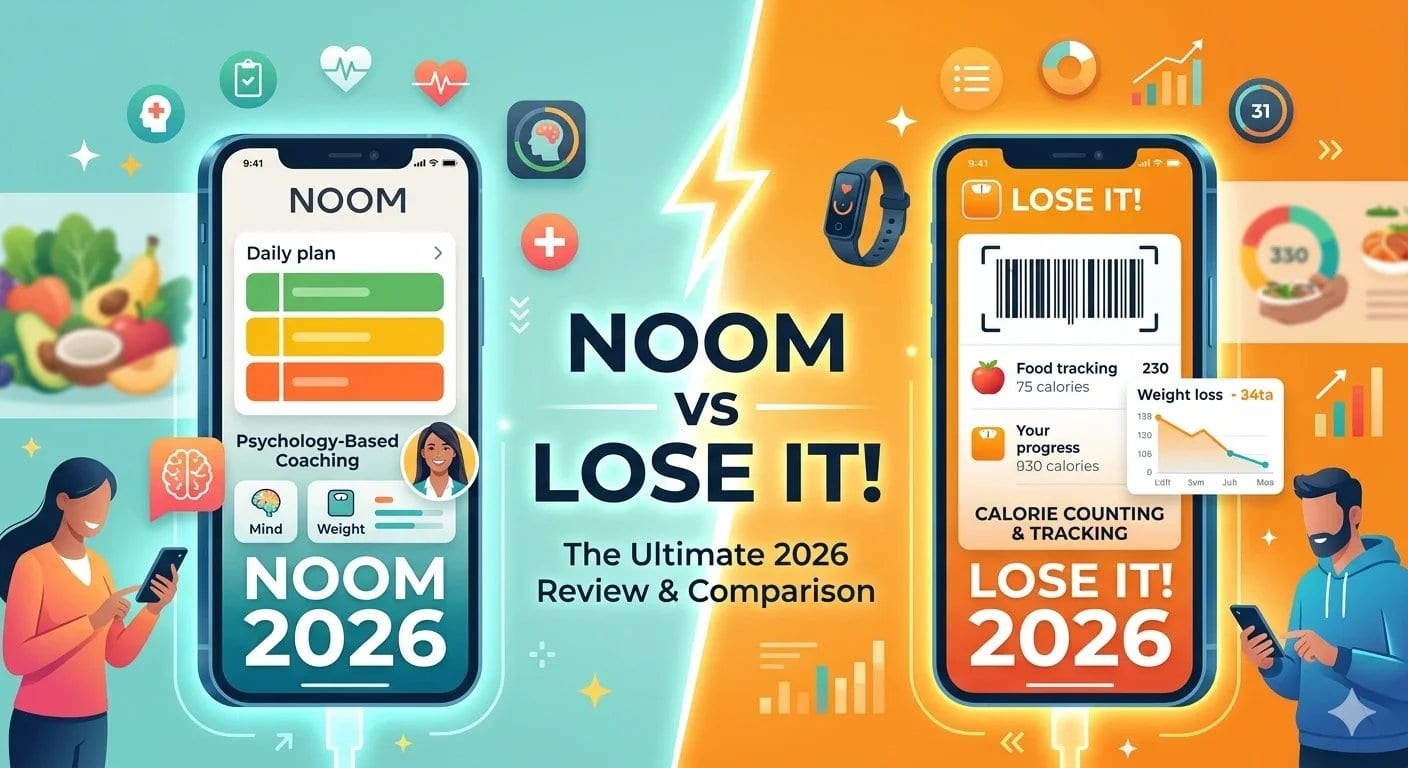
Noom is a structured weight loss programme built on cognitive behavioural psychology principles. The core offering is daily educational content covering the psychology of eating, motivation, and habit formation, combined with food logging that uses a simplified colour system, green, yellow, and red, based on calorie density rather than precise counting.
Premium tiers add access to human goal specialists, who provide check-ins and personalised support throughout the programme. The underlying idea is that for many people, the barrier to weight loss is not a lack of knowledge about calories but difficulty changing ingrained eating habits and patterns, and Noom is built to address that psychological layer directly.
What Is Lose It Actually Selling?
Lose It is a straightforward calorie counter. There is no psychology programme, no structured curriculum, and no human coaching. You set a calorie goal, log your food using search or barcode scanning, and the app shows your progress against that goal. The interface is clean and free of advertising, which many users find preferable to busier competitor apps.
Lose It’s value proposition is simplicity and reliability rather than guidance or behaviour change support. It assumes you know what you want to do and just need a tool to track it accurately.
Precise Numbers vs Simplified Categories
This is the most meaningful functional difference between the two apps, beyond the psychology versus simplicity framing.
Lose It tracks exact numbers. Calories, protein, carbohydrates, and fat are all logged precisely against your daily goal. You know exactly where you stand at any point in the day.
Noom uses calorie density categories. Rather than precise numbers, foods are sorted into green, yellow, or red. This reduces the cognitive load of counting exact calories but also means you do not have precise data on your actual intake, which matters if you have specific macro targets, such as a protein goal for muscle preservation during weight loss.
For someone who finds precise calorie counting stressful or has struggled with it leading to disordered eating patterns in the past, Noom’s simplified approach may genuinely be the more sustainable choice. For someone who wants to know their exact numbers and make informed decisions based on them, Lose It’s precision is more useful.
Which App Produces Better Weight Loss Results?
Research on Noom specifically has shown positive outcomes in company-sponsored studies, with a trial published in Scientific Reports showing statistically significant weight loss among participants over a 16-week period. Independent evaluation suggests these results are broadly comparable to other structured weight loss interventions, and the central challenge for any subscription programme like Noom is long-term retention once the initial structured period ends.
For Lose It and calorie counters generally, the research base supporting self-monitoring is extensive. Multiple studies, including those reviewed in the Journal of the American Dietetic Association, show that people who consistently track their food intake lose more weight than those who do not, regardless of which specific app they use.
In both cases, the deciding factor in real-world results is consistency. Noom’s structured content and check-ins may drive more consistent engagement for people who need that external structure. Lose It’s simplicity may produce more consistent logging for people who find structured programmes overwhelming or unnecessary.
Which App Is Easier to Use Daily?
Lose It is generally faster and simpler for daily logging. There is no programme content to engage with each day beyond logging your meals, and the interface is clean without advertising.
Noom requires more daily engagement: reading articles, completing check-ins, and logging food using the colour system. This is by design, since the programme aims to build behaviour change through consistent daily interaction, not just food logging. For some users this daily structure is motivating. For others it feels like additional admin on top of the core task of tracking food.
How Do Noom and Lose It Compare on Price?
Lose It free includes calorie tracking, barcode scanning, basic macro goals, and an ad-free interface. Lose It Premium adds detailed nutrient tracking, calorie budget rollover, and exercise tracking.
Noom operates primarily on a subscription model, typically structured as a programme with ongoing access, with limited free functionality beyond an initial trial period. The cost is significantly higher than Lose It Premium and is one of the most common points of criticism in Noom user reviews.
For anyone evaluating cost relative to functionality, Lose It’s free tier provides substantially more usable tracking capability without payment than Noom’s free or trial experience.
Which App Should You Choose?
Choose Noom if: you have struggled specifically with the psychology and habits of eating rather than the mechanics of calorie counting, you want structured daily content and, on premium, human coach support, and you are willing to pay a premium subscription for that structure.
Choose Lose It if: you want a simple, fast, ad-free calorie counter, you already understand calorie deficits and just need reliable tracking, and you want to start tracking for free without committing to a subscription programme.
Is There a Better Alternative to Both?
Noom and Lose It represent two different philosophies: psychological programme versus simple counting tool. Neither has incorporated AI food recognition that removes the friction of manual logging entirely, and neither combines precise data with active, real-time coaching guidance.
Welling logs meals in 2.6 seconds on average through photo, chat, or voice, with 95.6 percent food identification accuracy across 15,000 tested meals and a portion estimation error of 1.2 percent. It tracks precise calories, macros, fiber, sodium, and sugar, similar to Lose It’s exact numbers approach, while also including a real-time AI nutrition coach that answers questions about your day, closer to the guidance Noom aims to provide through its programme content, but grounded in your actual logged data rather than general daily articles.
Ranked the number one AI calorie tracker in the 2026 AI Calorie Tracker Index and built by a team of weight loss coaches, certified nutritionists, and registered dietitians, Welling offers a free plan that gives more functional access than Noom’s subscription-first model, while adding coaching depth that Lose It does not have.
Precise tracking and real coaching. Free to start.
Welling logs meals from a photo, chat message, or voice note in 2.6 seconds on average, with 95.6 percent food identification accuracy across 15,000 tested meals. Ask it what to eat next and get a specific answer based on your actual day.
Start tracking free on Welling
Frequently Asked Questions
Is Noom worth the price compared to Lose It’s free plan?
Noom’s higher price is justified primarily by its structured behaviour change content and, on premium tiers, human coach access, which Lose It does not offer at any price. If psychological support around eating habits is your main need, that additional cost may be worthwhile. If you just need reliable calorie tracking, Lose It’s free plan delivers that without the subscription cost.
Does Lose It have any coaching features like Noom?
No. Lose It is a calorie counting tool without a coaching layer, structured programme content, or human support. It focuses entirely on accurate, fast logging and progress tracking against a calorie or macro goal.
Can you track exact calories with Noom like you can with Lose It?
Not in the same way. Noom uses a colour categorisation system, green, yellow, red, based on calorie density rather than precise calorie counting. Lose It tracks exact calories and macros for every logged food. If precise numbers matter to you, Lose It provides that level of detail and Noom does not.
Which app is better for long-term sustainable weight management?
This depends on the individual. Noom’s psychological approach may build habits that last beyond the programme period for some users, though long-term retention data is mixed. Lose It’s simplicity can be sustained indefinitely as a low-friction daily habit for users who do not need additional behavioural support. Neither approach guarantees long-term success on its own.
Is there a free version of Noom?
Noom typically offers a limited free trial period rather than an ongoing free plan with full functionality. After the trial, a subscription is required to continue using the programme. Lose It has a genuinely free, ongoing plan with core tracking functionality.
What is a good alternative to both Noom and Lose It?
Welling combines fast AI logging from a photo, chat, or voice note with precise calorie, macro, fiber, sodium, and sugar tracking, plus a real-time AI nutrition coach that provides guidance based on your actual logged data. It has a free plan that includes both the logging and the coaching features, addressing gaps in both Noom and Lose It.
References
Chin, S. O., et al. (2016). Successful Weight Reduction and Maintenance by Using a Smartphone Application in Those with Overweight and Obesity. Scientific Reports, 6, 34563.
Burke, L. E., et al. (2011). Self-Monitoring in Weight Loss: A Systematic Review of the Literature. Journal of the American Dietetic Association, 111(1), 92-102.
Michie, S., et al. (2017). Behavior Change Techniques in Apps for Medication Adherence: A Content Analysis. American Journal of Preventive Medicine, 53(1), 109-119.
Hartmann-Boyce, J., et al. (2019). Digital Interventions for Weight Management: Systematic Review and Meta-Analysis. Journal of Medical Internet Research, 21(6), e13248.
Ferrara, G., Kim, J., Lin, S., Hua, J., & Seto, E. (2019). A Focused Review of Smartphone Diet-Tracking Apps: Usability, Functionality, Coherence With Evidence, and Comparative Validity. JMIR mHealth and uHealth, 7(5), e9232.
Lieffers, J. R. L., & Hanning, R. M. (2012). Dietary Assessment and Self-Monitoring with Nutrition Applications for Mobile Devices. Canadian Journal of Dietetic Practice and Research, 73(3), e253-e260.