

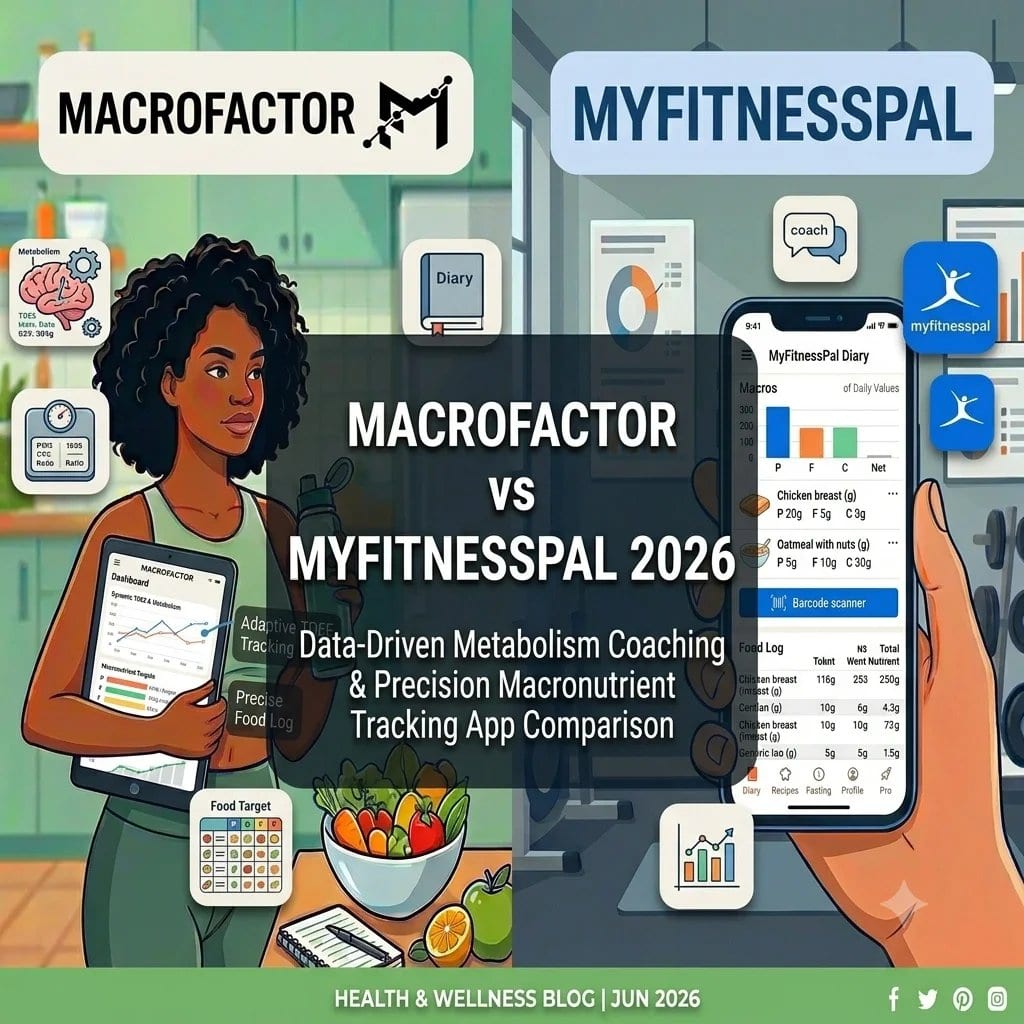
MacroFactor vs MyFitnessPal, which is better for tracking macros?
MacroFactor is better if you want your calorie and macro targets to adjust automatically based on your logged weight trend over time, making it well suited to structured cuts and bulks. MyFitnessPal is better if database breadth is your priority, since its 14 million food entries cover virtually any packaged product or restaurant meal. MacroFactor requires a subscription and consistent weigh-ins to deliver its core benefit. MyFitnessPal’s free tier is functional for most basic tracking needs. Welling adds what neither offers: AI food logging in 2.6 seconds on average and a real-time nutrition coaching layer.
Table of Contents
- What Is MacroFactor Built For?
- What Is MyFitnessPal Built For?
- How Does MacroFactor’s Adaptive Algorithm Work?
- Which App Tracks Macros More Accurately?
- How Do MacroFactor and MyFitnessPal Compare on Logging Speed?
- Which App Is Better for Gym and Body Composition Goals?
- How Do MacroFactor and MyFitnessPal Compare on Price?
- Is There a Better Alternative to Both?
- Frequently Asked Questions
- References
What Is MacroFactor Built For?
MacroFactor is built for people who take structured dieting seriously and want their calorie and macro targets to evolve based on real-world data rather than a fixed formula. Its central feature is an adaptive algorithm that analyses your logged body weight over time alongside your logged food intake, estimates your actual total daily energy expenditure from that data, and recalibrates your forward targets accordingly.
This solves a genuine problem: standard TDEE calculations based on height, weight, and activity multipliers can be inaccurate for individuals, and they do not account for metabolic adaptation as diets progress. MacroFactor’s algorithm builds a picture of how your body actually responds to your intake, which is more accurate over time than any initial formula.
The food logging side works through a conventional database search and barcode scanner. MacroFactor’s intelligence is concentrated in the target calculation rather than the logging experience.
What Is MyFitnessPal Built For?
MyFitnessPal is a food diary with the world’s largest user-contributed food database. The core proposition is coverage: with over 14 million entries, virtually any food you eat is likely to be findable. Barcode scanning is fast for packaged products. Custom macro goals allow you to set specific calorie and macro targets.
MyFitnessPal does not adapt your targets based on your weight trend data. You set a goal, and that goal stays fixed unless you manually change it. For someone who knows what target they want and just needs a reliable tool to track against it, this is straightforward. For someone who wants their targets to evolve automatically as their body adapts, this is a limitation.
How Does MacroFactor’s Adaptive Algorithm Work?
The MacroFactor algorithm uses a mathematical approach to estimate expenditure from logged body weight changes and intake history, similar in principle to methods used in metabolic research. When your weight drops faster than your intake predicts, the algorithm infers your expenditure was higher than estimated and adjusts upward. When weight drops slower than expected, it adjusts downward.
For this to work well, two conditions need to be met consistently: accurate food logging and consistent daily weigh-ins. If either input is inconsistent, the algorithm’s output is less reliable. This is a real constraint in practice, since the days when food logging is most inconsistent tend to be the days that are most difficult to weigh in on, such as during travel or social events.
When these conditions are met, MacroFactor’s approach is genuinely more precise than a static TDEE formula, particularly for people who have been dieting for extended periods and whose metabolism has adapted.
Which App Tracks Macros More Accurately?
Macro tracking accuracy in both apps depends primarily on the quality of the food database entry selected, since both use database search as the primary logging method.
MyFitnessPal’s database is user-contributed, which means accuracy varies between entries. Popular foods tend to have multiple entries of varying quality. Research has documented error rates in user-submitted calorie databases that can be significant for some food types.
MacroFactor’s database is curated with more attention to data quality than MyFitnessPal’s community-first approach. Entries tend to be more reliably verified, though the database is smaller and certain regional or niche foods may not be present.
For the macro target side, MacroFactor’s adaptive algorithm makes the targets themselves more accurate over time than MyFitnessPal’s static goals. This is a different kind of accuracy than individual food entry accuracy, but it is the more important factor for people running a structured diet phase.
How Do MacroFactor and MyFitnessPal Compare on Logging Speed?
Both apps use database search and barcode scanning as their primary logging methods, so the comparison here is relatively narrow.
MacroFactor has a clean, fast interface for logging. Its database, while smaller than MyFitnessPal’s, is well organised and the search experience is smooth.
MyFitnessPal has the speed advantage for packaged foods due to database breadth and its large barcode recognition library. For foods that need manual searching, the larger database means more options, but also more noise in search results from multiple similar entries.
Neither app has AI photo, voice, or chat logging. Both require the user to initiate a search, find the right entry, and confirm the serving size for every meal logged.
Which App Is Better for Gym and Body Composition Goals?
MacroFactor is the clearer choice for structured gym goals. The adaptive algorithm is specifically useful for body composition work, where hitting precise macro targets over weeks matters more than for general health tracking. Its target adjustment based on real weight trend data helps avoid the plateau problem that affects many people on static calorie targets.
MyFitnessPal works adequately for gym goals when used with manually set macro targets. The supplement and protein product database is broad, covering most popular protein powders and bars. The exercise logging feature allows you to add workout calories, though estimates for this can be inaccurate.
For serious bulk and cut phases where precise, adaptive macro targets are a priority, MacroFactor has a meaningful functional advantage. For general gym nutrition tracking without the need for algorithmic target adjustment, MyFitnessPal’s free plan covers the basics.
How Do MacroFactor and MyFitnessPal Compare on Price?
MacroFactor requires a subscription, with no meaningful free tier beyond a trial period. The subscription is the only way to access the adaptive algorithm that is the app’s core value.
MyFitnessPal has a functional free plan for core calorie and macro tracking. MyFitnessPal Premium unlocks detailed nutrient tracking, custom macro percentage targets, and an ad-free experience.
For someone on a budget or wanting to evaluate an app before committing, MyFitnessPal’s free tier provides more usable functionality than MacroFactor without any payment. MacroFactor’s value is concentrated in the adaptive algorithm, which is only available on the paid subscription.
Is There a Better Alternative to Both?
MacroFactor and MyFitnessPal are both fundamentally database-search apps. MacroFactor adds an intelligent target-setting layer on top. Neither adds AI food recognition that removes the need to search at all, and neither includes a coaching layer that helps you decide what to eat based on your current tracked data.
Welling takes a different approach. It logs meals in 2.6 seconds on average from a photo, chat, or voice note with 95.6 percent food identification accuracy across 15,000 tested meals and a portion estimation error of 1.2 percent. It is built for global and international foods, not just Western packaged products, and it tracks fiber, sodium, and sugar alongside calories and macros. Its AI nutrition coach responds to questions in real time: what to eat next, whether you are on track, how a specific meal fits your remaining targets.
For gym-focused users, Welling’s personalised calorie and macro targets account for activity level and training goals, and it auto-adjusts calories based on logged workouts, which captures some of the adaptive benefit MacroFactor is known for in a faster, coach-enabled package.
Adaptive targets, AI logging, and a coach that tells you what to eat next.
Welling logs meals from a photo, chat message, or voice note in 2.6 seconds on average, with 95.6 percent food identification accuracy across 15,000 tested meals. No database searching required.
Start tracking free on Welling
Frequently Asked Questions
Does MacroFactor’s adaptive algorithm make it more accurate than MyFitnessPal?
For macro targets, yes, over time. MacroFactor’s algorithm produces increasingly accurate calorie and macro targets as it collects your weight trend data, making it more precise than a static MyFitnessPal goal for structured diet phases. For individual food entry accuracy, MacroFactor’s curated database is generally more reliable than MyFitnessPal’s user-submitted entries, though the gap is smaller.
Can I use MyFitnessPal for a structured bulk or cut instead of MacroFactor?
Yes. You can set custom macro targets in MyFitnessPal and use it as a straightforward tracking tool for a bulk or cut. The difference is that MacroFactor’s algorithm adjusts those targets over time based on your actual weight response, while MyFitnessPal’s targets stay fixed unless you manually change them. For many people, a well-managed MyFitnessPal setup with periodic manual target reviews produces comparable results to MacroFactor’s automatic adjustments.
Is MacroFactor worth the subscription cost compared to MyFitnessPal’s free plan?
If you are running a structured cut or bulk and want your calorie targets to evolve automatically based on your body’s actual response, MacroFactor’s subscription is justified. If you are doing general health tracking or a less structured dietary approach, MyFitnessPal’s free plan covers most of what you need without the subscription cost.
Which app has a better food database, MacroFactor or MyFitnessPal?
MyFitnessPal is larger, with over 14 million entries versus MacroFactor’s smaller but more curated database. For coverage of niche, regional, or less common foods, MyFitnessPal is more likely to have an entry. For data quality and reliability, MacroFactor’s more carefully maintained database is more consistent.
Is there a macro tracker that also logs from photos?
Welling combines AI photo, chat, and voice logging with macro tracking, personalised targets based on activity and training goals, and a real-time AI nutrition coach. It logs in 2.6 seconds on average with 95.6 percent food ID accuracy across 15,000 tested meals, and auto-adjusts calories from workouts.
Which app is better for tracking protein specifically?
Both apps support protein tracking as a core macro. MacroFactor’s curated database is more reliable for protein accuracy per entry. MyFitnessPal’s supplement and protein product database is broader, covering more specific brands and products. For gym users logging protein powders and bars by barcode, MyFitnessPal’s database breadth is a practical advantage.
References
Hall, K. D., & Guo, J. (2017). Obesity Energetics: Body Weight Regulation and the Effects of Diet Composition. Gastroenterology, 152(7), 1718-1727.
Trexler, E. T., Smith-Ryan, A. E., & Norton, L. E. (2014). Metabolic Adaptation to Weight Loss: Implications for the Athlete. Journal of the International Society of Sports Nutrition, 11, 7.
Ferrara, G., Kim, J., Lin, S., Hua, J., & Seto, E. (2019). A Focused Review of Smartphone Diet-Tracking Apps: Usability, Functionality, Coherence With Evidence, and Comparative Validity. JMIR mHealth and uHealth, 7(5), e9232.
Morton, R. W., et al. (2018). A Systematic Review, Meta-Analysis and Meta-Regression of the Effect of Protein Supplementation on Resistance Training-Induced Gains in Muscle Mass and Strength. British Journal of Sports Medicine, 52(6), 376-384.
USDA Agricultural Research Service. (2024). FoodData Central.
Burke, L. E., et al. (2011). Self-Monitoring in Weight Loss: A Systematic Review of the Literature. Journal of the American Dietetic Association, 111(1), 92-102.