

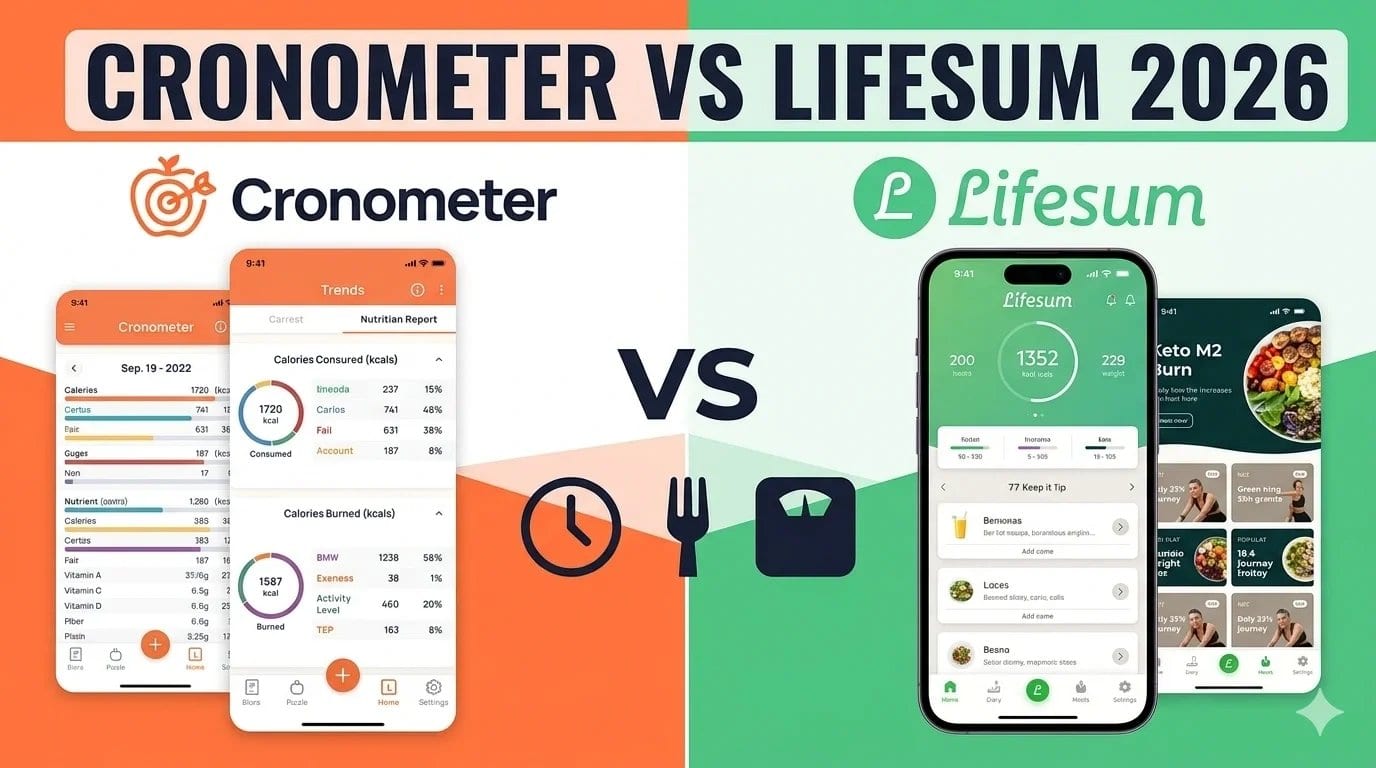
Cronometer vs Lifesum, which is better?
Cronometer is better if precise, verified nutrient data is your priority, tracking over 84 nutrients per food from sources like the USDA. Lifesum is better if you want a structured diet plan with a recipe library and visual guidance built around a specific goal like keto or balanced eating. Cronometer requires manual logging with no AI photo recognition. Lifesum offers a more guided, visually friendly experience but with a smaller, less verified database. Neither app logs from a photo in seconds. Welling does, while also offering an AI nutrition coach that responds to your actual day.
Table of Contents
- What Is Cronometer Built For?
- What Is Lifesum Built For?
- Which App Has More Accurate Data?
- Which App Tracks More Nutrients?
- Structured Plans vs Detailed Tracking: What Do You Actually Need?
- How Do Cronometer and Lifesum Compare on Price?
- Which App Should You Choose?
- Is There a Better Alternative to Both?
- Frequently Asked Questions
- References
What Is Cronometer Built For?
Cronometer exists to provide the most accurate nutritional data available in a consumer calorie tracking app. Every food entry is sourced from verified databases such as the USDA FoodData Central, and the app tracks over 84 nutrients per entry, including vitamins, minerals, and individual amino acids.
This level of precision is aimed at users with specific needs: managing a medical condition that requires nutrient monitoring, optimising athletic performance through detailed macro and amino acid tracking, or anyone who simply wants to know exactly what they are eating rather than a rough estimate. The trade-off is a manual, search-based logging process with no shortcuts for unpackaged or home-cooked food beyond entering ingredients individually.
What Is Lifesum Built For?
Lifesum is built around structured eating, not precise nutrient auditing. You select a goal, get a suggested diet plan with recipes, and log against that plan using a visually friendly interface with progress rings and colourful graphics. The recipe library is designed to take the guesswork out of meal planning for specific dietary approaches like keto, balanced eating, or general weight loss.
Lifesum’s database, while functional, is smaller and less rigorously verified than Cronometer’s. The strength of the app lies in the integrated experience between recipes, meal plans, and logging, rather than in nutrient-level precision.
Which App Has More Accurate Data?
Cronometer is more accurate on a per-entry basis. Because every food is sourced from official, verified nutritional databases, the data you see for a given entry can be trusted to reflect laboratory-tested values, assuming you select the correct entry and portion size.
Lifesum’s database, like most consumer calorie tracking apps outside of Cronometer, includes a mix of verified and less rigorously checked entries, with stronger integration around its own recipe content than around general food search. For foods within Lifesum’s recipe library, the data is reliable because it is calculated directly from the recipe ingredients. For general food search outside that library, accuracy is less consistent.
For anyone whose primary concern is data trustworthiness, Cronometer is the clearer choice between these two specific apps.
Which App Tracks More Nutrients?
This is not a close comparison. Cronometer tracks over 84 nutrients per food entry, covering the full range of vitamins, minerals, and amino acids in detail. Lifesum tracks core macros and calories, along with some basic micronutrients, but does not approach Cronometer’s depth.
If your goal involves monitoring specific nutrient intakes, whether for a medical reason, an athletic goal, or general health optimisation, Cronometer is built for that purpose in a way that Lifesum is not designed to match.
Structured Plans vs Detailed Tracking: What Do You Actually Need?
This is the real question behind choosing between these two apps, since they are not built to compete on the same axis.
If you do not know what to eat and want a plan to follow, Lifesum’s structure, recipes, and visual guidance solve that problem directly. Cronometer gives you no guidance at all on what to eat; it only tells you what you have already eaten, in detail.
If you know roughly what you want to eat but want precise data on exactly what is in it, Cronometer’s verified database delivers that. Lifesum’s recipe-centric approach is less useful if you are not cooking from its specific recipe library.
Some people need both: a starting structure and ongoing precise tracking. Neither app alone covers both needs particularly well, which is a real limitation in this specific comparison.
How Do Cronometer and Lifesum Compare on Price?
Cronometer free includes core tracking and a substantial portion of its verified nutrient database. Cronometer Gold adds custom nutrient targets, biometric tracking, and recipe importing.
Lifesum free includes a basic food diary with limited diet plan access. Lifesum Premium unlocks the full diet plan library, advanced recipes, and more detailed nutrient tracking.
Cronometer’s free tier gives more access to its core value, verified data, without payment, than Lifesum’s free tier gives to its core value, structured diet plans, which are largely behind Premium.
Which App Should You Choose?
Choose Cronometer if: verified nutrient data is your priority, you are managing a condition or goal that requires precise micronutrient or amino acid tracking, and you are comfortable with manual logging in exchange for that precision.
Choose Lifesum if: you want structured guidance on what to eat, a recipe library appeals to you more than an open food diary, and the visual, guided interface motivates you more than a data-dense one.
Is There a Better Alternative to Both?
Cronometer and Lifesum solve different problems, precision and structure respectively, but neither solves the speed problem. Both require manual logging: Cronometer through detailed ingredient search, Lifesum through recipe selection or general food search outside its plans.
Welling logs meals in 2.6 seconds on average through photo, chat, or voice, with 95.6 percent food identification accuracy across 15,000 tested meals and a portion estimation error of 1.2 percent. It tracks fiber, sodium, and sugar alongside calories and macros, covering meaningfully more nutritional ground than Lifesum, though not matching Cronometer’s full 84-nutrient depth. Its AI nutrition coach provides the structure and guidance that Lifesum offers through static plans, but does so dynamically based on your actual logged data, answering real-time questions like what to eat next.
For someone weighing Cronometer’s precision against Lifesum’s structure, Welling offers a faster middle ground: meaningful nutritional tracking and real guidance, without the time cost of Cronometer’s manual entry or the rigidity of Lifesum’s fixed plans.
Get guidance and data, without the manual entry.
Welling logs meals from a photo, chat message, or voice note in 2.6 seconds on average, with 95.6 percent food identification accuracy across 15,000 tested meals, tracking calories, macros, fiber, sodium, and sugar with an AI coach to guide your next meal.
Start tracking free on Welling
Frequently Asked Questions
Is Cronometer more accurate than Lifesum?
Yes, for nutrient-level data. Cronometer sources every entry from verified databases like the USDA, while Lifesum’s database is less rigorously checked outside of its own recipe library, where the data is calculated directly from known ingredients.
Does Lifesum have detailed nutrient tracking like Cronometer?
No. Lifesum tracks core macros and calories with some basic micronutrients, but does not approach Cronometer’s 84-nutrient depth, which includes detailed vitamin, mineral, and amino acid breakdowns.
Which app gives more guidance on what to eat, Cronometer or Lifesum?
Lifesum, clearly. Cronometer is purely a tracking tool with no meal suggestions or structured plans. Lifesum provides diet plans, recipes, and meal suggestions built around specific goals, which is its primary differentiator from Cronometer.
Can I use Cronometer and Lifesum together?
There is no direct integration between the two apps, so using both would mean logging separately in each. Some people use Lifesum for meal planning ideas and inspiration while logging their actual intake in Cronometer for precise tracking, though this requires manually duplicating effort across both apps.
Which app is faster to log meals in, Cronometer or Lifesum?
Lifesum is faster when logging meals from its own recipe library, since the nutritional data is pre-calculated. Cronometer requires manual entry for every meal, which is slower, particularly for multi-component dishes. Neither app offers AI photo or voice logging.
Is there an app that is both fast and detailed like Cronometer and structured like Lifesum?
Welling combines fast AI logging from a photo, chat, or voice note with real-time coaching guidance on what to eat next, addressing both the speed gap in Cronometer and the rigidity gap in Lifesum’s fixed plans. It tracks fiber, sodium, and sugar alongside calories and macros, though it does not match Cronometer’s full amino acid and micronutrient depth.
References
USDA Agricultural Research Service. (2024). FoodData Central.
Burke, L. E., et al. (2011). Self-Monitoring in Weight Loss: A Systematic Review of the Literature. Journal of the American Dietetic Association, 111(1), 92-102.
Hartmann-Boyce, J., et al. (2019). Digital Interventions for Weight Management: Systematic Review and Meta-Analysis. Journal of Medical Internet Research, 21(6), e13248.
Lieffers, J. R. L., & Hanning, R. M. (2012). Dietary Assessment and Self-Monitoring with Nutrition Applications for Mobile Devices. Canadian Journal of Dietetic Practice and Research, 73(3), e253-e260.
Ferrara, G., Kim, J., Lin, S., Hua, J., & Seto, E. (2019). A Focused Review of Smartphone Diet-Tracking Apps: Usability, Functionality, Coherence With Evidence, and Comparative Validity. JMIR mHealth and uHealth, 7(5), e9232.
Michie, S., et al. (2017). Behavior Change Techniques in Apps for Medication Adherence: A Content Analysis. American Journal of Preventive Medicine, 53(1), 109-119.