

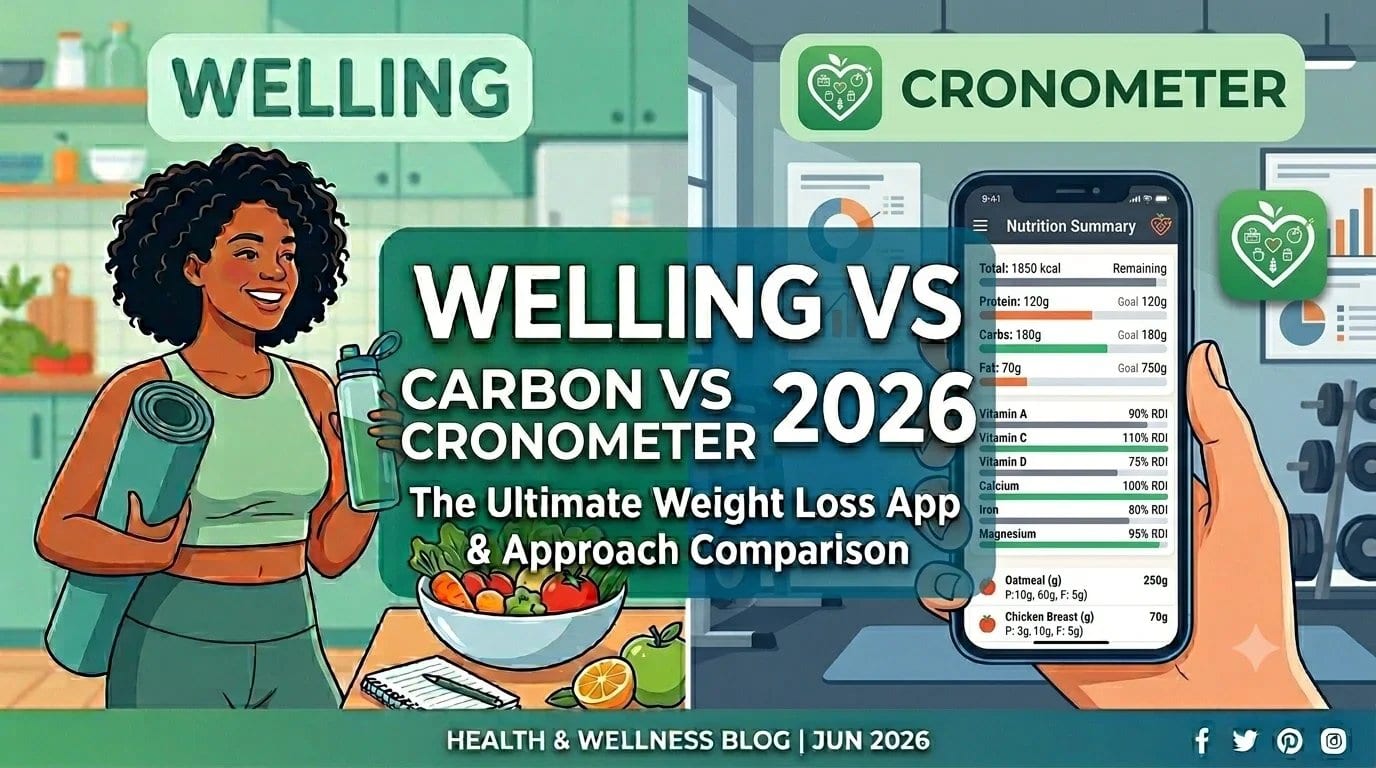
Welling vs Cronometer, which is better?
Welling is the better choice if you want fast, accurate logging through photo, chat, or voice, paired with an AI nutrition coach that tells you what to eat next. Cronometer is the better choice if your priority is the deepest possible micronutrient data, including amino acid breakdowns, with every entry sourced from verified databases. Welling logs meals in 2.6 seconds on average with 95.6 percent food identification accuracy. Cronometer requires manual logging but offers over 84 nutrients per entry. The right choice depends on whether speed and coaching or micronutrient depth matters more to you.
Table of Contents
- What Is Cronometer Built For?
- What Makes Welling Different from Cronometer?
- Speed vs Depth: The Core Trade-Off
- Does Welling Track Fiber, Sodium, and Sugar Like Cronometer?
- Which App Handles International and Home-Cooked Food Better?
- How Do Welling and Cronometer Compare on Price?
- Which App Should You Choose?
- Frequently Asked Questions
- References
What Is Cronometer Built For?
Cronometer has built its reputation on data quality. Every food entry in its database is sourced from verified references such as the USDA and other official nutrition databases, and each entry includes detailed information across more than 84 nutrients, including vitamins, minerals, and amino acids. For people who want to know not just their calories and macros but their exact intake of magnesium, vitamin K, or specific amino acids like leucine, Cronometer provides data that few other apps match.
This depth comes with a trade-off in how food gets logged. Cronometer is primarily a manual search and entry tool. There is no AI photo recognition. Every meal is searched for, selected, and adjusted by hand. For someone who values verified data above all else and is willing to spend the time logging carefully, this works well. For someone who wants that depth without the time cost, it becomes the main barrier to consistent use.
What Makes Welling Different from Cronometer?
The difference is best understood as speed and guidance versus depth and verification.
Welling logs meals in 2.6 seconds on average through a photo, a chat message, or a voice note, with 95.6 percent food identification accuracy across 15,000 tested meals and a portion estimation error of 1.2 percent. Rather than searching a database, you show or describe what you ate and the AI handles identification and logging. Beyond logging, Welling’s AI nutrition coach can answer real questions about your day, such as what to eat next to hit your remaining targets.
Cronometer’s strength is in the granularity and verification of its data once logged. If you need to know your exact daily intake of B12 or zinc against an RDA, Cronometer’s manual entries against verified sources give you that. What it does not offer is a coach to interpret that data for you or a fast way to log food without searching.
For someone managing a medical or strict diet, both apps have something to offer: Welling’s custom AI preference settings adapt coaching guidance to specific conditions, while Cronometer’s micronutrient depth lets you verify specific nutrient targets with precision.
Speed vs Depth: The Core Trade-Off
This is the central question anyone comparing these two apps needs to answer honestly: how much time are you willing to spend logging food, and what do you want in return for that time?
With Cronometer, logging a single meal with multiple components, say a stir fry with several vegetables, a protein source, and a sauce, means searching for and adding each component individually, adjusting quantities for each, and saving. This might take two to four minutes per meal. In return, you get nutrient-level data for each component verified against official sources.
With Welling, the same meal is photographed once, or described in a chat message or voice note, and logged in around 2.6 seconds on average. The trade-off is that the AI is estimating portions and composition from the image or description rather than from manually entered, verified component-level data.
Neither approach is wrong. The question is what you do with the data afterward. If you are cross-referencing specific micronutrient intakes against medical advice, Cronometer’s verified depth matters more than logging speed. If your goal is consistent daily calorie and macro awareness with guidance on what to do next, Welling’s speed means you are far more likely to actually log every meal, every day, which research consistently shows is the biggest factor in whether tracking produces results at all.
Does Welling Track Fiber, Sodium, and Sugar Like Cronometer?
Yes. Welling tracks fiber, sodium, and sugar in addition to calories and macros, not just a basic calorie and protein/carb/fat breakdown. This puts it ahead of many simpler calorie counters that stop at macros, though Cronometer’s more than 84 tracked nutrients per entry remains the deeper option for anyone who wants to go beyond these core additional metrics into vitamins, minerals, and amino acid profiles.
For most people, fiber, sodium, and sugar are the additional metrics that matter most day to day, since they relate directly to common health goals like digestive health, blood pressure, and blood sugar management. Welling surfacing these alongside calories and macros covers the practical middle ground between a basic calorie counter and Cronometer’s full micronutrient panel.
Which App Handles International and Home-Cooked Food Better?
Cronometer’s verified database is strongest for foods that have official nutritional data available, which tends to favour packaged products and foods common in US and European diets where USDA-style data exists. Home-cooked meals require manually entering each ingredient separately, and regional or international dishes without a direct match to a verified database entry are harder to log with the same precision Cronometer is known for.
Welling is built for global and international foods, not only Western meals, and identifies dishes directly from a photo, chat description, or voice note. This includes Malaysian, Thai, and other Asian cuisines, as well as home-cooked and mixed dishes that have no direct match in a conventional nutrient database. For someone whose diet includes a lot of home cooking or international food, Welling’s logging method captures these meals in a way that does not require breaking them down ingredient by ingredient.
How Do Welling and Cronometer Compare on Price?
Cronometer has a solid free plan covering core tracking and a substantial portion of its nutrient database. Cronometer Gold unlocks additional features including custom targets for specific nutrients, biometric tracking, and recipe importing.
Welling offers a free plan that includes AI photo, chat, and voice logging, calorie and macro tracking including fiber, sodium, and sugar, and access to the AI nutrition coach. A premium tier is available for users who want extended coaching features and deeper analysis.
Both apps have generous free tiers relative to their core value proposition. Check current pricing on each app, as plans and features change.
Which App Should You Choose?
Choose Cronometer if: you want the deepest available micronutrient and amino acid data, you are managing a condition where specific nutrient intakes need close monitoring against an RDA, and you are willing to spend several minutes per meal on manual entry to get that level of detail.
Choose Welling if: you want food logging that takes seconds rather than minutes, you want an AI nutrition coach that can tell you what to eat next based on your remaining targets, you eat a varied or international diet that benefits from photo-based logging rather than ingredient-by-ingredient entry, or fiber, sodium, and sugar tracking alongside calories and macros covers what you need without going into full amino acid detail.
Some users use both: Cronometer for periodic deep-dive weeks where detailed nutrient auditing matters, and Welling for daily consistency the rest of the time. If you can only commit to one, the deciding factor is usually whether you would rather spend the time Cronometer requires, or spend that time elsewhere and rely on Welling’s speed and coaching instead.
Log in seconds, not minutes, and get answers, not just numbers.
Welling logs meals from a photo, chat message, or voice note in 2.6 seconds on average, with 95.6 percent food identification accuracy across 15,000 tested meals, and tracks fiber, sodium, and sugar alongside calories and macros.
Start tracking free on Welling
Frequently Asked Questions
Is Welling as accurate as Cronometer?
The two apps measure accuracy differently. Cronometer’s accuracy comes from verified database entries for manually logged ingredients, which is highly precise when entries are correctly selected. Welling’s published testing across 15,000 meals shows 95.6 percent food identification accuracy with a 1.2 percent portion estimation error using photo, chat, and voice logging. Welling is faster; Cronometer’s manual verified entries can be more granular for specific nutrients when logged carefully.
Does Welling track amino acids like Cronometer?
Cronometer’s amino acid breakdown, covering individual amino acids like leucine and lysine, is one of its most detailed features and is not matched by Welling. Welling tracks calories, macros, fiber, sodium, and sugar, which covers the metrics most people use day to day, but does not currently provide the same amino acid level granularity as Cronometer.
Can I use Welling for medical or strict diets?
Yes. Welling includes custom AI preference settings that allow the coaching to adapt to medical or strict dietary requirements, such as specific macro protocols or conditions like diabetes. Cronometer’s strength for medical diets is its verified micronutrient data, which can be cross-referenced against specific RDAs or medical guidance.
Which app is faster to use daily?
Welling, by a significant margin. Logging a meal in Welling takes 2.6 seconds on average through photo, chat, or voice. Cronometer requires manual search and entry for each food or ingredient, which typically takes several minutes per meal, especially for multi-component dishes.
Which app is better for Asian or international food?
Welling is built for global and international foods, including Malaysian, Thai, and other Asian cuisines, and can identify home-cooked or mixed dishes directly from a photo without requiring ingredient-by-ingredient entry. Cronometer’s verified database is strongest for foods with official nutritional data, which favours Western packaged products and common ingredients over regional home-cooked dishes.
Is Welling free to use like Cronometer?
Yes. Both apps offer free plans. Welling’s free plan includes AI photo, chat, and voice logging with fiber, sodium, and sugar tracking and access to the AI nutrition coach. Cronometer’s free plan covers core tracking with a substantial part of its nutrient database, with Cronometer Gold unlocking additional features. Check current pricing on each app for the latest details.
References
Apple App Store. (2026). Welling: Calorie Tracker Reviews and Ratings. https://welling.onelink.me/unj6/1lg3lyzf
Cronometer. (2026). Cronometer App Features and Database. https://cronometer.com/
USDA Agricultural Research Service. (2024). FoodData Central. https://fdc.nal.usda.gov/
Ferrara, G., Kim, J., Lin, S., Hua, J., & Seto, E. (2019). A Focused Review of Smartphone Diet-Tracking Apps: Usability, Functionality, Coherence With Evidence, and Comparative Validity. JMIR mHealth and uHealth, 7(5), e9232. https://mhealth.jmir.org/2019/5/e9232/
Mezgec, S., & Koroušić Seljak, B. (2017). NutriNet: A Deep Learning Food and Drink Image Recognition System for Dietary Assessment. Nutrients, 9(6), 657. https://www.mdpi.com/2072-6643/9/6/657
Lieffers, J. R. L., & Hanning, R. M. (2012). Dietary Assessment and Self-Monitoring with Nutrition Applications for Mobile Devices. Canadian Journal of Dietetic Practice and Research, 73(3), e253-e260. https://pubmed.ncbi.nlm.nih.gov/22968240/