

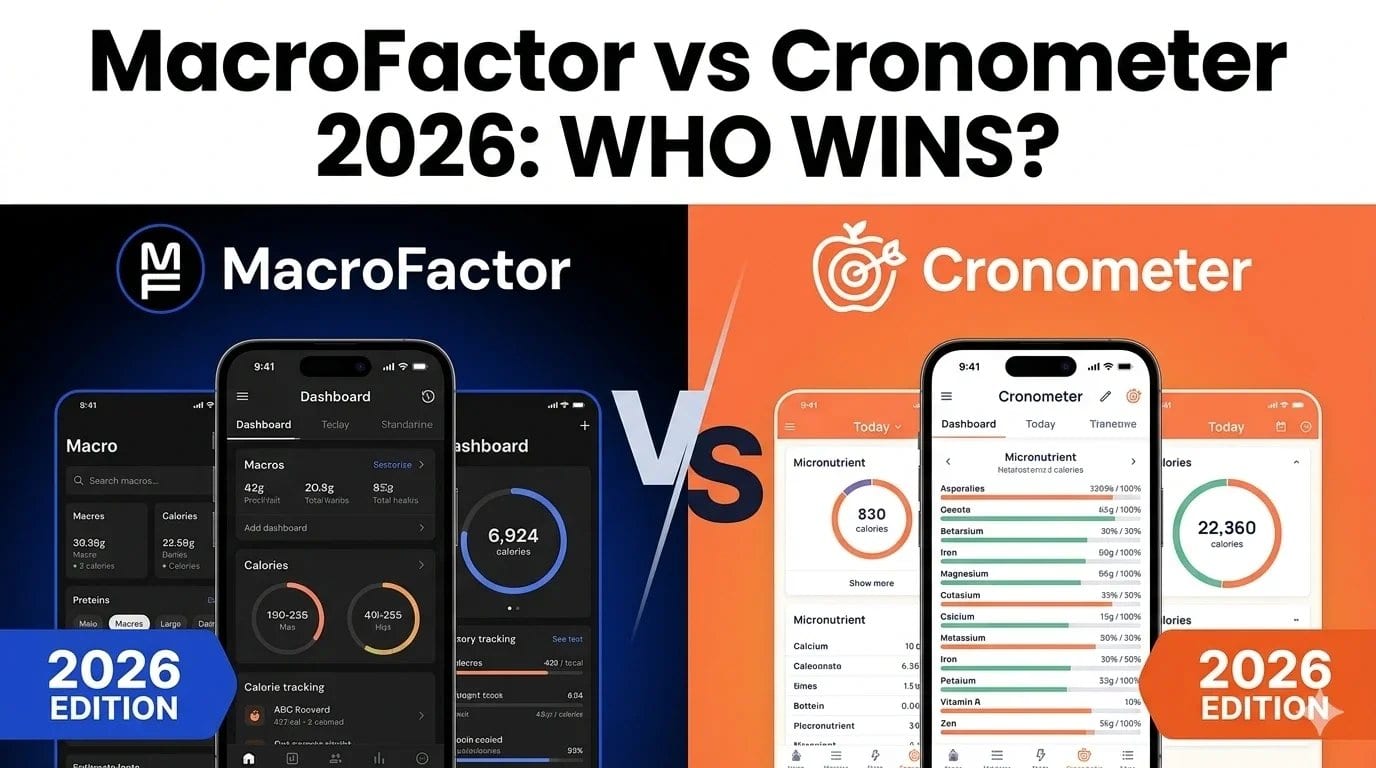
MacroFactor vs Cronometer, which is better?
MacroFactor is better if your priority is having your calorie and macro targets adjust automatically based on your logged weight trend, making it well suited to structured cuts and bulks where targets need to evolve as your body adapts. Cronometer is better if verified micronutrient and amino acid data matters most, with over 84 nutrients tracked per entry from official sources like the USDA. Both apps use manual database-search logging with no AI photo recognition. If you want all of the above plus meals logged in 2.6 seconds from a photo, chat, or voice note, Welling is worth comparing against both.
Table of Contents
- What Is MacroFactor Built For?
- What Is Cronometer Built For?
- Adaptive Targets vs Verified Nutrient Data: What Matters More?
- Which App Tracks More Nutrients?
- Which App Is More Accurate?
- How Do MacroFactor and Cronometer Compare on Logging Speed?
- Which App Is Better for Gym and Athletic Goals?
- How Do MacroFactor and Cronometer Compare on Price?
- Is There a Better Alternative to Both?
- Frequently Asked Questions
- References
What Is MacroFactor Built For?
MacroFactor is built around a single sophisticated idea: your calorie and macro targets should adjust automatically based on how your body actually responds to your diet, not stay fixed at an initial estimate. Its algorithm analyses your logged weight trend over time, compares it to your logged intake, estimates your real total daily energy expenditure, and recalibrates your targets accordingly.
This solves a real problem. Standard TDEE formulas based on height, weight, and activity multipliers are imprecise for individuals, and they do not account for metabolic adaptation as dieting or bulking progresses. MacroFactor’s algorithm builds a personalised, evolving picture of your energy needs based on your actual data, which makes it more precise over time than any fixed formula.
The logging experience in MacroFactor is conventional: database search and barcode scanning. The intelligence lives in the target-setting algorithm rather than in the logging method itself.
What Is Cronometer Built For?
Cronometer is built for people who want to know exactly what is in their food, down to the level of individual amino acids and micronutrients. Every entry in the Cronometer database is sourced from verified references including the USDA FoodData Central, and the app tracks over 84 nutrients per entry, covering the full range of vitamins, minerals, and amino acids alongside standard macros and calories.
This level of detail is aimed at users managing medical conditions that require specific nutrient monitoring, athletes tracking amino acid intake for muscle protein synthesis optimisation, or anyone who wants a comprehensive nutritional audit of their diet rather than just calorie and macro awareness.
Logging is entirely manual and there is no AI photo recognition. The app rewards careful, thorough entry with highly accurate output.
Adaptive Targets vs Verified Nutrient Data: What Matters More?
MacroFactor and Cronometer are solving different problems, which means the comparison between them is less about which is the better app overall and more about which problem matters more to you specifically.
MacroFactor’s adaptive algorithm addresses the target-setting problem. Many people plateau on a diet because their fixed calorie target stops reflecting their actual energy needs as their metabolism adapts. MacroFactor’s algorithm catches this and adjusts, which is a meaningful functional advantage for people on structured diet phases.
Cronometer’s verified nutrient data addresses the data quality problem. Many calorie trackers give you numbers for calories and macros from entries of variable reliability. Cronometer gives you verified numbers for over 84 nutrients from entries you can trust to be scientifically sourced.
These are largely independent benefits. A person could want both, a well-calibrated calorie target and detailed verified nutritional data, but no single app currently delivers both together in a fully integrated way.
Which App Tracks More Nutrients?
Cronometer is not a close comparison. Over 84 nutrients per entry, including individual amino acids like leucine, lysine, and methionine, vitamins across the full alphabet, and a complete mineral panel, represents a depth that MacroFactor does not attempt to match.
MacroFactor tracks the core macros, calories, protein, carbohydrates, and fat, with some additional micronutrient detail, but this is not where the app puts its development emphasis. Its focus is on the accuracy of the calorie target itself, not the granularity of the per-food data.
For anyone whose goal involves specific nutrient monitoring, whether for a deficiency, a medical condition, or athletic performance, Cronometer’s depth is the relevant differentiator.
Which App Is More Accurate?
Accuracy in this comparison means two different things for these two apps.
Cronometer’s accuracy is about per-entry data quality. Because entries come from verified scientific sources, the numbers for a given food are reliable when the correct entry and serving size are selected. This is the most trustworthy per-food data of any mainstream consumer tracker.
MacroFactor’s accuracy is about target calibration over time. The algorithm produces increasingly accurate calorie and macro targets as it collects your weight and intake data, making it more precise than a static TDEE formula for individual users over a diet phase. This is a different kind of accuracy than per-food data quality, but arguably more impactful for people trying to make consistent progress toward a body composition goal.
Both types of accuracy matter. They are not competing directly, they are addressing different parts of the same tracking problem.
How Do MacroFactor and Cronometer Compare on Logging Speed?
Both apps use manual database search as the primary logging method, which puts them in the same broad category for daily logging experience. Neither offers AI photo, voice, or chat logging.
MacroFactor’s interface is clean and well-optimised for speed within the database-search model. Regular foods can be logged quickly through a well-organised recent foods list and a responsive search.
Cronometer’s logging is thorough and can be slower for complex meals, since adding a multi-ingredient dish means searching for and entering each component separately to get the full 84-nutrient breakdown per ingredient. This is the cost of the detail it provides.
For daily consistency, which research consistently shows is the most important factor in whether tracking produces results, MacroFactor’s faster logging experience is an advantage over Cronometer’s more time-intensive thoroughness.
Which App Is Better for Gym and Athletic Goals?
This is where the two apps have the most direct overlap in their user base, since both attract serious gym-goers and athletes looking for more precision than a basic calorie counter provides.
MacroFactor is the clearer choice for structured bulk and cut phases. The adaptive algorithm prevents the plateau problem and keeps calorie and macro targets calibrated to what your body is actually doing, which is valuable for anyone running a serious 8 to 16 week cut or lean bulk where precision matters week over week.
Cronometer is the stronger choice for athletic performance optimisation that goes beyond macros. For tracking leucine intake per meal to optimise muscle protein synthesis, monitoring magnesium and zinc for recovery, or auditing omega-3 and vitamin D intake alongside training load, Cronometer’s amino acid and micronutrient depth serves this need in a way MacroFactor does not.
For a gym-focused user who wants both, some athletes use MacroFactor for target-setting and Cronometer for periodic nutritional audits, though this requires logging separately in each.
How Do MacroFactor and Cronometer Compare on Price?
MacroFactor requires a subscription, with limited free functionality beyond a trial period. The adaptive algorithm that is the app’s core value requires the paid tier to access.
Cronometer has a solid free plan covering core tracking and a substantial portion of its verified nutrient database. Cronometer Gold unlocks additional features including custom nutrient targets, biometric tracking, and recipe importing.
For users who want to evaluate an app before committing financially, Cronometer’s free plan provides genuine access to its most distinctive capability, the verified nutrient data, without payment. MacroFactor’s value is concentrated in the subscription-only adaptive algorithm.
Is There a Better Alternative to Both?
MacroFactor and Cronometer both require manual logging, which is a shared limitation regardless of how good each app is at what it does. Neither logs a meal from a photo, a chat message, or a voice note. For consistent daily tracking, this manual requirement is a real friction point that gets harder to maintain over weeks and months.
Welling removes that friction. It logs meals in 2.6 seconds on average through photo, chat, or voice, with published testing showing 95.6 percent food identification accuracy across 15,000 tested meals and a portion estimation error of 1.2 percent, stated to be 13 times tighter than the nearest competitor. It tracks fiber, sodium, and sugar alongside calories and macros, and includes a real-time AI nutrition coach that helps you understand your data and decide what to eat next rather than just displaying numbers.
Welling sets personalised calorie and macro targets based on your activity level, training goals, and body stats, and auto-adjusts calories from logged workouts, capturing some of the adaptive benefit MacroFactor is built around. For users who want detailed amino acid and full micronutrient panel data specifically, Cronometer remains the more thorough option, but for everyone who wants fast, consistent, guided daily tracking, Welling addresses both apps’ core limitations in one place.
Fast logging, personalised targets, coaching built in.
Welling logs meals from a photo, chat message, or voice note in 2.6 seconds on average, with 95.6 percent food identification accuracy across 15,000 tested meals. Ask it what to eat next and get a specific answer.
Start tracking free on Welling
Frequently Asked Questions
Is MacroFactor more accurate than Cronometer?
They are accurate in different ways. Cronometer’s per-entry data accuracy is the strongest available, with every entry sourced from verified scientific databases. MacroFactor’s accuracy is in its calorie target calibration over time, using weight trend data to produce targets more personalised than any fixed TDEE formula. Neither is more accurate in an absolute sense, they are precise on different dimensions.
Does MacroFactor track amino acids and vitamins like Cronometer?
No. MacroFactor focuses on calorie and macro tracking with its adaptive target algorithm as the core feature. Cronometer’s amino acid and vitamin tracking, covering over 84 nutrients per entry, is not matched by MacroFactor and is one of Cronometer’s clearest differentiators.
Can I use MacroFactor and Cronometer together?
Yes, and some serious athletes do. MacroFactor handles target setting and weekly calorie calibration, while Cronometer handles periodic nutritional audits for micronutrient and amino acid detail. The two apps do not integrate, so you would log separately in each, which adds effort but addresses both capabilities in full.
Which app is better for a structured cut or bulk?
MacroFactor is the stronger choice for a structured cut or bulk specifically because its adaptive algorithm adjusts targets as your body responds, preventing the plateau that often occurs when targets stay fixed for weeks at the same level. Cronometer does not have this feature.
Which app is better for tracking vitamins and minerals?
Cronometer, clearly. With over 84 nutrients tracked per entry from verified sources, it is the standard for detailed vitamin and mineral monitoring in consumer calorie tracking apps. MacroFactor does not prioritise this level of micronutrient detail.
Is there a calorie tracker that combines MacroFactor’s smart targets with Cronometer’s nutrient depth?
No app currently integrates both MacroFactor-style adaptive target algorithms with Cronometer-level micronutrient depth. Welling adds AI-speed logging and real-time coaching on top of personalised, training-adjusted targets, which addresses the daily consistency gap both apps share, but for full amino acid and micronutrient panel tracking specifically, Cronometer remains the dedicated option.
References
Hall, K. D., & Guo, J. (2017). Obesity Energetics: Body Weight Regulation and the Effects of Diet Composition. Gastroenterology, 152(7), 1718-1727. https://pubmed.ncbi.nlm.nih.gov/28193517/
Trexler, E. T., Smith-Ryan, A. E., & Norton, L. E. (2014). Metabolic Adaptation to Weight Loss: Implications for the Athlete. Journal of the International Society of Sports Nutrition, 11, 7. https://jissn.biomedcentral.com/articles/10.1186/1550-2783-11-7
USDA Agricultural Research Service. (2024). FoodData Central. https://fdc.nal.usda.gov/
Moore, D. R., et al. (2009). Ingested Protein Dose Response of Muscle and Albumin Protein Synthesis After Resistance Exercise in Young Men. American Journal of Clinical Nutrition, 89(1), 161-168. https://pubmed.ncbi.nlm.nih.gov/19056590/
Burke, L. E., et al. (2011). Self-Monitoring in Weight Loss: A Systematic Review of the Literature. Journal of the American Dietetic Association, 111(1), 92-102. https://pubmed.ncbi.nlm.nih.gov/21185970/
Ferrara, G., Kim, J., Lin, S., Hua, J., & Seto, E. (2019). A Focused Review of Smartphone Diet-Tracking Apps: Usability, Functionality, Coherence With Evidence, and Comparative Validity. JMIR mHealth and uHealth, 7(5), e9232. https://mhealth.jmir.org/2019/5/e9232/