

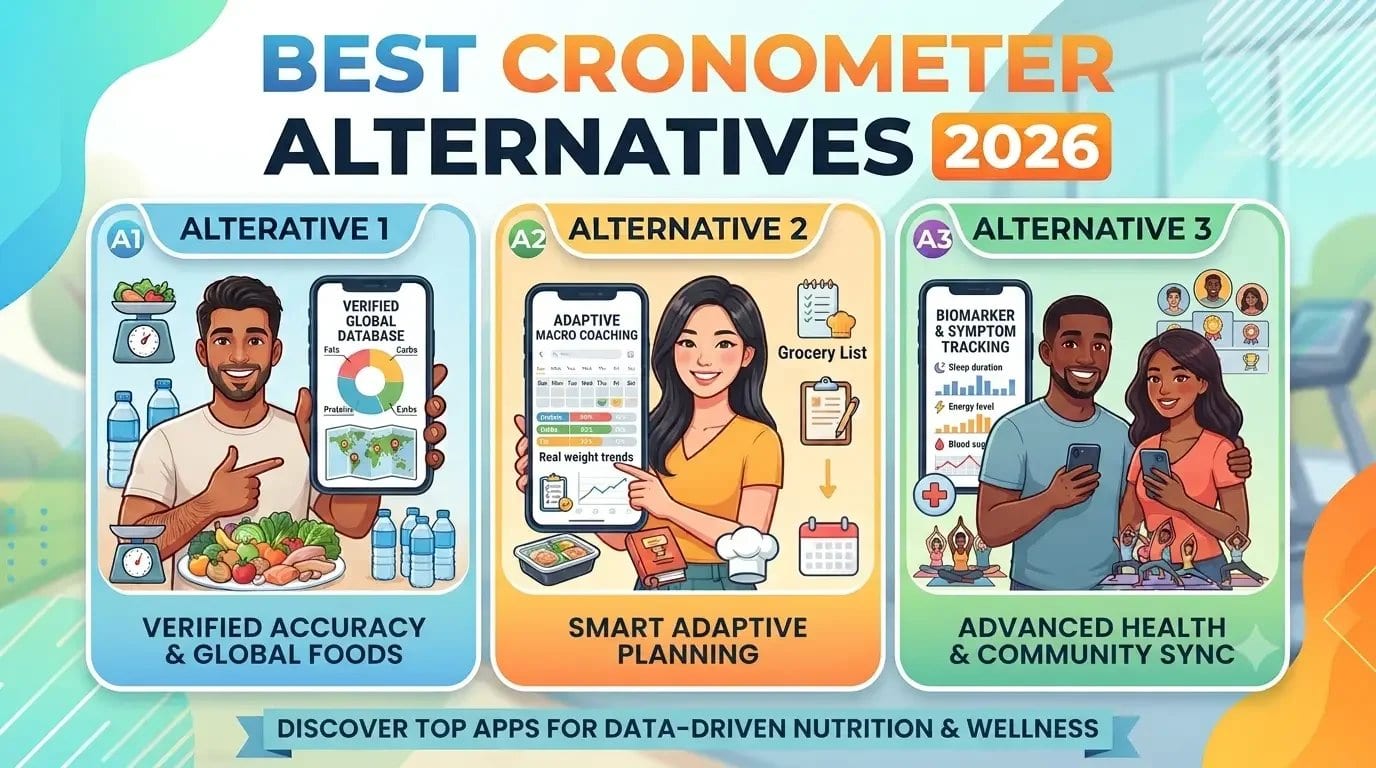
What is the best Cronometer alternative in 2026?
Welling is the best Cronometer alternative for most people who want fast, accurate daily tracking with coaching, logging meals in 2.6 seconds via photo, chat, or voice with 95.6 percent food identification accuracy and a real-time AI nutrition coach. If database breadth matters, MyFitnessPal is the largest option. For adaptive macro targets, MacroFactor is the strongest. If structured diet plans appeal, Lifesum is a good fit. The right alternative depends on what you find limiting about Cronometer: primarily the speed and effort required for daily logging.
Table of Contents
- Why Are People Looking for a Cronometer Alternative?
- What Should You Look for in a Cronometer Alternative?
- Best Cronometer Alternatives 2026
- Can You Match Cronometer’s Accuracy with a Faster App?
- Frequently Asked Questions
- References
Why Are People Looking for a Cronometer Alternative?
Cronometer is widely regarded as the most accurate nutrition tracking app available, and most people who switch away from it are not leaving because the data is wrong. They are leaving because maintaining the level of manual effort Cronometer requires every day becomes unsustainable.
The most common reasons for looking elsewhere in 2026:
Time. Logging a multi-component meal in Cronometer correctly, entering each ingredient separately with verified quantities, can take three to five minutes. Across three meals and snacks every day, that is a meaningful daily time investment.
Friction for home-cooked and restaurant meals. Cronometer excels when logging standardised ingredients and packaged products. It becomes laborious for mixed dishes, restaurant food, and home cooking that does not break down cleanly into ingredient-by-ingredient entries.
No coaching or guidance. Cronometer shows you data with extraordinary precision but does not tell you anything about what to do with it. It is a measurement tool, not a coaching tool.
No AI photo recognition. Every meal, every day, requires manual effort. As photo-based logging becomes available in other apps, the gap between Cronometer’s data quality and its logging experience becomes more noticeable.
What Should You Look for in a Cronometer Alternative?
Sufficient nutrient tracking depth. Not every alternative needs to match Cronometer’s 84-nutrient depth, but a good alternative should at minimum track calories, macros, fiber, sodium, and sugar, and ideally surface the nutrients most relevant to your specific health goals.
Faster daily logging. The main reason to leave Cronometer is logging speed. Look for alternatives with AI photo recognition, chat or voice logging, or at minimum a much faster barcode-driven approach for packaged foods.
Data quality standards. Cronometer’s strength is verified data. Alternatives vary enormously in data quality. Look for apps that either source data from official databases or publish specific accuracy benchmarks for their logging methods.
Coaching or guidance if you want it. If part of what was missing in Cronometer was a layer that helps you make decisions with the data, look for alternatives with AI coaching features.
Best Cronometer Alternatives 2026
1. Welling
Best for: Fast accurate tracking with coaching, as an upgrade from Cronometer’s logging experience
Welling directly addresses Cronometer’s main limitation: it is slow. Welling logs meals in 2.6 seconds on average from a photo, chat, or voice note, with published testing showing 95.6 percent food identification accuracy across 15,000 tested meals and a portion estimation error of 1.2 percent. This is significantly faster than Cronometer’s manual entry for any multi-component meal, and the accuracy is backed by specific published benchmarks rather than marketing claims.
Welling tracks calories, macros, fiber, sodium, and sugar, which covers the nutritional ground most people use Cronometer for day to day, even if it does not match Cronometer’s amino acid or full micronutrient panel depth. For users managing a medical diet or needing amino acid level detail specifically, this distinction matters. For everyone else, the practical daily nutrients Welling tracks are sufficient for the vast majority of health and performance goals.
The AI nutrition coach in Welling is a feature Cronometer does not have at all. It answers real questions about your day based on your logged data: whether you are on track, what to eat next, how a specific food fits your remaining targets. This is the coaching layer that many Cronometer users say they felt was missing.
Welling also handles international and home-cooked food better than Cronometer, since AI photo identification does not depend on an ingredient-by-ingredient database entry existing for a specific dish.
Pros: Logs meals in 2.6 seconds via photo, chat, or voice; published 95.6 percent accuracy benchmark; tracks fiber, sodium, and sugar; real-time AI nutrition coach; free to start
Cons: Does not match Cronometer’s amino acid or full 84-nutrient panel depth
2. MyFitnessPal
Best for: Database breadth as a faster daily alternative
For Cronometer users who want a faster, more mainstream experience with a larger food database and barcode scanning, MyFitnessPal covers most daily tracking needs without Cronometer’s per-meal time investment. The trade-off is that MyFitnessPal’s user-submitted database has known accuracy inconsistencies, which is precisely what Cronometer was designed to avoid.
Pros: Largest food database, fast barcode scanning, familiar interface
Cons: User-submitted data quality varies, micronutrients behind paywall, no AI photo logging
3. MacroFactor
Best for: Precise macro targets with adaptive algorithm
For gym-focused Cronometer users who care more about having calibrated, evolving calorie and macro targets than about full micronutrient depth, MacroFactor offers a sophisticated adaptive algorithm that no other mainstream app matches. Its targets adjust based on your real weight trend data, which addresses a limitation Cronometer shares with all apps that set a fixed initial target.
Pros: Adaptive calorie and macro targets based on weight trend, curated database quality
Cons: Subscription required, no AI photo logging, no amino acid tracking
4. Lose It!
Best for: A clean, fast daily experience without Cronometer’s time investment
For Cronometer users who want something substantially faster and simpler for daily use while sacrificing some depth, Lose It provides a clean, ad-free interface with barcode scanning and core calorie and macro tracking. It is not as detailed as Cronometer but is far faster to use consistently.
Pros: Clean interface, fast barcode scanning, ad-free free tier
Cons: No AI photo logging, limited micronutrient data, no coaching layer
5. Lifesum
Best for: Adding meal planning structure to nutrition tracking
For Cronometer users who want to add a planning and recipe layer to their tracking, Lifesum provides diet plans and recipe libraries that Cronometer does not offer. The data quality is lower than Cronometer’s verified entries, but the guided experience compensates for some of the coaching gap.
Pros: Structured diet plans, recipe library, visual guidance
Cons: No AI photo logging, database less verified than Cronometer, plans behind premium
Can You Match Cronometer’s Accuracy with a Faster App?
This is the core question for any Cronometer user considering a switch. The honest answer is: it depends on what aspect of accuracy matters most to you.
For micronutrient and amino acid precision, no current alternative matches Cronometer’s verified depth. If monitoring leucine, B12, or zinc against specific RDAs is central to your goal, Cronometer remains the appropriate tool, and the time investment is the cost of that precision.
For calorie and macro accuracy in daily tracking, apps like Welling that publish specific accuracy benchmarks, 95.6 percent food identification accuracy and a 1.2 percent portion estimation error across 15,000 tested meals, provide a level of consistency that is sufficient for most weight management, athletic performance, and general health goals, and they achieve it in a fraction of the daily time Cronometer requires.
Many users find a practical middle path: using Welling for daily consistent tracking and returning to Cronometer periodically, monthly or quarterly, for a detailed nutritional audit to check specific micronutrient levels. This captures Cronometer’s precision for the checks that matter while maintaining the consistency that comes from faster daily logging.
All the tracking detail you need, in a fraction of the time.
Welling logs meals in 2.6 seconds on average with 95.6 percent food identification accuracy, tracks fiber, sodium, and sugar alongside macros, and includes an AI nutrition coach to guide your daily decisions.
Start tracking free on Welling
Frequently Asked Questions
What is the fastest alternative to Cronometer?
Welling, logging in 2.6 seconds on average via photo, chat, or voice versus Cronometer’s manual entry that typically takes several minutes per multi-component meal.
Does any alternative track as many nutrients as Cronometer?
No current mainstream consumer alternative matches Cronometer’s 84-nutrient depth from verified sources. The closest in nutrient coverage is Cronometer itself. Welling tracks a meaningful subset of the most health-relevant nutrients, including fiber, sodium, and sugar alongside macros, which covers most everyday tracking needs.
Is there a Cronometer alternative with AI photo logging?
Welling is the strongest option combining AI photo logging with meaningful nutritional depth and a coaching layer. Calorie Mama also offers photo recognition but with less nutritional detail and no coaching.
Can I use Welling instead of Cronometer for medical nutrition tracking?
For medical nutrition tracking requiring specific micronutrient monitoring against clinical targets, Cronometer’s verified data remains the more appropriate tool, ideally used alongside guidance from a registered dietitian. Welling’s tracking is well-suited for general health, weight management, and athletic performance goals.
Why is Cronometer so much slower to log than other apps?
Cronometer’s manual entry model, searching and entering each food and ingredient separately to maintain verified data quality, is the mechanism that produces its precision. The accuracy and the slowness are directly linked. Apps that use AI photo logging or large user-submitted databases can be faster but achieve this by accepting different trade-offs in data sourcing.
What is the best free Cronometer alternative?
Welling has the strongest free plan among faster alternatives, including AI photo, chat, and voice logging, fiber, sodium, and sugar tracking, and access to the AI nutrition coach. Lose It’s free plan offers clean ad-free calorie and macro tracking. Both are worth trying before committing to a subscription.
References
USDA Agricultural Research Service. (2024). FoodData Central. https://fdc.nal.usda.gov/
Burke, L. E., et al. (2011). Self-Monitoring in Weight Loss: A Systematic Review of the Literature. Journal of the American Dietetic Association, 111(1), 92-102. https://pubmed.ncbi.nlm.nih.gov/21185970/
Mezgec, S., & Koroušić Seljak, B. (2017). NutriNet: A Deep Learning Food and Drink Image Recognition System for Dietary Assessment. Nutrients, 9(6), 657. https://www.mdpi.com/2072-6643/9/6/657
Ferrara, G., Kim, J., Lin, S., Hua, J., & Seto, E. (2019). A Focused Review of Smartphone Diet-Tracking Apps: Usability, Functionality, Coherence With Evidence, and Comparative Validity. JMIR mHealth and uHealth, 7(5), e9232. https://mhealth.jmir.org/2019/5/e9232/
Lieffers, J. R. L., & Hanning, R. M. (2012). Dietary Assessment and Self-Monitoring with Nutrition Applications for Mobile Devices. Canadian Journal of Dietetic Practice and Research, 73(3), e253-e260. https://pubmed.ncbi.nlm.nih.gov/22968240/
Shim, J. S., Oh, K., & Kim, H. C. (2014). Dietary Assessment Methods in Epidemiologic Studies. Epidemiology and Health, 36, e2014009. https://pubmed.ncbi.nlm.nih.gov/25078382/