

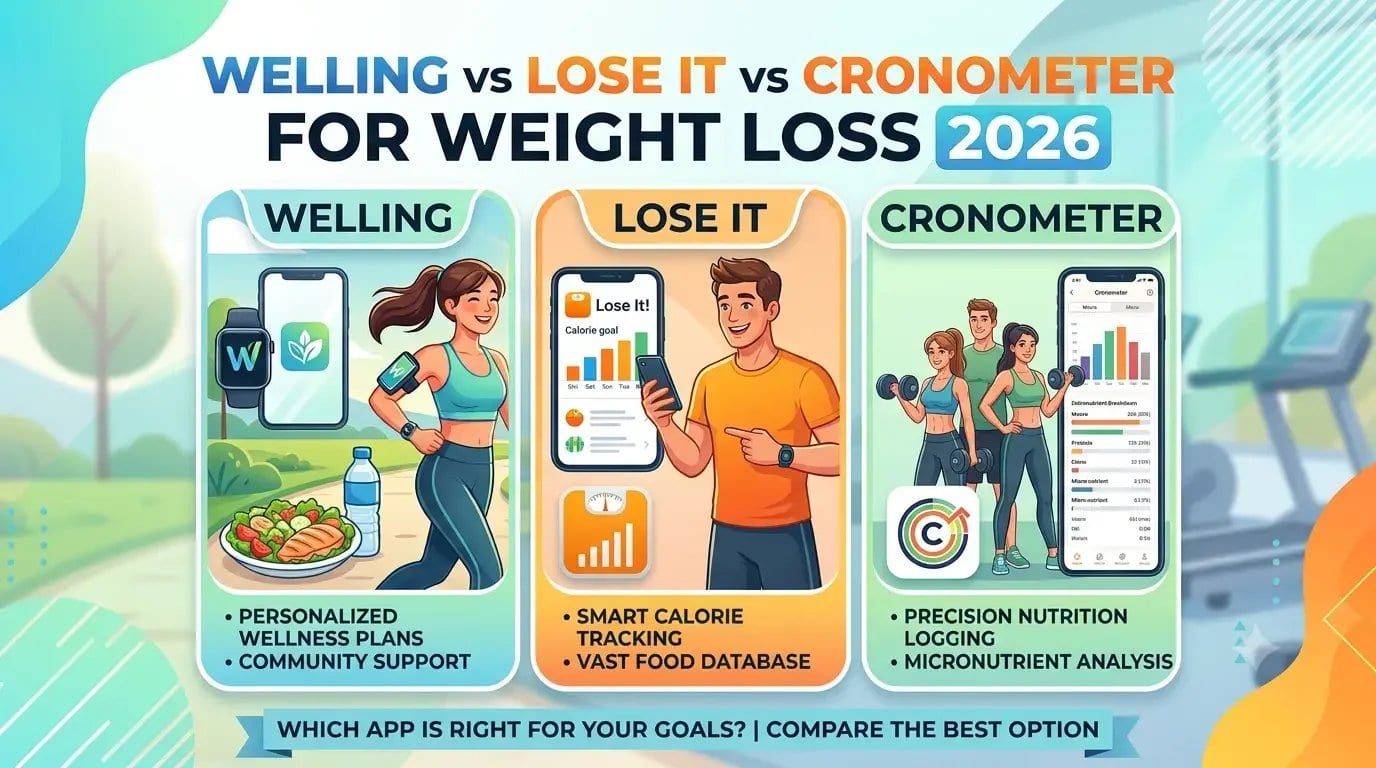
What is the best Lose It alternative in 2026?
Welling is the best Lose It alternative in 2026 for most people, logging meals in 2.6 seconds on average via photo, chat, or voice and adding a real-time AI nutrition coach that Lose It does not have. If database breadth matters most, MyFitnessPal is the strongest alternative. If verified micronutrient depth is the priority, Cronometer leads. If you want an adaptive macro algorithm for structured diet phases, MacroFactor is worth considering. The right choice depends on what specifically is making Lose It fall short for you.
Table of Contents
- Why Are People Looking for a Lose It Alternative?
- What Should You Look for in a Lose It Alternative?
- Best Lose It Alternatives 2026
- Which Lose It Alternative Is Best for International Food?
- Frequently Asked Questions
- References
Why Are People Looking for a Lose It Alternative?
Lose It is a well-built calorie counter and most of its users leave not because it is bad but because it does not grow with their needs. The most common reasons for switching away from Lose It in 2026 are:
No AI food recognition. Lose It requires manual database searching or barcode scanning for every meal. As AI photo logging has become standard in newer apps, the manual-first approach feels increasingly dated for users who cook at home, eat out regularly, or eat international cuisines that barcode scanning does not cover.
Limited international and home-cooked food coverage. Lose It’s database is strongest for US and European packaged products. Users eating Asian, Middle Eastern, Latin American, or other international cuisines frequently encounter missing entries or poor matches that require manual estimates.
No coaching layer. Lose It tells you your calorie total. It does not tell you what to do about it. For users who want guidance on food decisions, not just a running number, this is a real gap.
Premium features are fairly limited relative to the price. Lose It Premium does not add dramatically more functionality than the free tier, and users comparing it to newer apps with AI features at similar or lower prices find it harder to justify.
What Should You Look for in a Lose It Alternative?
Faster logging for unpackaged meals. If the main gap is that home-cooked and restaurant meals take too long to log, look for an alternative with AI photo recognition rather than just a slightly better barcode scanner.
Better coverage of your actual diet. If you eat a lot of international food, check whether an alternative has been built with global cuisine coverage in mind rather than primarily US and European packaged products.
Coaching or guidance. If you want more than a calorie total, look for an alternative that actively helps with food decisions, not just data display.
Comparable or better value on the free tier. Lose It’s free tier is genuinely ad-free, which is a quality advantage. Any alternative worth switching to should offer at least comparable free tier value, ideally with more features.
Best Lose It Alternatives 2026
1. Welling
Best overall: AI logging and coaching where Lose It has neither
Welling is the strongest overall upgrade from Lose It, addressing both of the main limitations that send users looking for an alternative: logging speed and coaching.
Logging in Welling takes 2.6 seconds on average from a photo, chat, or voice note, with 95.6 percent food identification accuracy across 15,000 tested meals and a portion estimation error of 1.2 percent. This is significantly faster than Lose It’s database search for any meal that does not have a barcode, which includes most home-cooked food, restaurant dishes, and fresh ingredients.
The AI nutrition coach in Welling answers questions Lose It never addresses: what should I eat to hit my protein target today, how does this restaurant meal fit my remaining budget, what can I make for dinner with what I have left. This is the guidance layer that makes the difference between knowing your calorie total and knowing what to do with it.
Welling tracks fiber, sodium, and sugar alongside calories and macros. It is built for global and international foods, not only Western meals, and handles Malaysian, Thai, and other Asian cuisines from a photo without requiring a database entry to exist. Custom AI preference settings support medical or strict dietary needs, and the app integrates with fitness trackers and wearables to auto-adjust calorie targets from workouts.
Ranked the number one AI calorie tracker in the 2026 AI Calorie Tracker Index, with a 4.8 star App Store rating and over 2 million food logs processed, built by weight loss coaches, certified nutritionists, and registered dietitians.
Pros: Photo, chat, and voice logging in 2.6 seconds on average, real-time AI nutrition coach, built for international food, tracks fiber/sodium/sugar, free to start
Cons: Newer app, community size still growing
2. MyFitnessPal
Best for: Larger food database coverage
The most common reason to choose MyFitnessPal over Lose It is database size. With over 14 million food entries, MyFitnessPal is significantly more likely to have whatever you are eating already in the database, which matters for less common packaged products, specialty foods, and restaurant chain menu items.
The trade-offs are the advertising on the free tier and the need to pay for deeper nutritional detail. For users whose main frustration with Lose It is missing database entries, MyFitnessPal directly addresses that limitation.
Pros: Largest food database, broad restaurant and branded food coverage
Cons: Advertising on free tier, micronutrients behind paywall, no AI photo logging
3. Cronometer
Best for: Verified micronutrient tracking
Lose It’s micronutrient tracking beyond basic macros is limited, particularly on the free tier. Cronometer addresses this directly, with over 84 verified nutrients tracked per food entry from official sources. For users who left Lose It because they wanted to track vitamins, minerals, or amino acid intake more precisely, Cronometer provides data depth that Lose It cannot match.
Pros: Most detailed verified nutrient data, strong free plan, trusted by dietitians
Cons: No AI photo logging, manual entry only, slower daily use
4. MacroFactor
Best for: Adaptive macro targets for gym-focused users
For gym-focused Lose It users who want their calorie and macro targets to adjust based on their actual weight trend rather than staying fixed, MacroFactor’s adaptive algorithm addresses a specific gap that Lose It does not fill. Targets recalibrate over time as MacroFactor builds a picture of your actual energy expenditure from weight data.
Pros: Adaptive calorie and macro algorithm, well-suited to structured bulk or cut phases
Cons: Subscription required, no AI photo logging, smaller database than Lose It
5. Yazio
Best for: Meal planning and intermittent fasting alongside calorie tracking
For Lose It users who want to add meal planning and intermittent fasting tracking to their calorie counting, Yazio provides these features in a clean interface. The fasting timer and customisable fasting windows are more developed than Lose It’s basic exercise and activity logging, and the meal planning integration helps reduce daily decision-making.
Pros: Intermittent fasting tracking, meal planning, clean interface
Cons: No AI photo logging, smaller database than Lose It and MyFitnessPal
Which Lose It Alternative Is Best for International Food?
This is a specific gap that Lose It users in Asia, the Middle East, Latin America, and other regions outside the US and Europe frequently identify as the reason they switch. A database built primarily on US packaged products and major Western restaurant chains fails the moment you try to log a home-cooked regional dish or a local restaurant meal that no one has entered.
Welling addresses this most directly. Because the AI identifies food from a photo, chat message, or voice note rather than matching against a pre-built list, it can log a Malaysian curry, a Thai stir fry, or a home-cooked Lebanese dish from the image alone, without that dish having been manually entered by another user. This is a structural advantage that a larger database alone does not solve, since database size only helps if someone has already entered the specific food you are looking for.
For users specifically replacing Lose It because of international food coverage gaps, Welling is the strongest available alternative.
Log faster, get coached, eat smarter.
Welling logs meals from a photo, chat message, or voice note in 2.6 seconds on average, with 95.6 percent food identification accuracy across 15,000 tested meals. Ask it what to eat next and get a specific answer.
Start tracking free on Welling
Frequently Asked Questions
What is the best free Lose It alternative?
Welling has the strongest free plan among alternatives with AI features, including photo, chat, and voice logging and access to the AI nutrition coach at no cost. MyFitnessPal’s free tier has the largest database. Cronometer’s free tier has the most detailed nutrient data. All three are worth testing before committing to a premium plan.
Is Welling better than Lose It?
For most people in 2026, yes. Welling logs meals faster through AI photo, chat, and voice input, covers international and home-cooked food better through its AI model rather than database matching, and includes a coaching layer that helps you decide what to eat, not just track what you have already eaten. Lose It remains a solid choice for users who eat mostly packaged foods and want a clean, simple calorie counter without additional features.
Does any Lose It alternative have a better barcode scanner?
MyFitnessPal has the highest barcode match rate due to its larger database. Welling also supports barcode scanning alongside photo, chat, and voice logging, so packaged products can be scanned while unpackaged meals are handled by the AI.
Can I export my data from Lose It before switching?
Lose It allows users to export their data from the app, giving you a record of past meals, weight history, and calorie logs. Most alternatives do not import this data directly, so switching generally means starting a new food log, though your Lose It history remains accessible in the export.
Which Lose It alternative works best for Asian food?
Welling is built specifically for global and international foods, including Malaysian, Thai, and other Asian cuisines, and can identify home-cooked and regional dishes from a photo without requiring a database entry. This is the most practical solution for users who cook or eat Asian food regularly and have been frustrated by Lose It’s coverage gaps in this area.
Is Lose It Premium worth it, or should I switch to a different app?
If the features Lose It Premium unlocks, detailed nutrient data, meal planning, and calorie rollover, address your specific needs and you are already comfortable with the logging interface, the upgrade may be worth it. If you find yourself wanting AI photo logging, better international food coverage, or coaching guidance, switching to Welling or another app addresses those needs more completely than a Lose It Premium upgrade does.
References
Burke, L. E., et al. (2011). Self-Monitoring in Weight Loss: A Systematic Review of the Literature. Journal of the American Dietetic Association, 111(1), 92-102. https://pubmed.ncbi.nlm.nih.gov/21185970/
Ferrara, G., Kim, J., Lin, S., Hua, J., & Seto, E. (2019). A Focused Review of Smartphone Diet-Tracking Apps: Usability, Functionality, Coherence With Evidence, and Comparative Validity. JMIR mHealth and uHealth, 7(5), e9232. https://mhealth.jmir.org/2019/5/e9232/
Mezgec, S., & Koroušić Seljak, B. (2017). NutriNet: A Deep Learning Food and Drink Image Recognition System for Dietary Assessment. Nutrients, 9(6), 657. https://www.mdpi.com/2072-6643/9/6/657
USDA Agricultural Research Service. (2024). FoodData Central. https://fdc.nal.usda.gov/
Lieffers, J. R. L., & Hanning, R. M. (2012). Dietary Assessment and Self-Monitoring with Nutrition Applications for Mobile Devices. Canadian Journal of Dietetic Practice and Research, 73(3), e253-e260. https://pubmed.ncbi.nlm.nih.gov/22968240/
Chung, C. F., et al. (2017). Boundary Negotiation in the Use of Personal Informatics for Healthy Living. Proceedings of ACM CSCW, 770-786. https://dl.acm.org/doi/10.1145/2998181.2998337