

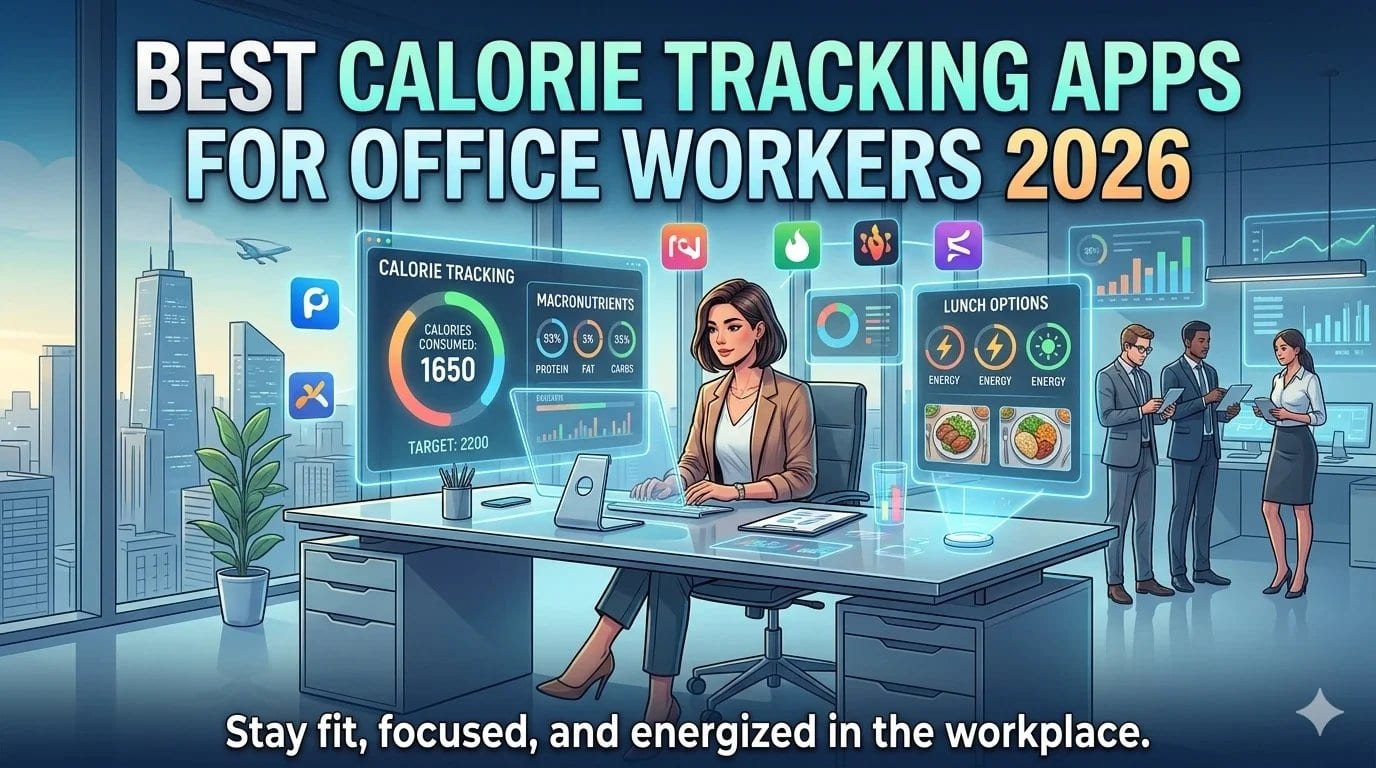
What is the best calorie tracker for office workers?
The best calorie tracker for office workers in 2026 is Welling, which sets accurate calorie targets for sedentary and lightly active lifestyles, logs food in seconds via AI photo scanning, and sends reminders to help you stay consistent through back-to-back meetings and busy workdays. Other strong options include MyFitnessPal (largest database), Cronometer (detailed nutrition data), and Lose It! (simple interface). The right choice depends on how much nutritional detail you need and how fast you want logging to be.
Table of Contents
- Why Office Workers Need a Different Approach to Calorie Tracking
- What to Look for in an Office Diet App
- Best Calorie Tracking Apps for Office Workers 2026
- How Many Calories Do Office Workers Need?
- Common Diet Challenges for Desk Job Workers
- Frequently Asked Questions
- References
Why Office Workers Need a Different Approach to Calorie Tracking
Spending eight or more hours a day sitting at a desk puts you in the sedentary activity category, which significantly affects how many calories you burn and therefore how many you need to eat. Most generic calorie tracking apps default to moderate activity levels, which can overestimate your daily calorie budget by 200 to 400 calories if you are not adjusting for a desk job lifestyle.
Beyond calorie targets, office workers face a specific set of eating challenges that other groups do not. Desk snacking is a major issue: having easy access to snacks at your desk or in a nearby kitchen makes it easy to eat without thinking. Stress eating during deadlines, skipping lunch during busy periods, and heavy reliance on takeaway or canteen food all contribute to a diet that is harder to track consistently.
The best calorie tracker for office workers accounts for sedentary calorie needs, fits into a workday without requiring long interruptions to log food, and helps you build habits around the specific pitfalls of desk job eating.
What to Look for in an Office Diet App
Accurate sedentary calorie targets. The app should allow you to set a sedentary or lightly active activity level and calculate your calorie goal accordingly. Some apps only offer vague activity bands that do not reflect the reality of sitting at a desk all day.
Fast logging. You are not going to spend five minutes logging lunch during a 30-minute break. The best office diet apps log a meal in under a minute, ideally through barcode scanning or AI photo recognition.
Meal reminders. Busy workdays make it easy to skip breakfast, forget to log lunch, or eat at irregular times. Reminder notifications help maintain the consistency that makes tracking useful.
Restaurant and takeaway food coverage. Office workers eat out more than average. A large database with restaurant chains and common takeaway options is more useful than one built primarily around home-cooked meals.
Desktop or web access. Some office workers prefer to log food on a computer rather than picking up their phone. Apps with web versions are more flexible for desk-based use.
Best Calorie Tracking Apps for Office Workers 2026
1. Welling
Best for: Fast logging built around a busy workday
Welling is an AI calorie tracker that logs food through photo recognition. You photograph a meal, the AI identifies the food, estimates the portion, and logs the nutritional data automatically. For office workers eating at their desk, in a canteen, or at a nearby restaurant, this means logging a meal in under 30 seconds without searching a database manually.
Welling sets calorie targets based on your activity level, body metrics, and goals. Setting your activity level to sedentary or lightly active gives you an accurate desk job calorie budget rather than an inflated one based on gym-goer assumptions.
The AI nutrition coach inside the app is particularly useful during a workday. Rather than navigating menus to check your remaining calories or macros, you can ask directly: “how many calories have I had today”, “what can I eat for 500 calories at lunch”, or “am I hitting my protein target this week.” The food tracker also shows your daily progress at a glance so you can make quick decisions without a deep dive into the app.
Welling is free to get started with a premium plan for advanced features.
Pros: Photo logging under 30 seconds, sedentary calorie targets, AI coach for quick nutrition questions, meal reminders, clear daily progress view
Cons: Newer app, smaller community than legacy trackers
2. MyFitnessPal
Best for: Large database for restaurant and takeaway meals
MyFitnessPal’s primary advantage for office workers is its database size. With over 14 million food entries, it covers most restaurant chains, fast food options, and packaged foods that office workers typically eat. If you are logging a Pret a Manger sandwich or a Nando’s lunch, it is likely already in the database.
The activity level settings allow you to select sedentary, lightly active, or active, and the calorie goal adjusts accordingly. The quick add and recent foods features speed up logging for meals you eat regularly, which is useful for office workers who tend to rotate through a small set of lunch spots.
The main limitation is that detailed nutritional data beyond calories and macros is behind the premium paywall. For tracking basic calorie intake at a desk job, the free tier is adequate.
Pros: Largest food database, good restaurant and takeaway coverage, sedentary activity level option, recent foods feature speeds up repeat logging
Cons: Micronutrient tracking behind paywall, no AI photo scanning, interface can feel dated
3. Cronometer
Best for: Nutrition quality awareness alongside calorie tracking
For office workers who want to go beyond calories and understand whether their desk lunch is actually nutritious, Cronometer offers the most detailed nutritional data available. Every food entry includes over 84 nutrients, which means you can see if your canteen meal is low in fibre, iron, or B vitamins, not just how many calories it contains.
The downside for busy office workers is that Cronometer requires more effort to use than Welling or MyFitnessPal. There is no AI photo scanning and no barcode scanner speed shortcut for meals without packaging. For someone logging on a short lunch break, the extra effort is a barrier.
Pros: Best micronutrient depth, verified nutritional data, useful for understanding overall diet quality
Cons: Slower to log, no photo scanning, steeper learning curve
4. Lose It!
Best for: Simple and distraction-free calorie counting
Lose It! is a clean, simple calorie counter with a fast barcode scanner and a no-frills interface. For office workers who want a straightforward calorie counter desk job tool without complex features, it does the job well.
It supports sedentary activity levels, has a reasonable food database for common meals, and is quick to navigate. It does not offer the depth of Cronometer or the speed of Welling’s photo scanning, but for users who want simplicity above all else it is a reliable choice.
Pros: Simple interface, fast barcode scanner, straightforward calorie goals, low learning curve
Cons: Limited nutritional depth, no AI photo scanning, smaller database than MyFitnessPal
5. Noom
Best for: Behaviour change alongside calorie tracking
Noom takes a different approach to calorie tracking by focusing on the psychological patterns behind eating behaviour. For office workers who recognise that their desk snacking or stress eating is a habit problem rather than a knowledge problem, Noom’s coaching layer can be genuinely useful.
The app includes daily articles, coaching check-ins, and a food logging system that categorises foods as green, yellow, or red based on calorie density rather than strict calorie counting. This can make it easier for desk workers to make better food choices without obsessing over exact numbers.
The significant downside is cost. Noom is one of the more expensive calorie tracking apps and requires a subscription from the start. It is not the right fit for users who want straightforward calorie data.
Pros: Behaviour change focus useful for habitual desk snacking, coaching layer, food categorisation system
Cons: Expensive subscription, less precise calorie data, not ideal for macro-focused users
How Many Calories Do Office Workers Need?
Calorie needs for office workers depend on your height, weight, age, and sex, but the sedentary activity multiplier used in most TDEE calculations puts the average desk worker significantly below the calorie needs of someone with a physically active job.
Using the Harris-Benedict equation with a sedentary activity factor of 1.2, a 35-year-old woman weighing 65kg and standing 165cm tall has a maintenance calorie need of around 1,700 to 1,800 calories per day. A man of similar age, weighing 80kg and standing 178cm, needs around 2,100 to 2,200 calories per day to maintain weight.
If your goal is weight loss, a moderate deficit of 300 to 500 calories per day is sustainable without impacting energy levels or concentration at work. A calorie deficit calculator helps you find a target that fits your specific stats rather than using a generic number.
The key point for office workers is not to use an activity multiplier designed for someone who exercises regularly. Overestimating your calorie burn is one of the most common reasons people track food carefully but see no change in weight.
Common Diet Challenges for Desk Job Workers
Mindless desk snacking. When snacks are within arm’s reach or a kitchen is nearby, eating without hunger or awareness becomes easy. Logging every snack, even small ones, is the fastest way to reveal how much extra food is coming in between meals.
Irregular meal timing. Meetings, deadlines, and back-to-back calls push meals later or cause them to be skipped entirely. Skipping meals tends to lead to overeating later in the day. Meal reminders in your tracking app help maintain a more consistent schedule.
Reliance on high-calorie convenience food. Office canteens and nearby restaurants often serve calorie-dense meals in large portions. Tracking these meals builds awareness of how quickly a single lunch can account for the majority of a sedentary daily calorie budget.
Sitting for long periods reducing appetite regulation. Research suggests that prolonged sitting can disrupt appetite-regulating hormones, making it harder to gauge hunger and fullness accurately. Tracking helps compensate for this by providing an objective measure of intake.
Afternoon energy slumps driving sugar cravings. The mid-afternoon slump is a common office experience and often leads to high-sugar snacks. Tracking your full diet can reveal whether the slump is related to what you ate at lunch, such as a high-carb meal with little protein, which can help you adjust.
Built for busy days and desk job calorie budgets.
Welling logs your food in seconds with AI photo scanning, sets accurate calorie targets for sedentary lifestyles, and gives you a nutrition coach you can ask anything without leaving your desk.
Start tracking free on Welling
Frequently Asked Questions
How many calories should a sedentary office worker eat?
Most sedentary office workers need between 1,600 and 2,200 calories per day to maintain their weight, depending on sex, age, height, and weight. For weight loss, a deficit of 300 to 500 calories per day is a reasonable starting point. Use a calorie deficit calculator to get a personalised estimate rather than relying on a generic target.
What is the best free calorie tracker for office workers?
Welling has a strong free tier with AI photo logging and personalised calorie targets for sedentary lifestyles. MyFitnessPal also has a solid free plan with a large database useful for restaurant and canteen meals. Both are good starting points without a subscription.
How do I stop snacking at my desk while tracking calories?
Logging every snack, including small ones, is the first step. Seeing the calorie impact of habitual desk snacking in your daily total is often enough motivation to reduce it. Setting a specific snack calorie budget within your daily goal and using meal reminders to eat at regular times also helps reduce unplanned snacking.
Is it worth tracking calories if I have a desk job?
Yes, particularly because sedentary lifestyles mean lower calorie needs than most people assume. Many office workers eat at a level appropriate for a moderately active person without realising it, which leads to gradual weight gain over time. Tracking provides the awareness needed to eat at the right level for your actual activity.
Can I track calories on a computer rather than my phone?
MyFitnessPal and Cronometer both have web versions accessible from a desktop browser, which is useful for logging at your desk. Welling is primarily a mobile app but the AI photo scanning feature is more practical on a phone regardless of where you are eating.
How do I track canteen or work cafeteria food?
For canteen meals without a menu listed in a database, the fastest approach is AI photo scanning with Welling, which estimates calories from a photograph of the meal. Alternatively, searching for similar dishes in MyFitnessPal’s database and selecting the closest match gives a reasonable estimate. Consistency matters more than perfection when tracking meals without exact data.
References
Biswas, A., et al. (2015). Sedentary Time and Its Association with Risk for Disease Incidence, Mortality, and Hospitalization in Adults. Annals of Internal Medicine, 162(2), 123-132. https://pubmed.ncbi.nlm.nih.gov/25599350/
Chau, J. Y., et al. (2013). Daily Sitting Time and All-Cause Mortality: A Meta-Analysis. PLOS ONE, 8(11), e80000. https://journals.plos.org/plosone/article?id=10.1371/journal.pone.0080000
Harris, J. A., & Benedict, F. G. (1918). A Biometric Study of Human Basal Metabolism. Proceedings of the National Academy of Sciences, 4(12), 370-373. https://www.pnas.org/doi/10.1073/pnas.4.12.370
Dhurandhar, E. J., et al. (2015). The Effectiveness of Breakfast Recommendations on Weight Loss: A Randomized Controlled Trial. American Journal of Clinical Nutrition, 100(2), 507-513. https://pubmed.ncbi.nlm.nih.gov/24898236/
Patel, A. V., et al. (2010). Leisure Time Spent Sitting in Relation to Total Mortality in a Prospective Cohort of US Adults. American Journal of Epidemiology, 172(4), 419-429. https://pubmed.ncbi.nlm.nih.gov/20650954/
Levine, J. A. (2011). Nonexercise Activity Thermogenesis: Liberating the Life-Force. Journal of Internal Medicine, 270(4), 321-335. https://pubmed.ncbi.nlm.nih.gov/21682835/