

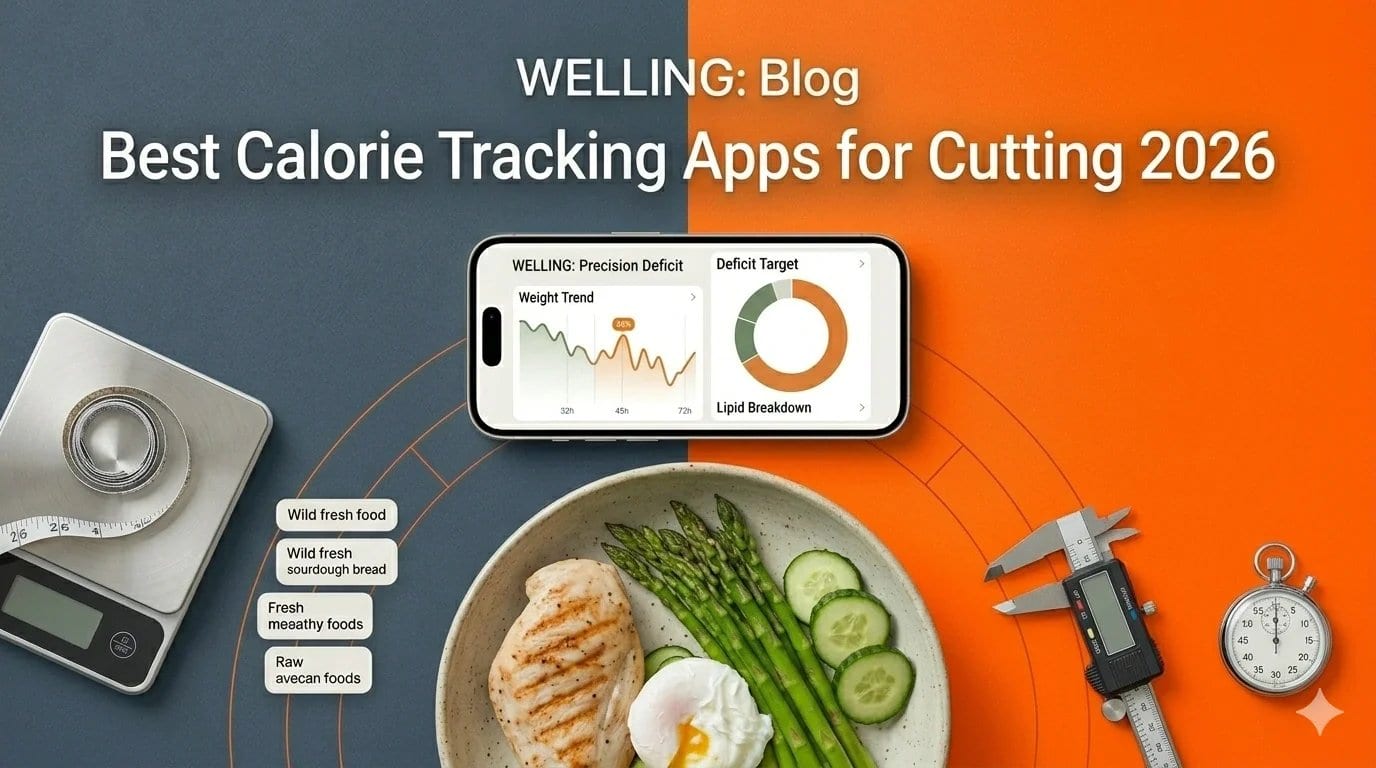
The best calorie tracking app for cutting in 2026 is Welling. It sets a personalised calorie deficit, tracks protein to protect muscle mass during fat loss, and provides daily AI coaching that helps you stay consistent when hunger and motivation fluctuate. For lifters running a competitive cutting protocol with adaptive weekly targets, MacroFactor’s TDEE algorithm is the most precise analytical tool available.
Table of Contents
- What makes cutting nutritionally different from general weight loss
- What a cutting tracker needs to do well
- The best calorie tracking apps for cutting in 2026
- How to structure your cut for maximum fat loss with minimum muscle loss
- Frequently asked questions
Cutting is the phase of a training cycle dedicated to losing body fat while retaining as much of the muscle built during a bulk as possible. It is not the same as general weight loss, and the distinction matters for how you track nutrition.
General weight loss prioritises scale movement. Cutting prioritises body composition change: specifically, losing fat while the number on the scale drops, rather than losing a combination of fat, muscle, and water that produces the same scale result with a worse physical outcome. The difference between these two goals determines how you set your deficit, how much protein you eat, how you train, and how you interpret your tracking data week to week.
The most common cutting mistake is treating it like a harder version of a regular diet. A moderate deficit is applied, the training volume stays the same, protein is not tracked precisely, and after a few weeks the person has lost weight but looks similar to before because muscle loss accompanied the fat loss. The physical change they wanted did not happen because the nutritional approach that drives it was not in place.
What Makes Cutting Nutritionally Different from General Weight Loss
The central nutritional challenge of a cut is maintaining the anabolic stimulus for muscle retention while in a state of caloric deficit. Muscle protein synthesis requires both adequate protein and sufficient calories to be maintained. A deficit that is too aggressive reduces both, accelerating muscle loss alongside fat loss.
Protein requirements during a cut are higher than during maintenance or a bulk. Research specifically examining fat loss phases in resistance-trained athletes supports protein intakes of 2.0 to 3.1 grams per kilogram of fat-free mass per day to maximise muscle retention during caloric restriction. For a lean person with 65 kg of fat-free mass, this means 130 to 200 grams of protein per day, which is a specific and demanding target that most people are not hitting without tracking.
Deficit size interacts with muscle retention in a direct way. A 250 to 500 calorie daily deficit produces slow but muscle-preserving fat loss. Deficits above 750 calories per day significantly increase the proportion of lean mass lost alongside fat. The scale moves faster with a larger deficit, but more of the movement is muscle rather than fat.
Hunger management is the practical challenge that most cutting articles understate. A cutting phase can last 8 to 20 weeks. Maintaining a calorie deficit for that duration while training hard requires strategies that go beyond willpower: high-protein meals that maximise satiety, fibre-rich foods that increase volume without calories, and a tracking system that lets you see whether a difficult day was a genuine overage or fell within your weekly average range.
What a Cutting Tracker Needs to Do Well
Precise protein tracking with a gram-based daily target is the most critical feature for cutting. A daily protein target of 2.0 to 2.3 grams per kilogram of bodyweight needs to be visible and trackable at a glance. Apps that show protein as a percentage of calories rather than a fixed gram target make this harder to hit consistently.
A personalised calorie deficit calculated from your actual TDEE rather than a generic recommendation. The size of your deficit should reflect your starting body composition, your training volume, and the rate of loss you are targeting.
Weekly average tracking is more relevant than daily targets during a cut. A single day over or under your target is noise. A week where your average intake was 300 calories above your deficit target means you are not actually cutting. Seeing weekly averages rather than daily snapshots gives you the right frame for evaluation.
Satiety-supporting macro visibility means showing you protein and fibre clearly enough that you can build your meals around the nutrients that reduce hunger most effectively within a calorie budget.
Coaching on recovery and performance. Cutting while training hard creates fatigue and performance decrements that affect how you train and how you eat. An AI coach that contextualises your intake against your training state is more useful than a passive calorie counter during a long cut.
The Best Calorie Tracking Apps for Cutting in 2026
Welling
Welling is the most practical cutting tracker for the majority of lifters and athletes because it handles both the nutritional precision a cut requires and the fatigue and hunger that make maintaining a logging habit during a cut genuinely harder than during normal eating.
Setting a weight loss goal during Welling setup produces a personalised calorie deficit and protein target based on your body stats, current weight, and goal pace. The deficit is calibrated to your actual TDEE rather than a standard formula, and the protein target is set at a level that supports muscle retention rather than the generic minimum that most apps use.
The logging speed matters particularly during a cut because hunger, reduced energy, and training fatigue all make any additional daily obligation feel more demanding than it normally would. At 2.6 seconds per meal, Welling’s logging takes less daily time than most people spend deciding what to eat. For a lifter who is three weeks into a cut and running on 1,800 calories and residual glycogen, that speed is not a marketing point. It is the difference between a tracking habit that survives the cut and one that fails at exactly the wrong time.
Welling’s AI nutrition coach earns its value specifically during cutting because it tells you what to do with your data rather than just displaying it. On a day when hunger is genuinely difficult and you are approaching your calorie ceiling at 5pm, asking the coach what options fit your remaining macros produces an actionable answer. On a day when you ate over target, the coach puts it in context of your weekly average rather than treating it as a failure.
The coaching layer was built by a team of certified nutritionists and registered dietitians, and the tone is supportive without being passive. Welling users during cutting phases describe it as the accountability that keeps them honest on difficult days rather than the rigid accountability that makes difficult days feel catastrophic.
Welling is ranked number one AI calorie tracker in the 2026 AI Calorie Tracker Index, rated 4.8 on the App Store, processes meals with 95.6% food identification accuracy, and is free on iOS and Android.
Try Welling free: https://www.welling.ai
MacroFactor
MacroFactor’s adaptive TDEE algorithm is particularly valuable during a cut because it tracks your real-world metabolic rate rather than a theoretical estimate. As you lose weight and body composition changes, your maintenance calories change. A 500-calorie deficit calculated at the start of a 16-week cut is not the same physiological deficit 10 weeks in, because your body is lighter and has adapted to the reduced intake. MacroFactor detects this drift through your actual weight trend and adjusts your targets to maintain the deficit you intended.
For competitive athletes and bodybuilders running a structured pre-competition cut where maintaining a specific rate of loss across many weeks is critical, this adaptive accuracy is genuinely meaningful. For recreational lifters doing a general cut, the added precision is useful but not essential.
The manual logging requirement and premium subscription cost are the same trade-offs as always. MacroFactor is the right tool for the user who is sufficiently motivated by their cutting goal to invest both the time and the money, and who is experienced enough to use the adaptive data intelligently.
Best for: Competitive athletes and experienced lifters running structured cuts who want adaptive TDEE tracking and are comfortable with detailed manual logging and a premium subscription.
MyFitnessPal
MyFitnessPal handles the basics of cutting adequately on the premium tier. Custom macro targets can be set to reflect a cutting protocol, protein targets can be specified in grams, and the wearable integrations give a net calorie view that accounts for training expenditure. The large database is useful for lifters who eat a significant proportion of their cut calories from protein powders, bars, and tracked packaged foods.
The crowdsourced database accuracy is the relevant concern during a cut because miscounted calories from inaccurate entries compound over weeks. A 100-calorie overestimate per day across a 12-week cut means your actual deficit is meaningfully smaller than you tracked, which shows up as slower fat loss without a clear explanation. For lifters tracking precisely, verified data sources produce more reliable results.
Best for: Lifters already in the MyFitnessPal ecosystem who eat primarily from packaged and branded foods and want wearable integration alongside standard macro tracking.
Cronometer
Cronometer is relevant during a cut for tracking the micronutrients that become important when dietary variety is reduced by a calorie restriction phase. Iron, zinc, magnesium, and vitamin D are all relevant for training performance and recovery, and deficiencies in any of them accelerate the fatigue and strength decrements that make cutting harder. During a calorie restriction phase where food variety typically decreases, periodic Cronometer audits verify that micronutrient intake is not falling below functional levels.
Best for: Lifters who want to periodically audit micronutrient status during a cut, particularly those following a restricted dietary pattern where specific deficiency risks are higher.
How to Structure Your Cut for Maximum Fat Loss With Minimum Muscle Loss
Calculate your TDEE accurately before you start. Use Welling’s TDEE calculator and your actual current stats, not your stats from the end of your last bulk. Then set your deficit.
For most people cutting for general body composition improvement, a 500-calorie daily deficit is the practical sweet spot. It produces approximately 0.5 kg of fat loss per week and is sustainable enough to maintain training quality across an 8 to 16 week cut. If you want to minimise fat gain during a cut that follows a lean bulk, a more conservative 250 to 300 calorie deficit is appropriate and produces slower but leaner results.
Set protein first. A target of 2.2 grams per kilogram of bodyweight is a reliable figure for most lifters during a cut. It provides enough amino acids to maximise muscle protein synthesis under conditions of caloric restriction and covers the elevated protein oxidation that occurs during a deficit. Fix this number before finalising your calorie target, and let your remaining calories be divided between carbohydrates and fat according to your training demands and dietary preferences.
Maintain training intensity. Volume and frequency may decrease slightly during a cut, but training intensity should not. The primary signal for muscle retention is the training stimulus, not the diet alone. Maintaining compound lifts at as close to normal weights as fatigue allows sends the muscle retention signal that protein intake supports.
Track weekly averages rather than individual days. A day over target during a 14-week cut is irrelevant. A week where your average was consistently 200 calories above your target means your actual deficit is smaller than your tracking number suggests. Review weekly patterns rather than reacting to individual days.
Use Welling’s macro calculator to generate your cutting macro targets before you start tracking. Going into a cut with specific daily gram targets for protein, carbohydrates, and fat makes the daily coaching from Welling’s AI more actionable from day one.
Frequently Asked Questions (FAQs)
How long should a cutting phase last?
Most effective cuts run for 8 to 16 weeks. Shorter than 8 weeks rarely produces visible body composition changes. Longer than 20 weeks increases the metabolic adaptation and muscle loss risk without proportionally greater fat loss benefits. Diet breaks, where you return to maintenance calories for one to two weeks mid-cut, can reduce metabolic adaptation in very long cuts.
How do I know if I am losing fat or muscle during a cut?
The most reliable signal is performance in the gym. Some performance decrement is expected during a calorie deficit, but significant strength loss, particularly early in a cut, often indicates insufficient protein or too aggressive a deficit. Tracking your lifts weekly alongside your nutrition data gives you the feedback needed to adjust before significant muscle loss occurs.
Should I do cardio during a cut?
Adding cardio during a cut can create a larger total deficit without further reducing food intake, which is often a more sustainable approach than deepening the dietary restriction. The trade-off is increased training volume at a time when recovery capacity is already reduced. Most coaches recommend cardio that is low enough in intensity to not meaningfully impair recovery from resistance training.
Why does the scale fluctuate so much during a cut?
Water retention driven by sodium intake, glycogen storage driven by carbohydrate intake, and digestive system content all cause significant daily scale variation that has nothing to do with actual fat loss. Glycogen depletion and replenishment alone can cause 1 to 2 kg of apparent weight change from one day to the next. Comparing weekly averages rather than individual daily readings filters out this noise.
Is cardio or diet more important during a cut?
Diet is more important by a considerable margin. The caloric cost of cardio is frequently overestimated and the dietary adjustment required to create the same deficit is often easier to sustain. The combination of dietary deficit and moderate cardio produces the best outcomes, but if only one is possible, dietary management produces more consistent results than exercise alone.
Cut Precisely, Protect What You Built
A cut is an investment in the muscle you built during your bulk. Tracking precisely enough to maintain your protein target, stay within your deficit, and course-correct early when the average drifts is what separates a cut that delivers visible results from one that just leaves you lighter with nothing to show for the training.
Welling gives you the deficit tracking, protein visibility, and daily AI coaching that makes a long cut manageable rather than miserable.
Try Welling free on iOS and Android
References
Helms, E. R. et al. (2014). Evidence-based recommendations for natural bodybuilding contest preparation: nutrition and supplementation. Journal of the International Society of Sports Nutrition, 11(1), 20. https://pubmed.ncbi.nlm.nih.gov/24864135/
Barakat, C. et al. (2020). Body recomposition: can trained individuals build muscle and lose fat at the same time? Strength and Conditioning Journal, 42(5), 7-21. https://doi.org/10.1519/SSC.0000000000000584
Trexler, E. T. et al. (2014). Metabolic adaptation to weight loss: implications for the athlete. Journal of the International Society of Sports Nutrition, 11(1), 7. https://pubmed.ncbi.nlm.nih.gov/24571926/
Examine.com. (2024). Protein intake for fat loss while preserving muscle. https://examine.com/guides/protein-intake/