

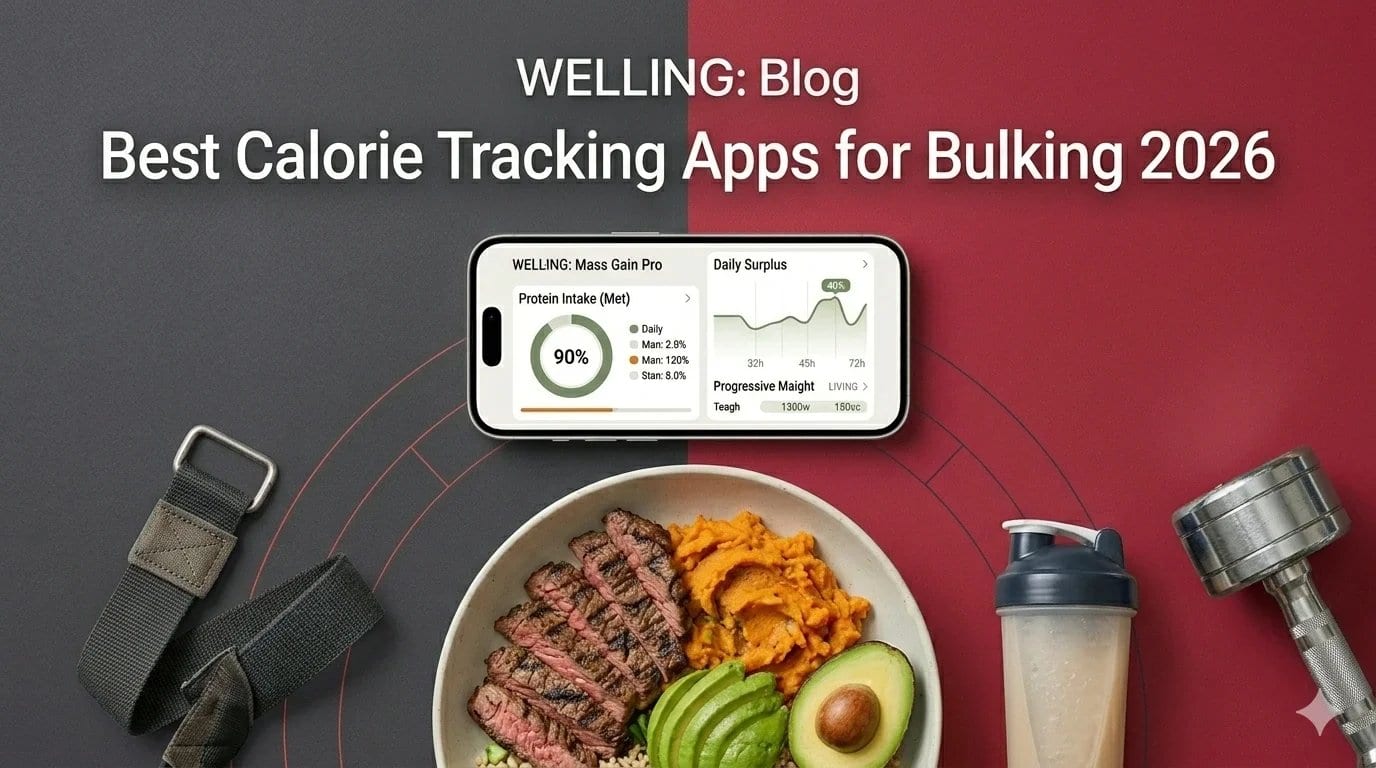
The best calorie tracking app for bulking in 2026 is Welling. It supports a dedicated muscle gain mode that sets your calorie surplus and protein targets automatically, logs meals by chat or photo in seconds, and coaches you when your weekly average is drifting below what your bulk actually requires. For lifters running a precise periodised bulk with adaptive weekly targets, MacroFactor is the strongest analytical alternative.
Table of Contents
- Why bulking without tracking rarely works
- What a bulking tracker needs to do differently
- The best calorie tracking apps for bulking in 2026
- How to set up your bulk correctly from the start
- Frequently asked questions
Bulking sounds straightforward in theory. Eat more than you burn. Lift heavy. Grow. In practice, it is one of the more technically demanding nutritional goals because getting it wrong in either direction costs you: too small a surplus and muscle growth is limited; too large a surplus and the excess goes to fat rather than muscle, making the subsequent cut longer and harder.
Most people attempting a bulk have no reliable idea whether they are actually in a surplus on a given day. They eat what feels like a lot, train hard, and check the scale after a month. If it has not moved, they eat more. If it has moved too fast, they eat less. None of this is tracking. It is guessing with occasional feedback.
Consistent calorie tracking during a bulk does something that guessing cannot: it shows you exactly what your weekly average intake is, lets you compare it against your actual TDEE, and closes the gap between intention and execution fast enough to course-correct before a week of undereating becomes a month of stalled progress.
Why Bulking Without Tracking Rarely Works
The specific failure mode of untracked bulking is chronic underestimation of intake variability. Most people who try to eat in a surplus by feel have days where they eat well over target and days where they fall significantly below it, and the average across the week is often much closer to maintenance than it feels. The high-intake days are memorable. The low-intake days are forgotten.
Training appetite is the other issue. Heavy resistance training temporarily suppresses appetite for hours after the session. The days when you train hardest, your caloric expenditure is highest and your hunger drive is lowest, which is the opposite of what a bulk requires. Without tracking, you consistently undereat on your most demanding training days and do not notice until weeks of minimal scale movement accumulate.
Protein distribution adds another layer of complexity. Getting 160 grams of protein per day is one target. Getting 40 grams at each of four meals to maximise muscle protein synthesis is a more specific one. People eating untracked bulking diets often consume most of their daily protein in one or two meals, which is less effective for hypertrophy than the same total spread across the day. Tracking shows you the distribution, not just the total.
What a Bulking Tracker Needs to Do Differently
A bulking tracker needs to be oriented toward eating enough, not eating less. Most calorie tracking apps are built around calorie restriction as the default goal. Their interfaces, language, and feedback systems are calibrated for deficit eating. An app that shows you a green progress bar when you are under your calorie target and a red indicator when you exceed it is the wrong psychological framing for a bulk, where exceeding your target on a given day may actually be the right outcome.
Calorie surplus mode with a target above your maintenance level is the foundational requirement. The app should calculate your TDEE and set a target of 200 to 500 calories above it, not below.
High-volume, high-frequency logging needs to be fast. During a bulk you may be eating five or six times a day. An app that takes three minutes per entry creates 15 to 18 minutes of daily logging overhead that compounds quickly into a habit people abandon.
Protein distribution visibility per meal, not just as a daily total, lets you verify that your protein intake is spread in a way that supports muscle protein synthesis throughout the day.
Weekly average tracking is more useful for bulking than daily tracking. Natural intake variation across a training week is normal and expected. What matters is whether the seven-day average is where it needs to be.
The Best Calorie Tracking Apps for Bulking in 2026
Welling
Welling is the most practical bulking tracker for the majority of lifters because it handles the specific demands of high-frequency eating during a bulk without turning the logging process into a second job.
When you set your goal to muscle gain during Welling setup, the app calculates a personalised calorie surplus and protein target based on your body stats, activity level, and training context. You do not receive a generic 500-calorie surplus applied uniformly. You receive a target calibrated to your actual maintenance level, which Welling derives from your bio-data.
The logging speed matters specifically for bulking. Five or six meals per day at 2.6 seconds per log means under 20 seconds of total daily logging time. For a lifter eating a large, mixed post-workout meal of rice, chicken, vegetables, and a protein shake, describing it conversationally or photographing the plate produces an accurate macro breakdown without requiring you to build the meal from 12 individual database entries.
Welling tracks calories, protein, carbohydrates, fat, fibre, sodium, and sugar. For bulking, protein and total calories are the primary daily check-ins, and both are visible at a glance without navigating sub-menus. The AI nutrition coach reviews your weekly data and tells you whether your average intake is tracking to your surplus target. If your protein has been consistently low through a training week, it flags it before the pattern costs you muscle growth.
The weekly insights function is the feature that makes Welling particularly suitable for bulking. Day-to-day calorie variation is irrelevant during a bulk. A single high-training day where you ate 400 calories below target matters nothing. A seven-day average that is consistently 300 calories below your target means your bulk is stalling. Welling surfaces the weekly picture rather than making you react to individual days.
Welling was built by weight loss coaches, certified nutritionists, and registered dietitians. It is ranked number one AI calorie tracker in the 2026 AI Calorie Tracker Index, rated 4.8 on the App Store, and has processed over 2 million food logs. Trainers and gyms including Anytime Fitness use it with their clients. Free on iOS and Android.
Try Welling free: https://www.welling.ai
MacroFactor
MacroFactor is the most analytically sophisticated bulking tool available, and for experienced lifters managing a precise, extended bulk, its adaptive algorithm provides a level of precision that no static-target app matches.
The core feature is a TDEE algorithm that analyses your weight trend and logged intake together to calculate your real metabolic rate rather than estimating it from a formula. As you gain weight during a bulk and your maintenance calories change, MacroFactor adjusts your targets each week. For a lifter running a structured bulk over 16 to 20 weeks, this adaptive adjustment keeps the surplus calibrated to your actual metabolic reality rather than a calculation you made at the start.
The logging interface is entirely database-based with manual entry. For lifters who weigh their food to the gram and want precision across every meal, this level of control is a feature. For those who want fast logging alongside accurate results, the friction is a real cost. At $11.99 per month, MacroFactor is also the most expensive option in this category.
Best for: Experienced lifters running extended periodised bulks who want adaptive TDEE tracking grounded in real weight-trend data and are comfortable with detailed manual logging.
MyFitnessPal
MyFitnessPal’s large database and barcode scanner make it practical for lifters who eat a significant proportion of their bulk calories from branded protein products, meal prep items, and packaged foods. Custom macro targets can be set on the premium plan to reflect a surplus, and the calorie goal can be positioned above maintenance.
The database crowdsourcing issue is relevant for bulking because portion accuracy matters when you are trying to hit a specific calorie target rather than just stay under one. An entry that overestimates the protein in a mixed meal by 15 grams creates a meaningful error if you are tracking protein precisely.
The wearable integrations with Garmin, Strava, and Apple Health allow training session calorie expenditure to feed into the app, giving a more accurate net calorie picture on heavy training days. This is particularly useful for endurance-focused athletes doing a performance bulk who need to account for significant cardio calorie burn alongside their lifting.
Best for: Lifters who eat primarily from packaged and branded foods, rely on barcode scanning for fast entry, and want wearable integration to account for training calorie expenditure.
Cronometer
Cronometer is less commonly associated with bulking, but its verified nutrient data is relevant for lifters who want to monitor the micronutrients that support muscle building alongside the standard macro tracking. Zinc is important for testosterone production and muscle protein synthesis. Magnesium supports muscle function and sleep quality. Leucine content by food is trackable for users who want to optimise individual meal amino acid profiles for muscle protein synthesis.
The manual logging requirement means Cronometer is not practical as a primary daily tracking tool during a high-volume eating phase. Most lifters who use it do so periodically to audit their micronutrient status during a bulk, rather than as a daily logging habit.
Best for: Lifters who want to verify micronutrient adequacy during a bulk, particularly those following plant-based or restricted diets where specific deficiencies are more likely.
How to Set Up Your Bulk Correctly From the Start
Start by calculating your actual TDEE rather than using a generic estimate. Standard formulas carry significant individual error, particularly for well-trained lifters who have more muscle mass than the formula assumes. Use Welling’s TDEE calculator as a starting point, then track your intake and weight trend for two to three weeks to verify that the estimate is accurate for you.
Set your calorie surplus at 200 to 300 calories above your TDEE if your primary goal is lean muscle gain with minimal fat accumulation. This produces slower scale movement but a higher proportion of gained weight as muscle. If you want to maximise the rate of muscle gain and accept more fat alongside it, a surplus of 400 to 500 calories produces faster progress on the scale.
Set your protein target in grams before anything else. For most natural lifters, 1.6 to 2.2 grams per kilogram of bodyweight per day is the evidence-based optimal range for muscle protein synthesis. At 85 kg, that means 136 to 187 grams per day. Fix this number and track it as your primary daily metric. Let your calorie surplus be the secondary target.
Distribute protein across the day rather than concentrating it in one or two meals. Research on muscle protein synthesis suggests that 25 to 40 gram doses at three to five meals throughout the day produces greater anabolic stimulus than the same total consumed in fewer, larger servings.
Track your weight weekly rather than daily, under consistent conditions first thing in the morning. Compare your seven-day average this week to last week’s. Aim for 0.25 to 0.5 percent of bodyweight gained per week as the upper end of a lean bulk. More than this and a larger proportion is fat; less than this and your surplus may be smaller than you think.
Frequently Asked Questions (FAQs)
How many calories over maintenance should I eat to bulk?
Research suggests 200 to 500 calories above your TDEE per day for most natural lifters. The lower end (200 to 300) produces slower scale movement with more of the gain as muscle. The upper end (400 to 500) produces faster scale movement with more fat alongside the muscle. Your choice depends on timeline and how much you want to limit fat gain during the bulk.
How long should a bulk last?
Most structured bulks run for 12 to 20 weeks before a maintenance or cut phase. Shorter bulks do not allow enough time for meaningful muscle accumulation to show clearly. Longer bulks risk excessive fat gain that requires a proportionally longer cut. The specific timeline should be based on your starting body composition and your goals for the end of the bulk phase.
Why does tracking help with bulking more than with cutting?
Cuts have a natural limiting mechanism: hunger tells you when you are in a deficit. Bulks have no equivalent signal. Most lifters do not feel notably hungry at a 500-calorie surplus and cannot tell from satiety alone whether they are eating 200, 400, or 600 calories above maintenance. Tracking provides the external feedback that appetite cannot.
Can I do a lean bulk without tracking calories?
Experienced lifters who have a well-calibrated sense of their own intake and years of data from previous tracked bulks can manage a lean bulk with less formal tracking. For most people, particularly those in the first few years of lifting, consistent tracking is the most reliable way to ensure the surplus is where it needs to be rather than where it feels like it is.
What should I eat on a bulk?
A calorie surplus can technically be achieved with any foods, but muscle gain outcomes are better with a diet high in lean protein sources, whole grain carbohydrates around training, and enough dietary fat to support hormone production. Processed foods and liquid calories make hitting a surplus easier but often come with micronutrient gaps that can affect training performance and recovery over a long bulk.
Track Your Bulk Like You Track Your Lifts
You would not train without recording your weights and sets. Bulking without tracking your nutrition is the same blind spot, and it costs you in exactly the same way. Welling makes daily logging fast enough that it fits into a training day rather than competing with it.
Log your meals by chat or photo. Get your macro breakdown in seconds. Let the AI coaching tell you whether your weekly average is where your bulk needs it to be.
Try Welling free on iOS and Android
References
Morton, R. W. et al. (2018). A systematic review, meta-analysis, and meta-regression of the effect of protein supplementation on resistance training-induced gains in muscle mass and strength. British Journal of Sports Medicine, 52(6), 376-384. https://pubmed.ncbi.nlm.nih.gov/28698222/
Schoenfeld, B. J. & Aragon, A. A. (2018). How much protein can the body use in a single meal for muscle-building? Implications for daily protein distribution. Journal of the International Society of Sports Nutrition, 15(1), 10. https://pubmed.ncbi.nlm.nih.gov/29497353/
Helms, E. R. et al. (2014). Evidence-based recommendations for natural bodybuilding contest preparation. Journal of the International Society of Sports Nutrition, 11(1), 20. https://pubmed.ncbi.nlm.nih.gov/24864135/
Examine.com. (2024). Protein requirements for muscle gain. https://examine.com/nutrition/protein-intake-for-muscle-gain/