

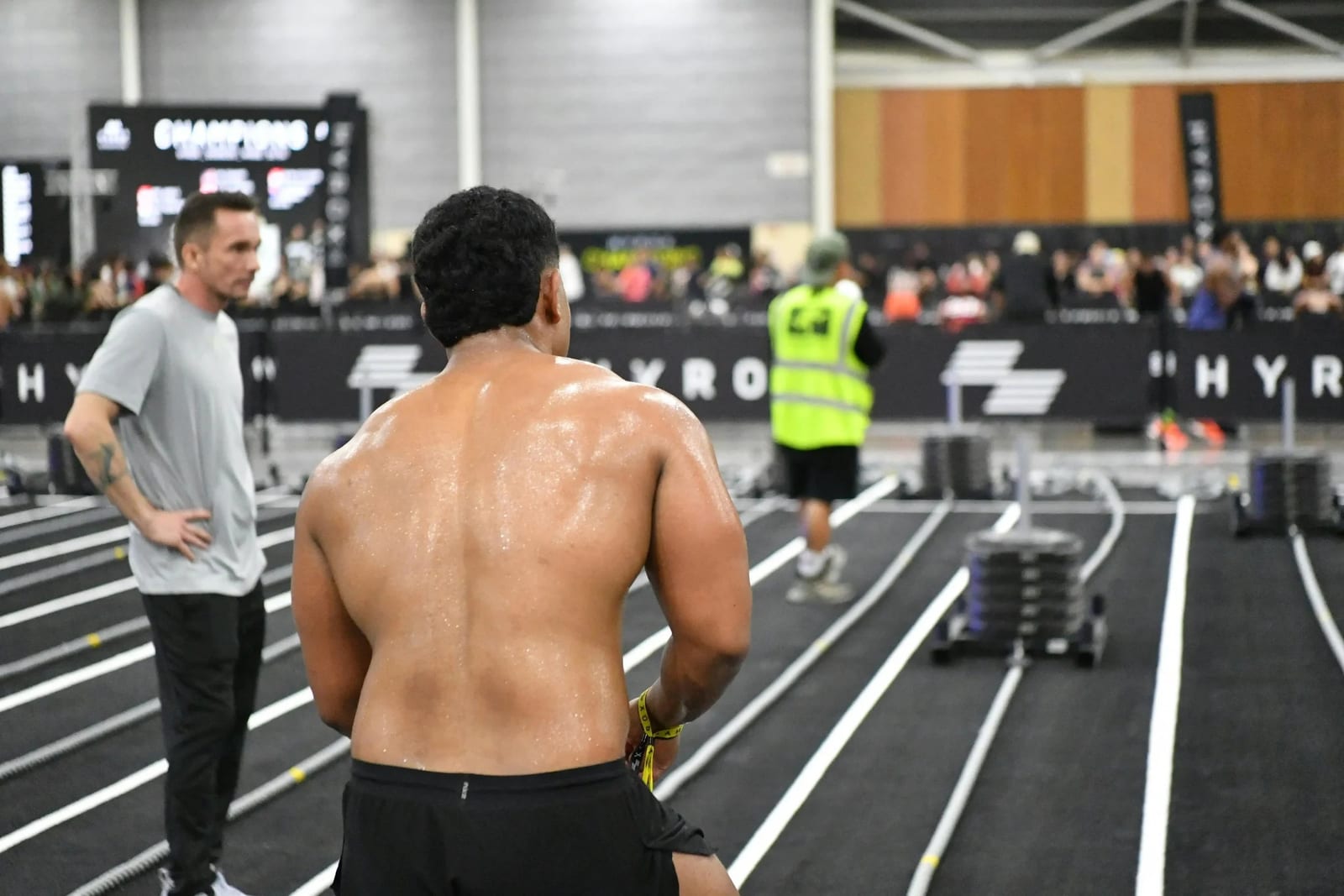
Hyrox is a standardized indoor fitness race where athletes run 1 kilometer and then complete one functional workout station, repeated eight times for a total of 8 kilometers of running and 8 workout stations. The stations include SkiErg, Sled Push, Sled Pull, Burpee Broad Jumps, Rowing, Farmers Carry, Sandbag Lunges, and Wall Balls. Races take place in convention centers globally and most athletes finish in 60 to 90 minutes.
Table of Contents
- What Is Hyrox?
- The Hyrox Race Format Explained
- All 8 Hyrox Workout Stations
- Hyrox Divisions: Which One Is Right for You?
- How Long Does a Hyrox Race Take?
- Why Hyrox Is Exploding in Popularity Right Now
- What Happens on Hyrox Race Day?
- How to Start Training for Your First Hyrox
- Hyrox Nutrition: Fueling Your Training and Race
- Upcoming Hyrox Events in the US
FAQ
If you have been seeing the word “Hyrox” everywhere lately and wondering what the fuss is about, you are not alone. Hyrox has gone from a niche fitness event founded in Hamburg, Germany in 2017 to a global movement attracting over 650,000 competitors in 2024 and projecting over one million participants in the 2025 to 2026 season. In the United States, events sell out in minutes. New York sold out in 40 minutes. London now operates a ballot system with over 70,000 people competing for 16,000 spots.
So what exactly is Hyrox, why is everyone obsessed with it, and should you sign up?
This guide covers everything you need to know, from the race format and workout stations to divisions, race day expectations, training basics, and how to fuel your body properly for the challenge.
What Is Hyrox?
Hyrox is an indoor fitness race built around a single repeating format: run 1 kilometer, complete one functional workout station, and repeat the sequence eight times. That gives you a total of 8 kilometers of running and 8 workout stations, completed in one continuous effort.
The race is held indoors in large convention centers and exhibition halls, which means the format is entirely standardized. Every Hyrox event in the world follows the same course, uses the same eight stations, and records athlete times on a global leaderboard. Whether you race in Los Angeles, Houston, New York, or London, your time is directly comparable to anyone else who has ever done a Hyrox.
This standardization is one of the key reasons Hyrox has grown so fast. It gives athletes a measurable, repeatable benchmark that they can chase across seasons and cities.
Hyrox was founded in 2017 by Olympic champion Moritz Fürste and event specialist Christian Toetzke. Their founding idea was simple but powerful: millions of people were already training in gyms every day, but unlike runners or cyclists, they had no standardized competition to enter. Hyrox gave fitness a finish line.
The Hyrox Race Format Explained
The structure of every Hyrox race is identical:
Run 1km, complete Station 1. Run 1km, complete Station 2. Repeat through Station 8.
There is no rest period built into the format. You move from your run directly into the station, and then from the station directly into the next run. The clock runs the entire time.
The total distance covered is 8 kilometers of running plus the combined distance and reps of all eight workout stations. For most recreational athletes, this takes between 60 and 90 minutes of continuous effort at a high to moderate intensity.
The brilliance of the format is that it tests two things simultaneously: aerobic endurance and muscular strength. Pure runners often struggle with the strength stations. Pure gym athletes often fall apart on the runs. Hyrox rewards the athlete who has developed both qualities.
All 8 Hyrox Workout Stations
Here are the eight workout stations, completed in this exact order at every Hyrox event:
Station 1: SkiErg 1,000 meters on a SkiErg machine. This primarily targets your upper body and core and also has a significant cardiovascular demand. Many athletes find this station more tiring than it looks.
Station 2: Sled Push 50 meters of pushing a weighted sled down a track. This is universally regarded as one of the hardest stations. The leg drive required, especially when your legs are already fatigued from the first run, catches a lot of athletes off guard.
Station 3: Sled Pull 50 meters of pulling the sled back using a rope. After the push, your legs are already burning. The pull adds grip and upper back fatigue on top of that.
Station 4: Burpee Broad Jumps 80 meters of burpee broad jumps, performed continuously. You do a burpee and then jump forward as far as possible, repeating until you have covered 80 meters. This station is a cardiovascular and total body challenge.
Station 5: Rowing 1,000 meters on a rowing machine. This tests both your aerobic engine and your pulling strength. A strong rowing pace here can make a real difference to your overall time.
Station 6: Farmers Carry 200 meters of walking while carrying two heavy kettlebells, one in each hand. Grip strength and posture are key here. Most athletes do the 200 meters in one unbroken effort, but you are allowed to put the weights down.
Station 7: Sandbag Lunges 100 meters of walking lunges while holding a sandbag. After six stations and six kilometers of running, your legs will be significantly fatigued by this point. Pacing is critical.
Station 8: Wall Balls 100 wall ball repetitions. This is the final station and it is famous for being the one that finishes people. After eight kilometers of running and seven previous stations, performing 100 wall balls at a squat-to-throw movement is genuinely brutal. This is where Hyrox races are won or lost for many athletes.
Station weights by division:
Open division uses lighter loads suitable for most trained adults. The Pro division increases weight significantly across all stations. Weights also differ between men and women within each division.
Hyrox Divisions: Which One Is Right for You?
One of the reasons Hyrox is so popular is that it is genuinely accessible across a wide range of fitness levels. There are multiple divisions to suit different athletes:
Open (Singles) The standard division. You complete all eight stations alone using the Open-division weights. This is the right starting point for the majority of first-time athletes.
Pro (Singles) Heavier weights across every station. This division is for experienced athletes with a strong base of both running and functional fitness. Average Pro finish times are around 60 to 70 minutes.
Doubles Two athletes share all the work. One runs while the other completes the station, and they can switch at any time. This is a great format for friends who want to compete together without the full solo load.
Relay A team of four athletes, each taking one or two stations. This is the most accessible entry point for groups and is very popular for corporate teams or social fitness groups.
Age Group Divisions Hyrox offers age group categories ranging from under-24 all the way to 70 and above. Over 65 percent of Hyrox athletes at recent events were over the age of 30, and the oldest recorded finisher was 74 years old. This is genuinely a race for every age.
How Long Does a Hyrox Race Take?
Finish times vary widely depending on your fitness level, division, and strategy.
Here is a general guide for the Open division:
Elite recreational athletes: 55 to 70 minutes
Average trained athletes: 75 to 90 minutes
Beginners and first-timers: 90 to 120 minutes
There is no time limit on Hyrox events, and the finish rate is remarkably high. Around 98 percent of athletes who start a Hyrox finish it. The format is challenging, but it is designed to be completable.
The average finish time for men in the Pro division was 1 hour and 22 minutes in the 2024 to 2025 season.
Why Hyrox Is Exploding in Popularity Right Now
Hyrox’s growth from 650 athletes at its first event to over 650,000 in 2024 did not happen by accident. Several factors explain why this particular fitness race has resonated so strongly.
It is standardized and competitive. Your time in Chicago is directly comparable to someone’s time in Berlin. That creates genuine personal bests, a reason to keep improving, and a sense of being part of a global athletic community.
It sits in the middle of the fitness world. Hyrox is not purely a running race and not purely a strength event. It rewards athletes who have built both qualities, which describes a huge proportion of the modern gym population. Runners who lift. CrossFitters who run. Regular gym-goers who have been wanting a race to aim at.
It is inclusive by design. Around 70 percent of Hyrox participants are first-time athletes at any given event. The doubles and relay formats make it accessible for people who are not ready to go solo. The age group structure ensures 50-year-olds are competing against other 50-year-olds.
The community and atmosphere are exceptional. Hyrox events are essentially fitness festivals. Thousands of athletes compete across a full weekend in massive indoor venues. The crowd energy, music, and shared effort create an atmosphere that runners who have done traditional road races often describe as completely different from anything they have experienced.
The format is repeatable. Unlike obstacle course racing or adventure events, which vary completely from one event to the next, every Hyrox is the same. Athletes can train specifically for the format, measure their improvement, and return to the next event knowing exactly what to expect.
What Happens on Hyrox Race Day?
If you are planning your first Hyrox, here is what to expect when you arrive.
You will check in at the venue, collect your timing chip, and receive your athlete bib. Registration typically opens 90 minutes before your division’s first wave.
Athletes are released in waves based on their expected finish time. You start your run on the floor of the convention center, which is set up with the sled track, rowing machines, SkiErgs, and other equipment visible throughout the space.
The sled push station at Station 2 tends to be the wake-up call for most first-timers. What feels manageable during training often feels significantly harder when your legs are already carrying fatigue from a kilometer of running.
The crowd is present throughout the race. Spectators line the course and cheer for athletes at every station. The energy in a Hyrox venue is unlike most fitness events.
Wall balls at Station 8 are the final boss. After seven stations and seven kilometers of running, the prospect of 100 wall balls is psychologically daunting. Pacing yourself here, rather than trying to do them all in one unbroken set, is the approach most athletes recommend for beginners.
After crossing the finish line, you receive your finisher medal, have your photo taken, and join the spectator area. Most events have a social area where athletes can watch other divisions and recover together.
How to Start Training for Your First Hyrox
You do not need to be an elite athlete to finish a Hyrox. Most people with a base of regular fitness can prepare adequately in 8 to 16 weeks.
Here is the foundational framework:
Build your running base first. You will run 8 kilometers on race day at a maintained effort level. If you are not currently running regularly, Zone 2 aerobic running should be your first priority. Three runs per week, two at an easy conversational pace and one slightly longer effort, is a solid starting structure.
Train the stations specifically. Access to a SkiErg, rowing machine, sled, and wall ball is ideal. Many Hyrox-affiliated gyms have all of this equipment. If you cannot access a sled, heavy leg press and Romanian deadlifts are the best substitutes.
Practice the stations when you are tired. This is the most important and most overlooked training principle. Doing wall balls fresh in a gym is very different from doing them after eight kilometers of running. Add “Hyrox finishers” to your training sessions: end a run with a set of wall balls and a farmers carry. Do it regularly. Your race-day performance will reflect this preparation.
Do not skip strength work. The sled push, sled pull, and farmers carry all require genuine functional strength. Two strength sessions per week focusing on lower body compound movements and pulling exercises will significantly improve your station performance.
Hyrox Nutrition: Fueling Your Training and Race
Training for Hyrox places significant demand on your body. The combination of running volume and strength work means your calorie and nutrient needs are higher than most recreational athletes expect, particularly in the final weeks of a training block.
The key nutritional priorities for Hyrox are:
Carbohydrates as your primary fuel. Hyrox training is high-intensity and energy-demanding. Carbohydrates power your anaerobic efforts on the strength stations and keep your running pace consistent across all eight kilometers. Aim for 4 to 7 grams of carbohydrate per kilogram of body weight per day during your training block, scaling toward the higher end on your hardest sessions.
Protein for recovery. The muscular demand of sled work, lunges, and carries creates significant tissue breakdown. Adequate protein, roughly 0.7 to 1.0 grams per pound of body weight per day, is essential for recovering between sessions and arriving at race day with your muscles in good condition.
Consistent daily tracking. One of the most common mistakes Hyrox athletes make is under-eating during a training block. You are training harder than usual, and your body needs more fuel. Tracking your daily intake, even approximately, helps you stay on top of your targets.
This is where Welling can make a real difference. Welling is an AI nutrition coach that lets you log meals instantly by snapping a photo or describing what you ate in plain language. It calculates your calories and macros automatically, tracks your protein and carbohydrate intake in real time, and adjusts your daily targets based on your body and goals. It’s a great alternative to apps like MyFitnessPal or MacroFactor for athletes who are already managing training schedules, work, and life, removing the friction from nutrition tracking is genuinely valuable.
Upcoming Hyrox Events in the US
The United States is one of the most active Hyrox markets in the world. Major events for 2026 include:
Las Vegas (season opener, early 2026)
Houston (multi-day event at the George R. Brown Convention Center)
New York (May 28 to June 7, 2026, the largest Hyrox event in North American history with 50,000 athletes across two weekends and eight days of racing)
Washington D.C. (September 7, 2026)
Miami (Miami Beach Convention Center)
Tickets for US events sell out quickly. If you are considering signing up, check hyrox.com for registration windows and set a reminder.
Frequently Asked Questions
What is Hyrox in simple terms?
Hyrox is an indoor fitness race where you run 1 kilometer, complete one functional workout, and repeat that sequence eight times. You cover 8 kilometers of running and complete 8 workout stations in one continuous timed effort.
Is Hyrox suitable for beginners?
Yes. Around 70 percent of athletes at any given Hyrox event are competing for the first time. The Open division uses manageable weights, and there are Doubles and Relay formats for athletes who want to share the work. Most people with a regular fitness base can prepare adequately in 8 to 16 weeks.
How is Hyrox different from CrossFit?
CrossFit workouts vary from day to day and are typically performed in a gym setting without a structured race format. Hyrox uses a standardized, repeating format that is identical at every global event, which allows for direct time comparisons and official world rankings. The movements in Hyrox are functional but more straightforward than many CrossFit workouts.
What should I eat before a Hyrox race?
Your pre-race meal should be carbohydrate-focused, low in fat and fiber, and eaten 2 to 4 hours before your start time. Good options include oatmeal with banana and honey, a bagel with peanut butter, or eggs on white toast. Eat only foods you have tested during training. Nothing new on race day.
How do I track my nutrition during Hyrox training?
Apps like Welling make macro and calorie tracking fast and simple. You can log meals by photo or by describing what you ate, and the AI nutrition coach calculates your intake and tracks your progress toward your daily protein, carbohydrate, and calorie targets automatically.
Do I need special equipment to train for Hyrox?
Ideally you will have access to a SkiErg, rowing machine, wall ball, sandbag, kettlebells, and a sled. Many Hyrox-affiliated gyms provide all of this. If a sled is not available, heavy leg press and deadlifts are effective substitutes for the push and pull stations.
How do I sign up for a Hyrox event?
Visit hyrox.com, find the race closest to you, and follow the registration instructions. Choose your division (Open is recommended for first-timers), select your preferred time slot if available, and complete payment. Set a registration reminder for popular events as US races frequently sell out within hours.
Can I do Hyrox if I am not a runner?
Yes, but building a running base is essential for a positive race experience. Eight kilometers of running under fatigue is the backbone of every Hyrox race. If you currently do not run, start with short 20 to 30 minute runs at a comfortable pace and build from there over your training block.
Welling is an AI weight loss coach that simplifies nutrition tracking and provides daily accountability and insights. Rated 4.8 in the App Store by thousands of users.
Download Welling on the Apple App Store or Google Play Store