

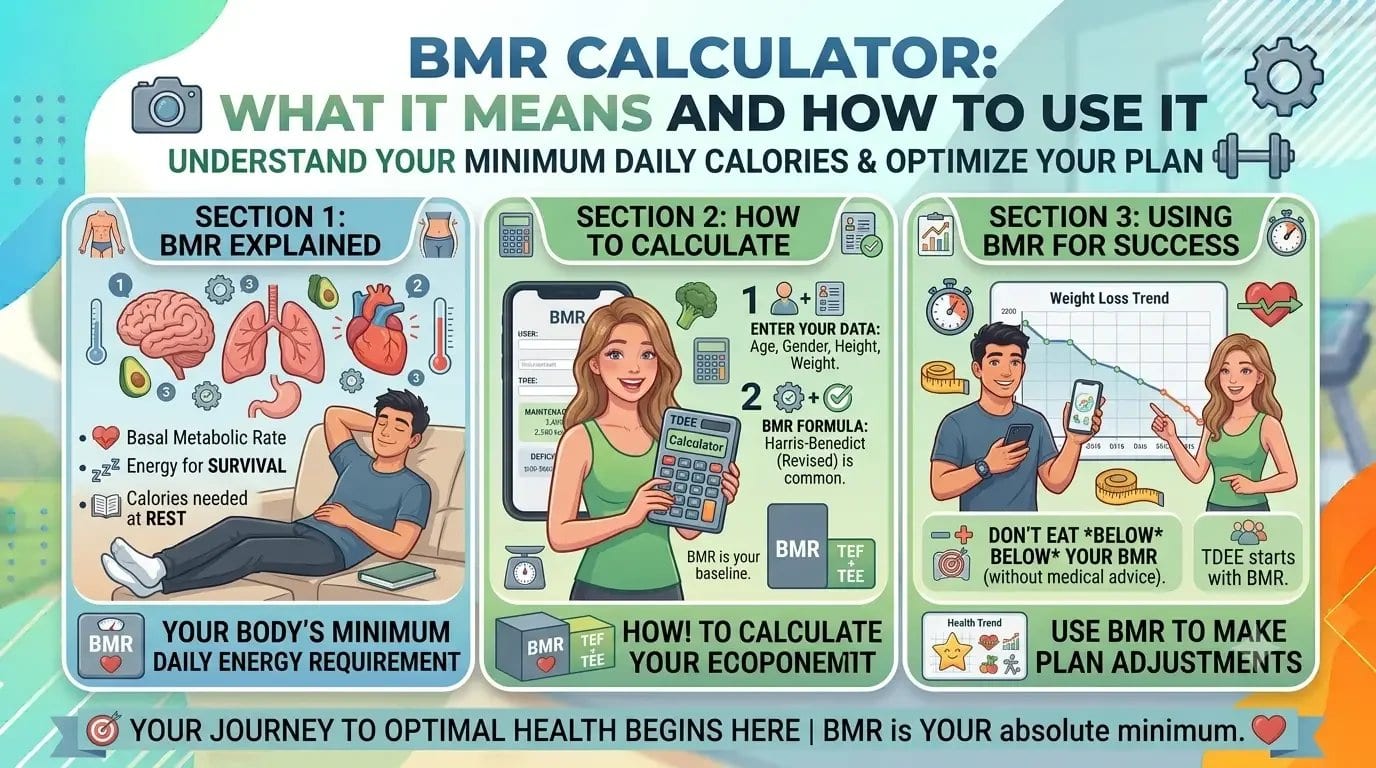
What is BMR and how do you use it?
BMR stands for Basal Metabolic Rate: the number of calories your body burns at complete rest just to keep you alive. It accounts for 60 to 70 percent of the calories most people burn each day. To use it for weight loss or gain, multiply your BMR by an activity factor to get your TDEE, then eat below or above that number. Use the calculator below to find your BMR in seconds.
Table of Contents
- BMR Calculator
- What Is BMR?
- What Is the Difference Between BMR and TDEE?
- What Affects Your BMR?
- Which BMR Formula Is Most Accurate?
- How Do You Use Your BMR to Set a Calorie Goal?
- How Do You Track Against a BMR-Based Calorie Target?
- Frequently Asked Questions
- References
BMR Calculator
BMR Calculator
Your Basal Metabolic Rate
Estimated TDEE by activity level:
BMR is calculated using the Mifflin-St Jeor equation. Multiply by your activity factor to get your daily calorie needs.
What Is BMR?
BMR stands for Basal Metabolic Rate. It is the number of calories your body burns at complete physical and digestive rest, the minimum energy required to maintain your vital functions: breathing, circulation, brain function, temperature regulation, and cellular repair.
Think of BMR as the energy cost of simply being alive. Even if you spent an entire day lying still and not eating, your body would still burn this many calories just to keep running.
For most adults, BMR accounts for 60 to 70 percent of total daily calorie expenditure. This means that even before you factor in exercise, your body is already burning the majority of its daily calories just to sustain basic function. This is why crash diets that drop intake dramatically below BMR are counterproductive: the body responds by reducing metabolic rate to protect itself, making sustainable fat loss harder.
What Is the Difference Between BMR and TDEE?
BMR is the calories your body burns at complete rest. TDEE is the calories your body burns across a full day including all activity.
The relationship is: TDEE = BMR x activity multiplier.
BMR alone is not a useful calorie target for eating because no one actually lies completely still all day. TDEE is the number you eat at to maintain weight, below to lose, or above to gain. BMR is the foundation that TDEE is built on.
A common mistake is eating at BMR as a calorie target. This creates a deficit that is far larger than intended, since it does not account for the substantial calories burned through daily activity, and can lead to excessive restriction that triggers metabolic adaptation and muscle loss.
What Affects Your BMR?
Body size. Larger bodies require more energy to maintain. BMR scales with body weight and height, which is why the Mifflin-St Jeor equation includes both.
Lean muscle mass. Muscle tissue burns more calories at rest than fat tissue. Two people of the same total weight but different body compositions, one muscular and one with higher body fat, have different BMRs, with the more muscular person burning more calories at rest.
Age. BMR declines with age, primarily because of gradual muscle mass loss. This is one reason calorie needs tend to decrease as people get older, even without changes in activity.
Sex. Men typically have higher BMRs than women of the same height and weight, primarily because men tend to have greater muscle mass and lower body fat percentage on average.
Hormones. Thyroid hormones, which the standard BMR equations do not account for, have a significant influence on metabolic rate. Hypothyroidism reduces BMR, and hyperthyroidism raises it, which is why individuals with thyroid conditions often find formula-based estimates less accurate for them personally.
Which BMR Formula Is Most Accurate?
Several BMR formulas exist, with the two most commonly used being the Mifflin-St Jeor equation and the older Harris-Benedict equation. A 2005 systematic review published in the Journal of the American Dietetic Association compared these formulas against measured resting metabolic rate and found that the Mifflin-St Jeor equation was the most accurate for a population of healthy non-obese adults, correctly predicting measured metabolic rate within 10 percent for approximately 82 percent of subjects, compared to 69 percent for the Harris-Benedict equation.
The Katch-McArdle formula, which uses lean body mass rather than total weight, produces more accurate results for individuals with known body composition data, particularly athletes and lean individuals. This calculator uses Mifflin-St Jeor because it requires only the commonly available inputs of age, sex, weight, and height.
How Do You Use Your BMR to Set a Calorie Goal?
The correct process is:
Step one: Calculate your BMR using the calculator above.
Step two: Multiply your BMR by the appropriate activity factor to get your TDEE:
Sedentary (little or no exercise): BMR x 1.2
Lightly active (exercise 1-3 days/week): BMR x 1.375
Moderately active (exercise 3-5 days/week): BMR x 1.55
Very active (hard exercise 6-7 days/week): BMR x 1.725
Extra active (physical job plus daily training): BMR x 1.9
Step three: Subtract your desired calorie deficit from your TDEE. A 500 calorie deficit produces approximately 0.5 kg of fat loss per week. Never set a target below your BMR without medical supervision, and apply the minimum safe floors of 1,500 kcal for men and 1,200 kcal for women for unsupervised dieting.
The calorie deficit calculator on Welling combines steps one through three into a single tool if you prefer the full calculation automated.
How Do You Track Against a BMR-Based Calorie Target?
The calculation gives you a number. Hitting that number consistently every day requires daily food tracking.
Welling logs meals in 2.6 seconds on average through photo, chat, or voice note, with 95.6 percent food identification accuracy across 15,000 tested meals. You enter your TDEE-based calorie target in the app, and every meal you log is tracked against it automatically with a running daily total showing remaining calories, macros, fiber, sodium, and sugar. The AI nutrition coach responds to questions like “what can I eat tonight to stay within my target” with specific, contextually correct answers based on what you have already logged.
This combination of a calculated BMR-based target and daily AI-assisted logging is the practical foundation of consistent calorie management.
Know your BMR. Hit your target every day.
Welling logs your meals from a photo, chat, or voice note in 2.6 seconds on average and tracks your daily calorie intake against your personal target automatically.
Frequently Asked Questions
What does BMR mean?
BMR stands for Basal Metabolic Rate. It is the number of calories your body burns each day at complete rest to sustain basic life functions, accounting for roughly 60 to 70 percent of most people’s total daily energy expenditure.
Should I eat at my BMR to lose weight?
No. BMR is the calories you burn at complete rest, not your full daily expenditure. Eating at your BMR would create a far larger deficit than intended because it ignores all the calories you burn through daily movement and activity. Eat below your TDEE (which includes your BMR plus activity), not below your BMR directly.
What is a normal BMR for a woman?
BMR varies significantly based on age, height, and weight. A rough average BMR for a 35-year-old woman weighing 65 kg and 165 cm tall is approximately 1,380 to 1,420 kcal per day using the Mifflin-St Jeor equation. Younger women, taller women, and heavier women will typically have higher BMRs.
What is a normal BMR for a man?
A rough average BMR for a 35-year-old man weighing 80 kg and 178 cm tall is approximately 1,820 to 1,870 kcal per day using the Mifflin-St Jeor equation. As with women, values vary substantially based on age, height, weight, and muscle mass.
Can you increase your BMR?
Yes, primarily through increasing lean muscle mass. Resistance training builds muscle tissue, which burns more calories at rest than fat tissue, raising BMR over time. This is one of the reasons resistance training is recommended alongside calorie restriction during weight loss, both to preserve muscle mass and to support a higher BMR.
Why is my actual weight loss different from what my BMR calculation predicts?
Formulas predict population averages with a margin of error of approximately 10 to 15 percent for individuals. Differences in actual muscle mass, thyroid function, NEAT levels, and individual metabolic variation all affect how accurate a formula-based estimate is for any specific person. Treat the output as a starting point and adjust based on real-world weight tracking data over two to three weeks.
References
Mifflin, M. D., et al. (1990). A New Predictive Equation for Resting Energy Expenditure in Healthy Individuals. American Journal of Clinical Nutrition, 51(2), 241-247. https://pubmed.ncbi.nlm.nih.gov/2305711/
Frankenfield, D., Roth-Yousey, L., & Compher, C. (2005). Comparison of Predictive Equations for Resting Metabolic Rate. Journal of the American Dietetic Association, 105(5), 775-789. https://pubmed.ncbi.nlm.nih.gov/15883556/
Harris, J. A., & Benedict, F. G. (1918). A Biometric Study of Human Basal Metabolism. Proceedings of the National Academy of Sciences, 4(12), 370-373. https://www.pnas.org/doi/10.1073/pnas.4.12.370
Speakman, J. R., & Selman, C. (2003). Physical Activity and Resting Metabolic Rate. Proceedings of the Nutrition Society, 62(3), 621-634. https://pubmed.ncbi.nlm.nih.gov/14692594/
Hall, K. D., & Guo, J. (2017). Obesity Energetics: Body Weight Regulation and the Effects of Diet Composition. Gastroenterology, 152(7), 1718-1727. https://pubmed.ncbi.nlm.nih.gov/28193517/
Tremblay, A., & Chaput, J. P. (2012). Adaptive Thermogenesis Can Make a Difference in the Ability of Obese Individuals to Lose Body Weight. International Journal of Obesity, 36(6), 771-776. https://pubmed.ncbi.nlm.nih.gov/22027950/