

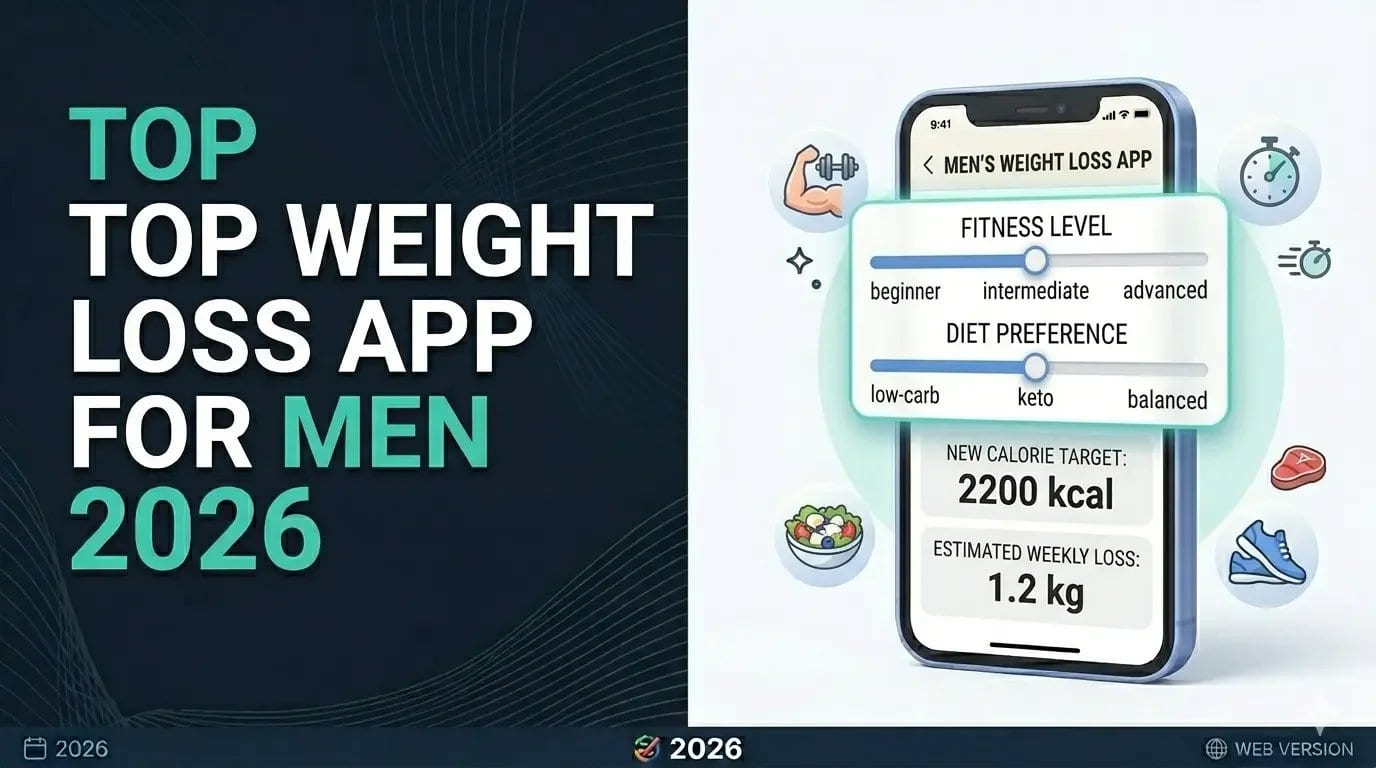
The best weight loss app for men in 2026 is Welling. It sets personalised calorie and protein targets based on your body stats, lets you log meals by chat or photo in seconds, and coaches you daily on what to adjust. For men who want more detailed adaptive macro tracking, MacroFactor is the strongest alternative.
Table of Contents
- Why weight loss works differently for men
- What to look for in a weight loss app as a man
- The best weight loss apps for men in 2026
- How to choose based on your goal and training style
- A practical weight loss framework for men
- Frequently asked questions
Men and women lose weight through the same basic mechanism, a sustained calorie deficit, but the context around that mechanism is different enough that it is worth understanding before choosing an app. Men typically carry more muscle mass, which means higher maintenance calorie requirements and a stronger response to protein-driven muscle retention during a deficit. Men are also more likely to be training alongside a weight loss goal, which adds the complexity of fuelling workouts adequately while still creating an energy deficit.
The other pattern that matters is the way many men approach tracking. Research consistently shows that men are more likely to track with the goal of optimising a specific outcome - hitting a protein target, reaching a strength goal, losing weight before an event - rather than tracking for general awareness. That goal-oriented approach means the app needs to give clear targets and useful feedback, not just a calorie total and a colour.
This guide covers the best weight loss apps for men in 2026, what each one does well for this specific use case, and how to choose based on how you actually train and eat.
Why Weight Loss Works Differently for Men
Men’s higher average muscle mass creates a metabolic baseline that means calorie requirements are typically higher than standard chart recommendations suggest. The standard 2,000-calorie daily reference figure that appears on food packaging is based on population averages that do not represent an active man’s actual energy needs. Using an accurate TDEE as the starting point for a calorie deficit matters more for men than the generic number might suggest.
Protein requirements are the second key difference. Men trying to lose weight while maintaining or building muscle, which is the goal for most men who exercise alongside a deficit - need substantially more protein than the standard recommendations for sedentary individuals. Research supports a target of 1.6 to 2.4 grams of protein per kilogram of bodyweight for men in a calorie deficit who are training. At 85 kg, that means 136 to 204 grams of protein per day. Most men eating normally are significantly below the lower end of that range without realising it.
The third factor is eating pattern. Men are more likely to eat fewer, larger meals and to eat opportunistically rather than to a planned schedule. A weight loss app that requires frequent logging of small, carefully portioned meals will not fit how most men actually eat. An app that handles a large, varied dinner logged by description or photo - without requiring you to build it from 12 individual ingredients, will.
What to Look for in a Weight Loss App as a Man
Accurate TDEE calculation is the foundation. Men’s calorie needs are highly individual and significantly affected by muscle mass and training volume. An app that generates a personalised target from your actual stats is more useful than one applying a generic formula.
Protein tracking prominently displayed matters more than any other macro for men focused on body composition. The app should show your daily protein total clearly, not buried behind calories in a submenu.
Fast logging for larger meals is practical for men who eat two or three substantial meals rather than five or six small ones. Chat and photo logging handles a large, mixed plate faster than database search.
Training integration is worth considering if you exercise regularly. Calorie requirements shift significantly on heavy training days versus rest days, and an app that accounts for this gives more accurate targets.
No-nonsense feedback resonates with how most men want to engage with a tracking tool. Clear data, practical suggestions, actionable coaching - without excessive encouragement or emotionally framed copy.
The Best Weight Loss Apps for Men in 2026
Welling
Welling is the most practical weight loss app for men who want results without tracking becoming a second job. The conversational logging interface handles the way men actually eat - large, mixed meals described in plain language or photographed in seconds - without requiring manual database construction for every meal.
Setting the goal to weight loss on setup triggers Welling to calculate your personalised calorie target and protein requirement based on your body stats, not a generic male average. The AI nutrition coach reviews your daily intake and provides specific guidance: if your protein is falling short, it tells you and suggests a fix. If your calorie average for the week is drifting above your target, it flags the pattern before it becomes a problem.
The accountability dimension is directly relevant for men who do well with clear check-ins rather than passive data. Welling’s daily coaching interactions are direct and practical - the kind of feedback that fits how most men prefer to engage with information about their performance.
Welling is rated 4.8 on the App Store, has processed over 2 million food logs, and is available free on iOS and Android. It integrates with Apple Health for users who want food intake data combined with activity from Apple Watch or other devices.
Try Welling free: https://www.welling.ai
MacroFactor
MacroFactor is the strongest option for men who approach weight loss as an optimisation problem and want adaptive calorie targets that respond to their actual body weight trend rather than a static estimate. Its TDEE algorithm monitors your weight data over time and adjusts your calorie target weekly, which accounts for metabolic adaptation that occurs as you lose weight - a real phenomenon that static apps ignore.
For men who train seriously and want to manage their weight loss precisely while protecting muscle mass, MacroFactor’s week-by-week adaptive targets and detailed macro coaching provide a level of sophistication that no general-purpose app matches. Every meal is logged manually through database search, which suits men who prefer precise, measured logging.
At $11.99 per month, MacroFactor is a premium product. For men who have already established a consistent tracking habit and want to take their precision further, the investment is justified. For those who are still building the daily logging habit, starting with Welling first is a lower-friction entry point.
Best for: Men who train seriously, want adaptive calorie targets, and are comfortable with detailed manual logging and a monthly subscription.
MyFitnessPal
MyFitnessPal’s database breadth is its main advantage for men who eat a varied diet including branded products, restaurant meals from major chains, and packaged foods where barcode scanning gives fast, accurate results. The large food database and wearable integrations with Garmin, Strava, and Apple Health make it practical for active men who want a combined view of training and nutrition.
Custom protein targets and detailed macro tracking are behind the premium paywall at around $8.49 per month. The free tier covers basic calorie tracking, which is adequate as a starting point but limited for men who want to track protein specifically. The crowdsourced database carries accuracy variation for non-standard entries that is worth being aware of when logging homemade or restaurant food.
Best for: Men already in the MyFitnessPal ecosystem, or those who rely heavily on packaged and branded foods where the barcode database is fast and reliable.
Lose It!
Lose It! offers a clean, goal-oriented interface that suits men who want a direct daily calorie budget and basic progress tracking without a dense data environment. The setup is fast, the daily view is uncluttered, and the free tier covers the basics of calorie tracking without an immediate paywall. The Snap It photo feature gives rough calorie estimates from photos for simple meals.
The main limitation for men specifically is macro depth. Detailed protein tracking and custom macro targets are premium features. For men whose primary lever is calorie management rather than precise protein targeting, the free tier serves the goal adequately. For those who want to optimise protein alongside calories, the premium tier or an alternative app gives more actionable data.
Best for: Men who want a clean, simple calorie budget app and are primarily focused on total calories rather than macro optimisation.
How to Choose Based on Your Goal and Training Style
If you want the fastest daily logging experience with AI coaching that tells you what to adjust, Welling is the right starting point. The calorie and protein targets are personalised, the logging handles large meals naturally, and the coaching fills the gap that most passive trackers leave.
If you train seriously and want adaptive targets that respond to your real metabolic data over weeks and months, MacroFactor is the most sophisticated tool available.
If you already use wearables and want a combined training and nutrition view with a large food database, MyFitnessPal covers that use case well on the premium tier.
If you want a simple daily calorie budget with minimal setup and no complexity, Lose It! is the cleanest free option.
A Practical Weight Loss Framework for Men
Start by establishing your actual TDEE rather than accepting a generic recommendation. A man’s real maintenance calories depend on muscle mass and training volume in ways that standard formulas underestimate. Use Welling’s TDEE calculator to establish a personalised baseline, then create a deficit of 300 to 500 calories from that number.
Set protein in grams before anything else. For men training while in a deficit, 1.8 to 2.2 grams of protein per kilogram of bodyweight is the target range that research supports for retaining muscle mass during fat loss. At 80 kg, that means 144 to 176 grams of protein per day. Make this your primary daily check-in metric.
Track training days and rest days separately if your training volume is significant. A heavy leg session or long run increases your energy expenditure by 300 to 600 calories compared to a rest day. Apps that account for activity give more accurate net calorie data than those using a static daily target.
Review your weekly average weight rather than daily readings. Weight fluctuates significantly day to day based on water retention, food volume, and training. A Monday-morning weigh-in each week under consistent conditions gives the trend data that actually reflects fat loss progress.
Target 0.5 to 1 percent of bodyweight lost per week as a sustainable range. Faster than this and muscle loss increases meaningfully. Slower than this is fine if you prefer a less aggressive deficit - the timeline extends but the outcome does not change.
Frequently Asked Questions (FAQs)
How many calories should a man eat to lose weight?
This depends entirely on your bodyweight, muscle mass, and activity level. Use a TDEE calculator to establish your maintenance calories, then subtract 300 to 500 calories for a sustainable deficit. A 90 kg moderately active man might have a maintenance TDEE of 2,600 to 2,900 calories. A 500-calorie deficit puts his weight loss target at 2,100 to 2,400 calories per day.
Do men lose weight faster than women?
Men typically lose weight faster in the short term because higher average muscle mass means a higher TDEE and a larger absolute deficit at equivalent food intake. Over the medium term, the difference narrows. The primary variable for both men and women is consistency of the calorie deficit over weeks and months.
Is protein really that important for men trying to lose weight?
Yes. Multiple meta-analyses show that higher protein intake during a calorie deficit preserves significantly more muscle mass than lower protein intake at the same calorie total. Muscle preservation matters for body composition, for maintaining metabolic rate during weight loss, and for long-term weight maintenance after reaching your goal.
Should men track calories or macros?
Tracking calories gives you the energy balance data. Tracking protein gives you the body composition data. For men whose goal is weight loss with muscle retention, tracking both is significantly more useful than tracking either alone. Calories determine the rate of weight change. Protein determines what that weight is made of.
How long does it take a man to lose weight?
At a 500-calorie daily deficit, the theoretical rate is approximately 0.5 kg of fat per week. In practice, the first week or two typically shows faster scale movement due to water and glycogen losses. After that, a consistent 0.3 to 0.6 kg per week is a realistic expectation for most men. Use a weight loss calculator to estimate your specific timeline.
Start Tracking Your Weight Loss Today
The difference between men who hit their weight loss goal and those who stall for months is rarely effort. It is usually the absence of consistent, accurate data about what they are eating. A good tracker removes the guesswork and makes the problem solvable.
Welling gives you personalised targets, instant meal logging by chat or photo, and an AI nutrition coach that tells you what to adjust. Rated 4.8. Free on iOS and Android.
References
Morton, R. W. et al. (2018). A systematic review, meta-analysis, and meta-regression of the effect of protein supplementation on resistance training-induced gains in muscle mass and strength in healthy adults. British Journal of Sports Medicine, 52(6), 376–384. https://pubmed.ncbi.nlm.nih.gov/28698222/
Helms, E. R. et al. (2014). A systematic review of dietary protein during caloric restriction in resistance trained lean athletes. International Journal of Sport Nutrition and Exercise Metabolism, 24(2), 127–138. https://pubmed.ncbi.nlm.nih.gov/24092765/
Hall, K. D. & Kahan, S. (2018). Maintenance of lost weight and long-term management of obesity. Medical Clinics of North America, 102(1), 183–197. https://pubmed.ncbi.nlm.nih.gov/29156185/
Healthline. (2024). The Best Weight Loss Apps for Men. https://www.healthline.com/nutrition/best-weight-loss-apps