

What is the best MyFitnessPal alternative in 2026?
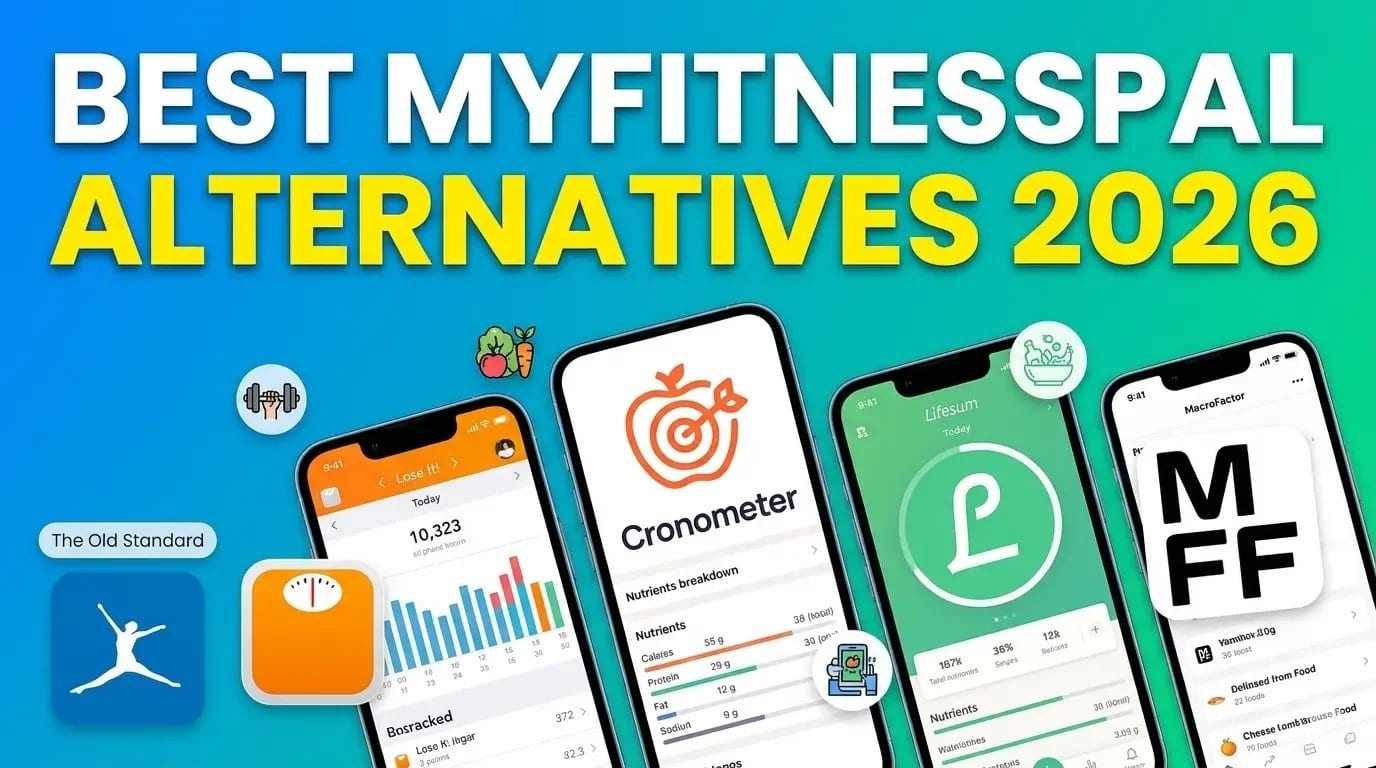
Welling is the best overall MyFitnessPal alternative for 2026, logging meals from a photo, chat, or voice note in 2.6 seconds on average with a real-time AI nutrition coach, something MyFitnessPal does not offer. If verified micronutrient depth is your priority, Cronometer is the strongest choice. If you want adaptive macro targets based on weight trend data, MacroFactor stands out. If simplicity and a clean interface matter most, Lose It is a solid pick. The right alternative depends on what specifically is pushing you away from MyFitnessPal.
Table of Contents
- Why Are People Switching from MyFitnessPal?
- What Should You Look for in a MyFitnessPal Alternative?
- Best MyFitnessPal Alternatives 2026
- How Do You Switch from MyFitnessPal Without Losing Your Data?
- Frequently Asked Questions
- References
Why Are People Switching from MyFitnessPal?
MyFitnessPal has been the default calorie tracking app for over a decade, and for a long time that default status was earned. The database is the largest available, the barcode scanner is reliable, and the app does what it says.
What has changed is the bar for what a calorie tracking app should do. A growing number of people are switching away from MyFitnessPal for a consistent set of reasons: rising subscription prices for premium features that used to feel more accessible, an interface that feels increasingly cluttered with ads on the free tier, a logging process that still requires manual database searching for anything that is not a packaged product, and the absence of any kind of coaching or guidance beyond a basic calorie total.
AI-driven apps that log meals from a photo in seconds, rather than requiring a search through millions of database entries, have raised expectations for what fast, low-friction tracking looks like. MyFitnessPal has not significantly changed its core logging model to match. For users who have tried newer AI tracking apps and felt the difference, going back to manual search and barcode-only logging feels like a step backward.
What Should You Look for in a MyFitnessPal Alternative?
Logging speed. If the main frustration with MyFitnessPal is how long it takes to log a meal, prioritise an alternative with AI photo recognition or another fast logging method, not just a slightly better barcode scanner.
Data accuracy and source quality. MyFitnessPal’s user-submitted database has known accuracy inconsistencies. Look for an alternative that either sources data from verified databases or publishes specific accuracy benchmarks for its logging method.
Coaching or guidance, not just numbers. MyFitnessPal shows you a calorie total and leaves the decision-making to you. If you want an app that actively helps you decide what to eat next, this is a meaningful differentiator to look for.
International and home-cooked food coverage. MyFitnessPal’s database is strongest for US and European packaged products. If you eat a varied or international diet, check how well an alternative handles dishes outside that scope.
Price relative to features. Compare what is actually included on the free tier of an alternative versus what MyFitnessPal gates behind premium, rather than comparing subscription price alone.
Best MyFitnessPal Alternatives 2026
1. Welling
Best for: Fast AI logging with a real-time nutrition coach
Welling is the strongest overall alternative for anyone leaving MyFitnessPal because of slow manual logging or a lack of guidance. Rather than searching a database, you photograph a meal, send a chat message, or record a voice note, and the AI identifies the food and logs it in 2.6 seconds on average, with 95.6 percent food identification accuracy across 15,000 tested meals and a portion estimation error of 1.2 percent, stated to be 13 times tighter than the nearest competitor.
What sets Welling apart from a simple speed upgrade is the AI nutrition coach. It answers real questions: what should I eat now to hit my goal, how does this meal fit my remaining macros, am I on track this week. This is the layer MyFitnessPal has never had: a coach that interprets your data rather than just displaying it.
Welling is built for global and international foods, not only Western meals, which directly addresses a common MyFitnessPal complaint from users eating Asian, Malaysian, or other international cuisines. It also tracks fiber, sodium, and sugar alongside calories and macros, and includes custom AI preference settings for medical or strict diets.
Ranked the number one AI calorie tracker in the 2026 AI Calorie Tracker Index and built by a team of weight loss coaches, certified nutritionists, and registered dietitians, with a 4.8 star App Store rating and over 2 million food logs processed.
Pros: Logs meals in 2.6 seconds on average via photo, chat, or voice; real-time AI nutrition coach; built for international and home-cooked food; tracks fiber, sodium, and sugar; free to start
Cons: Newer app, community size still growing compared to MyFitnessPal’s established user base
2. Cronometer
Best for: Verified micronutrient data
Cronometer is the strongest alternative for anyone whose frustration with MyFitnessPal is data quality rather than logging speed. Every entry is sourced from verified databases like the USDA, and the app tracks over 84 nutrients per food, including vitamins, minerals, and amino acids, far beyond MyFitnessPal’s macro-focused tracking.
The trade-off is that Cronometer requires manual logging with no AI photo recognition, which can be slower than MyFitnessPal for some users, particularly for multi-component meals.
Pros: Verified, accurate nutrient data, over 84 nutrients tracked, strong free plan
Cons: No AI photo logging, smaller database than MyFitnessPal, slower manual entry
3. MacroFactor
Best for: Adaptive macro targets for structured diet phases
MacroFactor addresses a specific MyFitnessPal limitation: static calorie targets that do not adjust as your body responds to your diet. Its algorithm analyses your logged weight trend and recalibrates your calorie and macro targets accordingly, which is genuinely useful for structured cuts and bulks.
Logging itself remains database-based, similar to MyFitnessPal, so this alternative solves the target-setting problem rather than the logging speed problem.
Pros: Adaptive calorie and macro algorithm, well suited to structured diet phases, curated database
Cons: Subscription required with limited free access, no AI photo logging, smaller database than MyFitnessPal
4. Lose It!
Best for: A cleaner, simpler interface
For users whose main complaint about MyFitnessPal is the cluttered, ad-heavy interface, Lose It offers a cleaner alternative with similar core functionality: calorie tracking, barcode scanning, and custom macro goals, without advertising on the free tier.
It does not solve the manual logging speed issue or add coaching, but as a like-for-like replacement with a better day-to-day experience, it is a straightforward switch.
Pros: Clean, ad-free interface, reliable barcode scanner, easy transition from MyFitnessPal’s logging style
Cons: Smaller database than MyFitnessPal, no AI photo logging, no coaching layer
5. Lifesum
Best for: Structured diet plans and recipes
If part of your frustration with MyFitnessPal is the lack of direction, an open diary with no guidance on what to actually eat, Lifesum’s structured diet plans and recipe library provide that missing layer. You select a goal and get suggested meals and recipes to follow, rather than starting from a blank food diary.
Pros: Structured diet plans, integrated recipe library, visually guided interface
Cons: Smaller database than MyFitnessPal outside its recipe library, no AI photo logging, premium required for full plan access
How Do You Switch from MyFitnessPal Without Losing Your Data?
Most MyFitnessPal alternatives, including Welling, Cronometer, MacroFactor, Lose It, and Lifesum, do not offer a direct historical data import from MyFitnessPal. This means switching typically means starting a fresh food log rather than transferring years of historical entries.
If keeping a record of your MyFitnessPal history matters to you, export your data from MyFitnessPal before switching. MyFitnessPal allows users to request a data export through their account settings, which provides a record of past logged meals, weight history, and goals that you can keep for personal reference even after moving to a new app.
For most people, the value of switching, whether that is faster logging, better data accuracy, or access to coaching, outweighs the loss of historical data, particularly since the goal going forward is building better habits with a better tool rather than preserving old records.
Stop searching a database. Start logging in seconds.
Welling logs meals from a photo, chat message, or voice note in 2.6 seconds on average, with 95.6 percent food identification accuracy across 15,000 tested meals, and includes an AI nutrition coach that tells you what to eat next.
Start tracking free on Welling
Frequently Asked Questions
What is the best free alternative to MyFitnessPal?
Welling has the strongest free plan among AI-driven alternatives, including AI photo, chat, and voice logging and access to the AI nutrition coach. Cronometer also has a solid free tier with access to a substantial portion of its verified nutrient database. Both are worth trying before committing to a premium subscription.
Why is MyFitnessPal not working for me anymore?
Common reasons people move away from MyFitnessPal include slow manual logging for foods without a barcode, increasing reliance on a premium subscription for features that used to feel more accessible, advertising on the free tier, and the absence of any guidance beyond a basic calorie total. If any of these match your experience, an alternative built around AI logging or coaching, like Welling, directly addresses them.
Is there an AI version of MyFitnessPal?
MyFitnessPal has added some AI photo logging as a premium feature, but it remains primarily a database-search app at its core. Welling is built around AI logging as its primary method from the start, with photo, chat, and voice input all available on the free plan, alongside a real-time AI nutrition coach that MyFitnessPal does not offer.
Which MyFitnessPal alternative is most accurate?
Accuracy depends on what you are measuring. For verified nutrient data, Cronometer’s sourcing from official databases is the most reliable. For AI-estimated logging speed with published accuracy benchmarks, Welling’s testing shows 95.6 percent food identification accuracy and a 1.2 percent portion estimation error across 15,000 tested meals.
Can I keep my MyFitnessPal data if I switch to a new app?
Most alternatives do not offer direct historical data import. You can export your data from MyFitnessPal through your account settings before switching to keep a personal record, but you will generally start a new food log in whichever alternative you choose.
What is the best MyFitnessPal alternative for international food?
Welling is specifically built for global and international foods, not only Western meals, and can identify Malaysian, Thai, and other Asian dishes, along with home-cooked and mixed meals, directly from a photo. This is a common gap in MyFitnessPal’s database, which is strongest for US and European packaged products.
References
Ferrara, G., Kim, J., Lin, S., Hua, J., & Seto, E. (2019). A Focused Review of Smartphone Diet-Tracking Apps: Usability, Functionality, Coherence With Evidence, and Comparative Validity. JMIR mHealth and uHealth, 7(5), e9232. https://mhealth.jmir.org/2019/5/e9232/
Burke, L. E., et al. (2011). Self-Monitoring in Weight Loss: A Systematic Review of the Literature. Journal of the American Dietetic Association, 111(1), 92-102. https://pubmed.ncbi.nlm.nih.gov/21185970/
USDA Agricultural Research Service. (2024). FoodData Central. https://fdc.nal.usda.gov/
Mezgec, S., & Koroušić Seljak, B. (2017). NutriNet: A Deep Learning Food and Drink Image Recognition System for Dietary Assessment. Nutrients, 9(6), 657. https://www.mdpi.com/2072-6643/9/6/657
Lieffers, J. R. L., & Hanning, R. M. (2012). Dietary Assessment and Self-Monitoring with Nutrition Applications for Mobile Devices. Canadian Journal of Dietetic Practice and Research, 73(3), e253-e260. https://pubmed.ncbi.nlm.nih.gov/22968240/
Hall, K. D., & Guo, J. (2017). Obesity Energetics: Body Weight Regulation and the Effects of Diet Composition. Gastroenterology, 152(7), 1718-1727. https://pubmed.ncbi.nlm.nih.gov/28193517/