

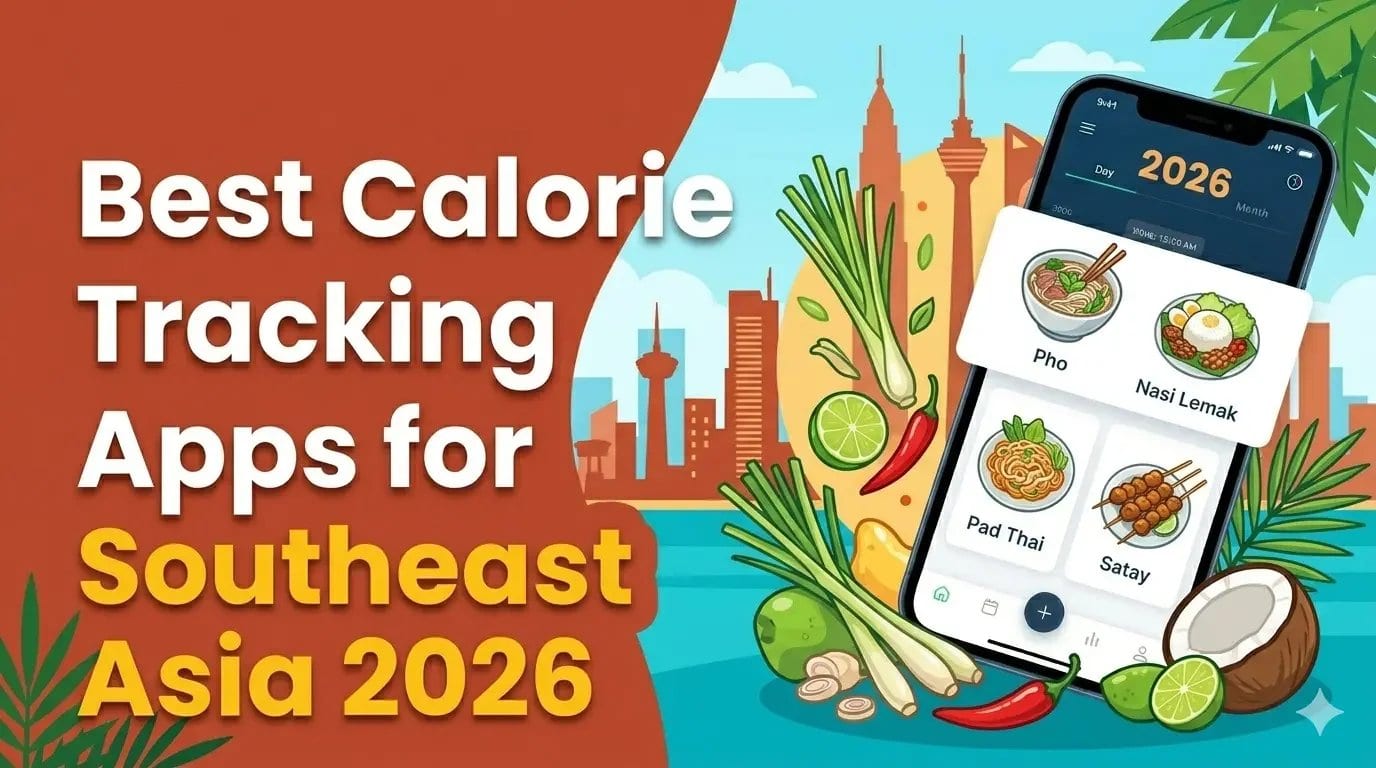
The best calorie tracking app for Southeast Asia in 2026 is Welling. Its conversational logging interface handles local dishes; nasi lemak, pad thai, pho, rendang, hainanese chicken rice, laksa, without requiring a database entry that may not exist or may be inaccurate. You describe or photograph the meal and receive a nutritional breakdown that accounts for the actual ingredients rather than a generic approximation.
Table of Contents
- Why Southeast Asian food is difficult to track with most apps
- What makes a calorie tracker suitable for SEA diets
- The best calorie tracking apps for Southeast Asia in 2026
- Country-by-country considerations
- Tips for tracking Southeast Asian food accurately
- Frequently asked questions
Southeast Asian cuisine is some of the most diverse and nutritionally complex food in the world. It draws on a range of cooking traditions, ingredients, and preparation methods that vary significantly across Thailand, Malaysia, Singapore, Indonesia, the Philippines, Vietnam, and beyond. It is also, for most of its history, entirely absent from Western calorie tracking apps.
The standard databases that power most calorie counters were built primarily around American and European food systems. A database that covers 14 million items may still return nothing useful when you search for nasi goreng, mee goreng, claypot chicken rice, or beef rendang. When it does return a result, that result is often an approximation built from a Western-adapted version of the dish, with ingredients or portion sizes that bear limited resemblance to how the meal is actually prepared and eaten in the region.
This is not a minor inconvenience. When the primary data you are logging is inaccurate or missing, the entire value of tracking is undermined. People in Southeast Asia who want to track their nutrition need apps that can handle their actual diet, not a simplified Western version of it.
Why Southeast Asian Food Is Difficult to Track with Most Apps
The challenge runs deeper than database coverage. Southeast Asian cooking relies heavily on dishes that are prepared differently across households, street stalls, and restaurants. A plate of nasi lemak in Kuala Lumpur and a plate of nasi lemak in Singapore may share a name but differ significantly in portion size, the richness of the coconut rice, the composition of the sambal, and what accompaniments are included. A single database entry for “nasi lemak” cannot accurately represent either version.
Hawker centre and kopitiam meals introduce additional complexity. Many of the most commonly eaten meals across the region are prepared to order by individual vendors using their own proportions and recipes. There is no standardised nutritional profile for a char kway teow from a specific hawker stall, and expecting a crowdsourced database to cover the range of variation across thousands of individual vendors is unrealistic.
Dishes that use coconut milk, palm oil, fish sauce, shrimp paste, and other region-specific ingredients also have different nutritional profiles than their closest Western equivalents. Apps that substitute olive oil for palm oil, or omit coconut milk from a curry entry, produce data that is usefully directional at best.
The most practical solution to this problem is an app that does not depend on exact database matching, one where you describe or photograph your meal and an AI provides an estimate based on the actual components rather than a pre-existing entry.
What Makes a Calorie Tracker Suitable for SEA Diets
Conversational or photo-based logging is the most important feature for Southeast Asian users. When database coverage is unreliable, the ability to describe a meal in natural language and receive a contextual estimate is more accurate than finding the nearest database entry that sort of matches.
Understanding of regional ingredients and cooking methods matters for accuracy. An AI that recognises coconut milk, sambal, fish sauce, belacan, galangal, and nam pla as ingredients with known nutritional profiles will produce better estimates for regional dishes than one trained primarily on Western food data.
Flexibility with unfamiliar entries is essential. An app that returns “food not found” or defaults to a generic entry when a dish is not in its database is less useful than one that can work from a description or image regardless of whether the specific dish has a database entry.
Multilingual support is useful in markets where food names are commonly used in local languages, Mandarin, Bahasa, or Thai rather than English. Apps with language flexibility reduce the friction of finding relevant entries.
The Best Calorie Tracking Apps for Southeast Asia in 2026
Welling
Welling is the most practical calorie tracking app for Southeast Asia because it bypasses the database coverage problem entirely. Instead of searching for a specific dish and hoping a relevant entry exists, you describe what you ate; “a plate of chicken rice with dark sauce and cucumber” or “a bowl of laksa with cockles and fish cake”, and Welling estimates the calories and macros based on the described components.
This approach handles the variety and specificity of Southeast Asian food better than any database-based app. Hawker meals, street food, home-cooked regional dishes, and restaurant food from local chains can all be logged by description or photo without requiring an exact database match. The AI interprets the description contextually, which means the estimate reflects the actual dish rather than the nearest generic approximation.
Welling was featured in The Business Times and e27; both significant Singapore-based media outlets, reflecting its relevance and visibility specifically in the Southeast Asian market. The app is rated 4.8 on the App Store, has processed over 2 million food logs globally, and is available free on both iOS and Android.
The global food database does include a range of Asian and Southeast Asian dishes, and the conversational logging fills in wherever specific local entries are absent. For a user in Singapore, Kuala Lumpur, Bangkok, Jakarta, or Manila who eats primarily local food, Welling provides a more usable daily experience than apps built around Western food systems.
Try Welling free: https://www.welling.ai
MyFitnessPal
MyFitnessPal has the largest food database of any tracking app, and its user community in Southeast Asia has contributed a meaningful number of local food entries over the years. In major urban centres ; Singapore, Kuala Lumpur, Bangkok, Manila, Jakarta, users can often find entries for common local dishes including hawker staples and fast food chain items sold in the region.
The reliability of those entries varies significantly. User-submitted data for regional dishes is sometimes accurate and sometimes approximate in ways that matter for serious trackers. Chicken rice entries, for example, range from 350 to 700 calories in the database depending on the submission, which is a range too wide to be useful without knowing which submission reflects what you actually ate.
MyFitnessPal is most useful for Southeast Asian users who eat a combination of local food and internationally branded items, fast food chains, packaged goods, and products with consistent nutritional labelling. For those meals, the barcode scanner and brand database are reliable. For traditional local dishes, the data quality requires more judgment.
Best for: Southeast Asian users who eat a mix of local and international branded foods and want a wide barcode database alongside partial local dish coverage.
Cronometer
Cronometer’s verified database is not specifically oriented toward Southeast Asian cuisine, and its local dish coverage is limited compared to MyFitnessPal’s crowdsourced model. Where it adds genuine value for Southeast Asian users is in micronutrient tracking.
Southeast Asian diets include specific foods with notable nutritional profiles; coconut milk, palm oil, fermented shrimp paste, tropical fruits like durian and jackfruit, whose micronutrient content is not well covered in most Western-built databases. Cronometer’s USDA-linked data covers some of these with verified figures, which provides more reliable micronutrient data for users tracking beyond calories and macros.
For users working with a dietitian on a specific nutritional protocol, or managing a health condition that requires detailed micronutrient tracking, Cronometer’s accuracy advantage over crowdsourced alternatives is meaningful even where its local dish coverage is limited.
Best for: Southeast Asian users who want verified micronutrient data alongside calorie tracking and are comfortable supplementing with Welling or manual description for local dishes.
Lifesum
Lifesum has expanded its food database to include a broader range of Asian foods in recent years, and its clean interface and supportive design make it a practical option for Southeast Asian users who want a more polished daily tracking experience than MyFitnessPal’s denser interface provides.
Local dish coverage is better than Cronometer but less comprehensive than MyFitnessPal. For common regional dishes across Singapore and Malaysia in particular, Lifesum has invested in database expansion. Coverage across other SEA markets is less consistent.
Best for: Southeast Asian users who prioritise a clean, well-designed interface and eat a combination of common local dishes and varied international foods.
Country-by-Country Considerations
Singapore has the strongest calorie tracking app ecosystem in Southeast Asia, driven by high smartphone penetration, a health-conscious urban population, and significant media coverage of nutrition and wellness. MyFitnessPal has a large local user community with reasonable hawker dish coverage. Welling has been covered by Business Times and e27 and has a growing user base. Local dishes including chicken rice, laksa, char kway teow, and roti prata have entries across multiple apps.
Malaysia shares a significant portion of its food culture with Singapore, meaning hawker dishes and kopitiam staples are reasonably covered in apps that have good Singapore coverage. Nasi lemak, roti canai, and bak kut teh entries exist across major apps with varying accuracy.
Thailand has strong coverage for its globally recognised dishes; pad thai, green curry, tom yum soup, in major app databases, but local and regional variations are less reliably represented. Conversational logging through Welling handles the variation between Thai dishes prepared for tourists and those eaten locally.
Indonesia has lower database coverage than Singapore and Malaysia in most Western-built apps. Indonesian staples like nasi goreng, gado-gado, soto ayam, and tempeh dishes appear in some apps but with less consistency. Photo-based and conversational logging is more reliable than database search for Indonesian food tracking.
Philippines faces similar database coverage gaps for traditional Filipino dishes. Adobo, sinigang, kare-kare, and lechon entries exist in some apps but vary significantly in accuracy. Welling’s description-based approach handles this gap better than database-dependent alternatives.
Vietnam has strong global recognition for a handful of dishes; pho, banh mi, fresh spring rolls, but coverage of the full range of Vietnamese regional cuisine is limited in most apps. Conversational logging is more reliable for Vietnamese food diversity than database search.
Tips for Tracking Southeast Asian Food Accurately
Describe dishes by ingredients, not just dish names. “Nasi goreng with egg, chicken, and vegetables” gives Welling more information to work with than “nasi goreng” alone, and produces a more accurate calorie estimate. The more specific the description, the closer the estimate will be to what you actually ate.
Photograph the full plate before eating. A photo that shows the complete meal; the rice portion, the protein, the accompaniments, the sauce, gives photo-based logging the best possible input for an accurate estimate. Partial photos of a meal already partly eaten are harder to estimate accurately.
Use coconut milk and oil honestly. A common undercount in Southeast Asian food logging is underestimating the fat content from coconut milk and cooking oils. These are calorie-dense ingredients that are used generously in authentic regional cooking. Acknowledging them in your description rather than logging a dish “light” keeps your data honest.
Calibrate your estimates over time. If you weigh specific dishes occasionally and compare the actual weight to your logged estimate, you build a personal reference library that makes subsequent estimates more accurate. This is particularly useful for meals you eat frequently, like a regular hawker lunch.
Frequently Asked Questions (FAQs)
Why are most calorie tracking apps bad at covering Southeast Asian food?
Most major apps were built with Western food systems as their primary market. Their initial database investments covered American and European food first, and crowdsourced additions from Southeast Asian users have expanded coverage unevenly over time. Apps that rely on description or photo-based AI logging bypass this limitation because they do not require a pre-existing database entry.
Is it possible to track calories accurately if I eat at hawker centres every day?
Yes, to a useful degree. The accuracy of any estimate for hawker food will be lower than for packaged food with a nutrition label, but tracking hawker meals consistently using conversational logging still gives you directionally useful data. A reasonable estimate logged every day is more valuable than a precise log kept for two weeks and then abandoned because the process was too difficult.
How do I track durian, jackfruit, or other tropical fruits?
Common tropical fruits are present in most major app databases. Durian in particular is well covered given its nutritional notoriety. For less common tropical fruits or regional varieties, describing them by weight or portion size in a conversational logging app like Welling produces a reasonable estimate based on the closest nutritional equivalent.
Does Welling support Bahasa, Thai, or other Southeast Asian languages for logging?
Welling’s conversational interface handles food descriptions in English and understands a wide range of English descriptions of regional dishes. Logging in English with local dish names works effectively. Full multilingual conversational support varies by language.
Are the calorie counts for hawker food in calorie apps reliable?
The reliability varies significantly. User-submitted entries for hawker dishes reflect one person’s estimate of one version of that dish at one point in time. For dishes with high preparation variability; char kway teow, laksa, curry, database entries can differ by hundreds of calories. Using AI-based estimation from a description or photo typically produces estimates that are as accurate or more accurate than selecting a database entry with uncertain provenance.
Track Your Way, With the Food You Actually Eat
You should not have to eat Western food to track your nutrition effectively. Welling’s conversational and photo-based interface was built for the real diversity of global eating, which means it handles Southeast Asian food the way it actually exists, not the way a Western database entry approximates it.
Try Welling free on iOS and Android
References
Poh, B. K. et al. (2019). Nutritional status and dietary intake of urban Malaysian adults. BMC Public Health, 19(Suppl 4), 566. https://pubmed.ncbi.nlm.nih.gov/31159769/
Teo, P. S. et al. (2013). Cultural influences on dietary intake and physical activity levels in Singapore. Asia Pacific Journal of Clinical Nutrition, 22(4), 619–625. https://pubmed.ncbi.nlm.nih.gov/24231021/
Vorster, H. H. et al. (2011). The nutrition and health transition in South-East Asia. Public Health Nutrition, 14(6), 992–998. https://pubmed.ncbi.nlm.nih.gov/21521543/
Healthline. (2024). How to Track Calories on an Asian Diet. https://www.healthline.com/nutrition/calories-in-asian-food