

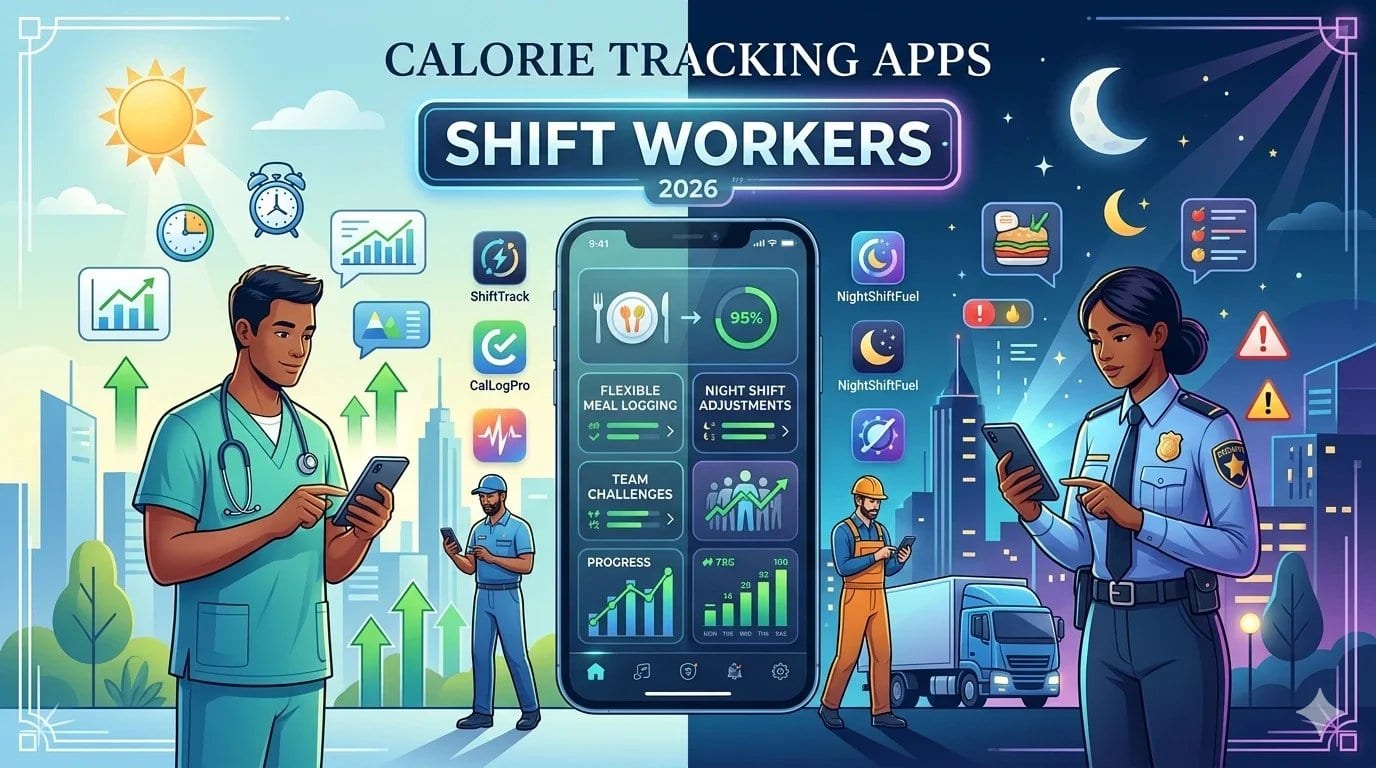
What is the best calorie tracker for shift workers?
The best calorie tracker for shift workers in 2026 is Welling, which logs food in seconds via AI photo scanning regardless of the time of day, sets calorie targets based on your actual activity level rather than assuming a standard schedule, and includes an AI nutrition coach to help you navigate the specific dietary challenges of irregular hours. Other strong options include MyFitnessPal (largest food database for canteen and takeaway meals), Cronometer (detailed micronutrient tracking), and Lose It! (simple and flexible logging). The right choice depends on how much nutritional detail you need and how quickly you need to log food during a shift.
Table of Contents
- Why Shift Work Makes Nutrition Harder
- What to Look for in a Shift Work Diet App
- Best Calorie Tracking Apps for Shift Workers 2026
- How Many Calories Do Shift Workers Need?
- Eating Strategies for Night Shift and Rotating Schedules
- Frequently Asked Questions
- References
Why Shift Work Makes Nutrition Harder
Shift work disrupts nearly every system in the body that regulates eating. Circadian rhythms, which govern hunger hormones, digestion, and metabolism, are tied to the natural cycle of daylight and darkness. When you work nights, rotating shifts, or irregular hours, your body clock and your eating schedule fall out of sync in ways that affect both what you want to eat and how your body processes what you eat.
Research published in the International Journal of Obesity found that shift workers are significantly more likely to gain weight and develop metabolic disorders than day workers, even when total calorie intake is similar. Eating at night, when the body is biologically primed for rest rather than digestion, affects insulin sensitivity, fat storage, and hunger hormone regulation in ways that make weight management genuinely harder.
Beyond metabolism, the practical challenges of shift work eating compound the biological ones. Vending machines and canteens stocked with high-calorie processed food are often the only options available at 2am. Fatigue increases cravings for sugar and refined carbohydrates. Irregular sleep patterns disrupt appetite regulation. Meal timing that changes week to week makes it hard to build consistent eating habits.
Tracking food does not solve all of these problems, but it gives shift workers the one thing that counteracts them most effectively: awareness. Knowing what you are actually eating, at what times, and in what quantities is the starting point for making better choices within the constraints of a shift work lifestyle.
What to Look for in a Shift Work Diet App
24-hour accessibility and flexible meal timing. A shift work diet app should not be built around the assumption of three meals at standard daytime hours. It should allow you to log food at any time, label meals however you like, and set reminders that align with your shift pattern rather than a 9-to-5 schedule.
Fast logging for break-time use. Shift workers often have short, fixed breaks with no flexibility to overrun. An app that takes two minutes to log a meal is not practical when you have a ten-minute break. Photo scanning or barcode scanning that logs a meal in under 30 seconds is essential.
Canteen and convenience food coverage. Night shift workers eat what is available, which often means canteen food, vending machine products, or takeaway. A large food database that covers these options reduces the friction of logging meals outside of home cooking.
Calorie targets that reflect irregular activity. Some shifts are physically demanding, others are sedentary. The best irregular hours calorie tracker allows you to adjust your activity level or calorie target to reflect the nature of each shift rather than applying a single fixed target across a varied week.
No time-of-day judgement. Some apps flag eating late at night or outside conventional meal windows as unusual or problematic. For shift workers, eating at midnight is normal and necessary. A good app does not penalise or highlight this.
Best Calorie Tracking Apps for Shift Workers 2026
1. Welling
Best for: Fast, flexible logging that works around any schedule
Welling is an AI calorie tracker that logs food through photo recognition. You photograph your meal, the AI identifies the food and portion, and the nutritional data is logged automatically in under 30 seconds. This makes it practical to log food on a short break mid-shift without spending time searching a database.
Welling sets personalised calorie targets based on your body stats, activity level, and goal. For shift workers whose physical demands vary between shifts, adjusting your activity level setting in the app reflects this variation without needing to manually calculate a new calorie budget each time.
The AI nutrition coach inside Welling is particularly useful for shift workers who are navigating specific dietary challenges. You can ask it things like “what should I eat before a night shift to avoid an energy crash”, “what is a good high-protein snack for 3am that I can get from a petrol station”, or “how do I stay under my calorie target when I am tired and craving sugar” and get a direct, contextual answer. The food tracker works at any hour without flagging unusual meal timing.
Welling is free to get started with a premium plan for advanced features.
Pros: Photo logging under 30 seconds ideal for short breaks, works at any hour without judgement, personalised activity-based calorie targets, AI coach for shift-specific nutrition questions
Cons: Newer app, smaller community than legacy trackers
2. MyFitnessPal
Best for: Largest database for canteen and convenience food
MyFitnessPal’s primary advantage for shift workers is the size of its food database. With over 14 million entries, it covers a wide range of canteen dishes, hospital and workplace cafeteria meals, convenience store products, and takeaway options that shift workers commonly rely on.
The app is available 24 hours a day with no time-based restrictions on logging. The recent foods feature speeds up logging for meals you eat regularly on rotation, which is useful for shift workers who tend to eat from a limited set of options during their shift.
The main limitations are that micronutrient tracking beyond calories and basic macros requires a premium subscription, and there is no AI photo scanning for unpackaged meals.
Pros: Largest food database for canteen and convenience food, 24-hour logging, recent foods feature, familiar interface
Cons: Micronutrients behind paywall, no AI photo scanning, user-submitted data quality varies
3. Cronometer
Best for: Monitoring micronutrient gaps from shift work eating
Shift workers are at higher risk of vitamin D deficiency from reduced sunlight exposure, and their diets often fall short on fibre, magnesium, and B vitamins due to reliance on convenient but nutritionally limited food options. Cronometer’s detailed micronutrient tracking makes these gaps visible in a way that other apps do not.
For shift workers who want to understand the full nutritional impact of their eating patterns, not just calories and macros, Cronometer is the most thorough tool available. Setting aside five to ten minutes to log meals carefully when time allows gives a detailed picture of where the diet is falling short.
The trade-off is that Cronometer’s manual logging process is slower than Welling’s photo scanning, which matters when logging on a short break.
Pros: Best micronutrient depth, useful for identifying vitamin and mineral gaps from shift work eating patterns, verified data quality
Cons: Manual logging only, no photo scanning, slower to use on short breaks
4. Lose It!
Best for: Simple and flexible calorie tracking without complexity
Lose It! is a clean, straightforward calorie tracker with fast barcode scanning and a simple interface. For shift workers who want a no-fuss calorie counter that does what it says without requiring a learning curve or significant time investment, it is a reliable choice.
It works at any hour, allows flexible meal timing, and has a decent database for common foods. It does not offer the nutritional depth of Cronometer, the photo scanning of Welling, or the database breadth of MyFitnessPal, but for straightforward calorie awareness during a shift it performs consistently.
Pros: Simple interface, fast barcode scanning, flexible meal timing, low learning curve
Cons: Limited micronutrient data on free plan, no AI photo scanning, smaller database
5. Yazio
Best for: Meal planning support alongside tracking
Yazio is a calorie and diet tracker with a strong meal planning feature that allows you to plan and log meals in advance. For shift workers who prepare meals at home before a shift and want to log them before heading out, Yazio’s pre-planning approach reduces the need to log during a busy shift.
The app has a solid food database, barcode scanning, and custom macro targets. The intermittent fasting tracking feature within Yazio can be useful for shift workers who choose to eat in a compressed window during or after a shift as a way of managing calorie intake around irregular hours.
Pros: Meal pre-planning reduces in-shift logging burden, intermittent fasting support, barcode scanner, solid food database
Cons: No AI photo scanning, meal planning works best with consistent meal prep routines which shift schedules can disrupt
How Many Calories Do Shift Workers Need?
Calorie needs for shift workers vary based on the physical demands of the job, body weight, and individual metabolism, but research suggests an important nuance: eating the same calories at night produces a different metabolic outcome than eating them during the day.
A study published in the Proceedings of the National Academy of Sciences found that eating out of alignment with the body’s circadian rhythm increases fat storage and reduces metabolic efficiency even when total calorie intake is identical. This means that shift workers may need to be more conservative with their calorie targets during night eating hours to achieve the same weight management outcomes as day workers eating the same amount.
As a starting point, use a calorie deficit calculator to establish your maintenance calories based on your activity level and body stats, then apply a deficit of 300 to 500 calories per day if weight loss is your goal. For physically demanding shifts such as nursing, manufacturing, or construction, your activity multiplier should reflect the higher calorie burn of those roles.
The most important thing is consistency in tracking. Irregular calorie intake that swings widely between shifts is harder to manage than a consistent daily target applied across all shifts.
Eating Strategies for Night Shift and Rotating Schedules
Eat a solid meal before your night shift starts. Having a proper meal before your shift reduces the likelihood of reaching for high-calorie vending machine options mid-shift when fatigue and hunger combine. Aim for a balanced meal with protein, complex carbohydrates, and vegetables one to two hours before the shift begins.
Keep protein high during night shifts. Protein is the most satiating macronutrient and helps maintain alertness and muscle mass during periods of sleep disruption. Prioritising protein-rich snacks and meals during night shifts, such as boiled eggs, Greek yoghurt, chicken, or nuts, reduces cravings for refined sugar.
Avoid large meals in the final hours of a night shift. Eating a large meal immediately before trying to sleep disrupts sleep quality and is associated with increased fat storage. Lighter snacks in the last two to three hours of a shift are preferable to a heavy meal.
Prepare meals in advance when possible. Batch cooking before a run of night shifts and storing portioned meals in a bag or cool box removes the decision-making element of eating during a shift. Pre-logging these meals in your tracker before the shift begins also removes the need to log while tired and busy.
Stay hydrated throughout. Shift workers, particularly those in warm or physically demanding environments, are at higher risk of dehydration than office workers. Dehydration is frequently mistaken for hunger, which drives unnecessary calorie intake during shifts. Keeping a water bottle with you and logging it in your tracker builds awareness of fluid intake alongside food.
Track your nutrition around your shift, not around a 9-to-5 assumption.
Welling logs your food in seconds with AI photo scanning, sets calorie targets based on your actual activity level, and gives you a nutrition coach that answers shift work diet questions at any hour.
Start tracking free on Welling
Frequently Asked Questions
How do shift workers manage their diet effectively?
The most effective strategies for shift workers are: eating a solid meal before a night shift starts, keeping protein intake high to manage hunger and cravings during the shift, avoiding large meals before sleeping after a night shift, and batch cooking to reduce reliance on convenience food. Tracking calories with a fast, flexible app builds the awareness needed to apply these strategies consistently.
Does shift work cause weight gain?
Research consistently shows that shift workers have higher rates of weight gain, obesity, and metabolic disorders than day workers. Disrupted circadian rhythms affect insulin sensitivity, appetite hormones, and how efficiently the body processes food eaten at night. While shift work makes weight management harder, it does not make it impossible. Tracking food intake and applying consistent calorie awareness significantly reduces the metabolic disadvantage of irregular hours.
What is the best free calorie tracker for night shift workers?
Welling has a strong free plan with AI photo logging that works at any hour without requiring time-consuming database searches during a short break. MyFitnessPal’s free tier also covers calorie tracking with a large database useful for canteen and convenience food. Both are good starting points without a subscription.
How should I time my meals as a shift worker?
General guidance for shift workers is to eat your main meal before the shift begins, have lighter protein-rich snacks during the shift to maintain energy and reduce cravings, and avoid large meals immediately before sleeping. During transitions between day and night shifts, gradual adjustment of meal timing rather than abrupt changes reduces the metabolic disruption of schedule changes.
Can I use intermittent fasting as a shift worker?
Intermittent fasting can work for shift workers but requires adaptation to the shift pattern. Time-restricted eating windows that align with your waking hours, rather than conventional daytime windows, can help manage calorie intake without the need for precise meal timing. Apps like Yazio have specific intermittent fasting tracking features. Speaking to a registered dietitian about how to apply fasting protocols safely around night shifts is advisable before starting.
Why do I crave junk food on night shifts?
Sleep deprivation and disrupted circadian rhythms increase levels of ghrelin, the hunger-stimulating hormone, and decrease leptin, the satiety hormone. This hormonal shift drives cravings specifically for high-calorie, high-sugar, and high-fat foods during periods of fatigue. Keeping protein intake high, staying hydrated, and having pre-prepared healthy snacks available reduces the intensity of these cravings by keeping blood sugar stable and satiety hormones better regulated.
References
Wang, X. S., et al. (2011). Shift Work and Chronic Disease: The Epidemiological Evidence. Occupational Medicine, 61(2), 78-89. https://pubmed.ncbi.nlm.nih.gov/21355031/
Scheer, F. A., et al. (2009). Adverse Metabolic and Cardiovascular Consequences of Circadian Misalignment. Proceedings of the National Academy of Sciences, 106(11), 4453-4458. https://www.pnas.org/doi/10.1073/pnas.0808180106
Spiegel, K., Tasali, E., Penev, P., & Van Cauter, E. (2004). Brief Communication: Sleep Curtailment in Healthy Young Men Is Associated with Decreased Leptin Levels, Elevated Ghrelin Levels, and Increased Hunger and Appetite. Annals of Internal Medicine, 141(11), 846-850. https://pubmed.ncbi.nlm.nih.gov/15583226/
Antunes, L. C., et al. (2010). Obesity and Shift Work: Chronobiological Aspects. Nutrition Research Reviews, 23(1), 155-168. https://pubmed.ncbi.nlm.nih.gov/20392282/
Pot, G. K. (2018). Sleep and Dietary Habits in the Urban Environment: The Role of Chrono-Nutrition. Proceedings of the Nutrition Society, 77(3), 189-198. https://pubmed.ncbi.nlm.nih.gov/29318992/
Heath, G., et al. (2019). Nutritional Interventions for Improving the Health Outcomes of Shift Workers. Nutrients, 11(10), 2449. https://www.mdpi.com/2072-6643/11/10/2449